
I. Papergames Sues Migu for Alleged Unauthorized Use of "Mr Love: Queen's Choice" Content in TV Drama Promotion
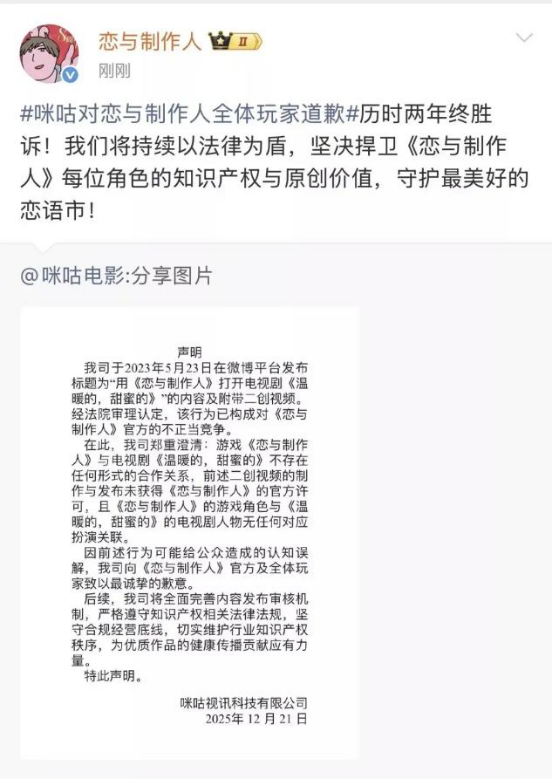
Recently, the Shanghai Intellectual Property Court rendered a final judgment in the case of Mr Love: Queen's Choice v. Migu. The court ruled that "Migu Video" (咪咕电影) engaged in unfair competition by illegally using original elements from the game in its commercial promotions. Subsequently, Migu Video issued a formal public apology to the official team of Mr Love: Queen's Choice and its players for the infringement.
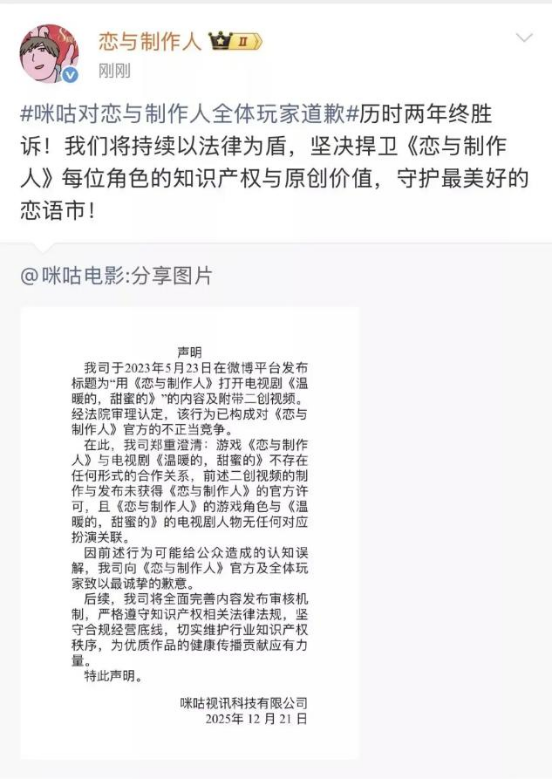
In May 2023, while releasing a promotional video for the TV series Warm and Sweet on the Weibo platform, Migu utilized original game character names, promotional PVs, music, special effects, and original voiceovers from Mr Love: Queen's Choice without official authorization.
After a two-year legal process, the Shanghai Intellectual Property Court ultimately ruled in favor of Mr Love: Queen's Choice. For the first time at the judicial level, it was clarified that distinctive game elements—such as meticulously constructed character names, personality settings (personas), iconic voiceovers, and visual identities—collectively constitute the core competitiveness and source of commercial value for a game product. These elements fall under the legal rights and interests protected by the Anti-Unfair Competition Law (AUCL). Migu's "free-riding" behavior—using core elements of another party's well-known work for marketing—clearly violates commercial ethics and disrupts the market order of fair competition.
Nuocheng’s Legal Commentary
When dealing with cross-industry rights protection for games, we suggest the following approach:
First, identify the infringing elements: Determine exactly which game elements the infringing subject has used (e.g., game footage, posters, voiceovers, copywriting, music, costume designs, etc.) to assess whether they constitute copyright infringement.
Second, apply the Anti-Unfair Competition Law: If certain infringed elements do not meet the threshold of "works" under copyright law (such as character names), yet constitute a vital part of the game's overall commercial value or serve as key identifiers, one may invoke Articles 2 and 7 of the Anti-Unfair Competition Law. This allows for a claim that the defendant’s actions constitute unfair competition through commercial confusion.
Finally, determine the amount of damages: Quantify compensation by comprehensively considering factors such as the scope and impact of the infringement, subjective malice, the legal standing of the rights involved, and the commercial value of the infringing content.
II. Implementation of Japan’s New "Smartphone Act": How Will the Gaming Industry Be Impacted?
The highly anticipated Act on Promoting Competition in Specified Smartphone Software (commonly referred to as the "Smartphone Act") officially came into effect in Japan on December 18, 2025. This legislation aims to dismantle the duopolistic landscape held by Apple and Google within the mobile app ecosystem. It is expected to have a profound impact on the Japanese gaming industry, particularly by bringing significant changes to payment channels and app distribution.
The core of the new law lies in the regulation of large-scale platform enterprises designated as "Specified Software Providers." The Act explicitly prohibits these providers from mandating that developers use their official payment systems and forbids them from hindering in-app redirection (out-linking) to external websites. This means game developers will have more freedom to steer players to "off-platform" channels, such as official websites, to complete payments. This will reduce the commissions paid to the Apple App Store and Google Play, thereby lowering operating costs for gaming companies.
Furthermore, the Act mandates the opening of the app store market. In the future, users will be able to obtain applications from third-party app stores other than the App Store or Google Play. The renowned developer Epic Games has already announced plans to launch the iOS version of the Epic Games Store in Japan, offering a revenue share significantly lower than that of traditional platforms.
Since the promulgation of this Act, among the top four regional markets by global revenue for Apple, mainland China remains the only one still subject to Apple’s dual monopoly over app payments and distribution, continuing to pay the standard 30% "Apple Tax."
Nuocheng’s Legal Commentary
The essence of this Act lies in imposing statutory obligations on platforms with a dominant market position to open up to third-party app stores and payment systems, aiming to break the duopolistic structure of the mobile ecosystem.
From the perspective of legislative technique, the Act establishes a highly deterrent administrative surcharge system (with fines reaching up to 20% of the relevant domestic turnover), far exceeding the standards of the current Antimonopoly Act (AMA). This demonstrates the regulators' determination to reshape the order of market competition. However, the complexity of implementation cannot be ignored: the primary challenge in compliance practice will be how to mandate interoperability without compromising user data security and privacy protection. Furthermore, the expansion of the Japan Fair Trade Commission’s (JFTC) discretionary power and the subsequent implementation of detailed enforcement rules will ultimately determine whether the Act can substantially reduce developer costs and promote effective competition in the digital market, rather than merely increasing compliance friction costs.
III. Shanghai Courts Release "White Paper on the Adjudication of Criminal Cases Involving the Gaming Industry"
Recently, the Shanghai Putuo District People’s Court released the White Paper on the Adjudication of Criminal Cases Involving the Gaming Industry (hereinafter referred to as the "White Paper"). The document provides a systematic analysis of 183 criminal cases concluded by the Shanghai No. 2 Intermediate People’s Court and its jurisdictional courts between 2021 and June 2025. The White Paper indicates that while the gaming industry has become a new engine for economic growth, it also faces increasingly severe criminal risks.
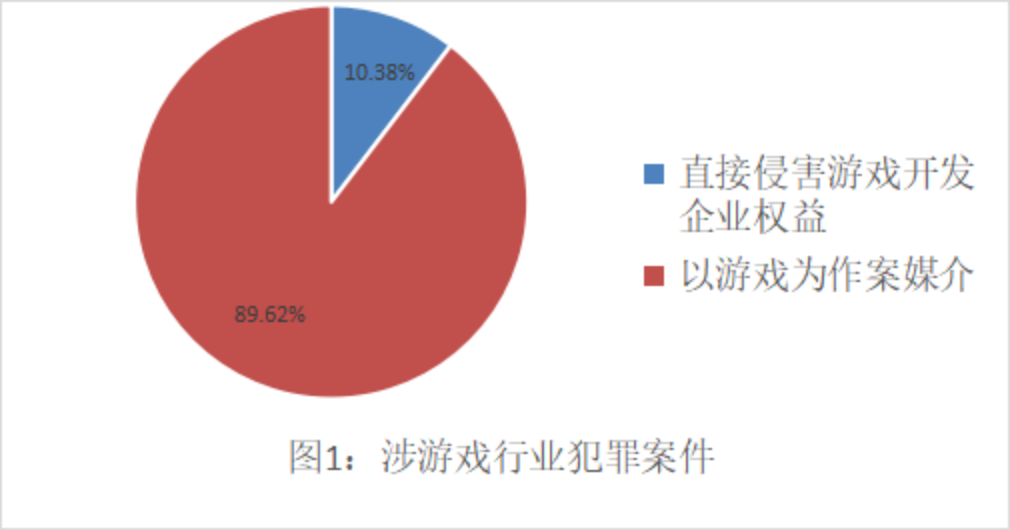
The White Paper points out that all cases can be broadly classified into two categories:
Games as a Medium for Crime: This constitutes the vast majority of cases (89.62%). Within this category, the crime of "opening casinos" (illegal gambling operations) is the most prominent, accounting for as much as 84.15% of such cases.
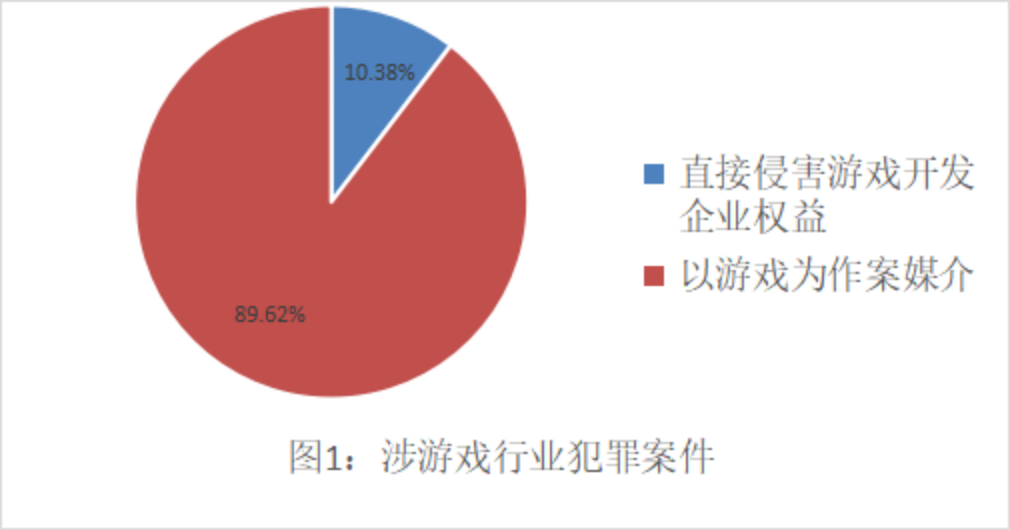
Direct Infringement on Game Developers' Rights and Interests: These cases involve activities that directly harm developers, such as the development of unauthorized plug-ins (cheats), the establishment of private servers, the bulk registration of fraudulent game accounts, and fraudulent third-party top-ups (recharge scams).
Criminal cases in the gaming industry exhibit four distinct characteristics:
Diversification of Criminal Methods and High Technical Dependence: Modus operandi are becoming more varied and rely heavily on sophisticated technological means.
Complicity and Dependence on the "Black and Gray" Cyber-Industry: There is a rising trend of joint offenses and a heavy reliance on the underground "Black and Gray" industry chain.
Concentration in High-Risk Game Environments: Crimes are predominantly clustered around popular titles such as Fantasy Westward Journey and Eggy Party.
High Rate of Plea Leniency: A significantly high proportion of cases (91.46%) involve the "System of Leniency for Admitting Guilt and Accepting Punishment."
The White Paper concludes that the high cost and limited effectiveness of risk prevention and control have led to a lack of motivation for enterprises to invest in security. Concurrently, while players have a robust demand for virtual property transactions, the absence of official trading platforms forces them toward third-party or private transactions. These carry immense risks, leading to frequent cases of fraud and malicious account recovery. Furthermore, low industry entry barriers and inadequate internal oversight have provided fertile ground for criminal activity.
To address these challenges, the White Paper proposes three governance directions:
Constructing a "Source Tracing + Technological Prevention" System: Establishing industry security standards and strengthening police-enterprise coordination.
Implementing "Transaction Blocking + Positive Guidance" Strategies: Solidifying the regulatory responsibilities of online platforms and enhancing legal education for players.
Synergizing "Criminal Crackdown + Administrative Enforcement + Industry Self-Regulation": Creating a unified regulatory force to execute a full-chain crackdown on the "Black and Gray" industries.
IV. Chongqing Launches "Starlight" Plan: AI-Empowered Culture and Entertainment Becomes New Focal Point
On December 29, 2025, the Chongqing Municipal Government released the Implementation Plan for Further Promoting the "Starlight" (Man Tian Xing) Action Plan for the Software and Information Service Industry (hereinafter referred to as the "Plan"), identifying Artificial Intelligence (AI) as the primary strategic direction. The Plan specifically highlights support for the gaming industry, encouraging the deep integration of AI technology with gaming.
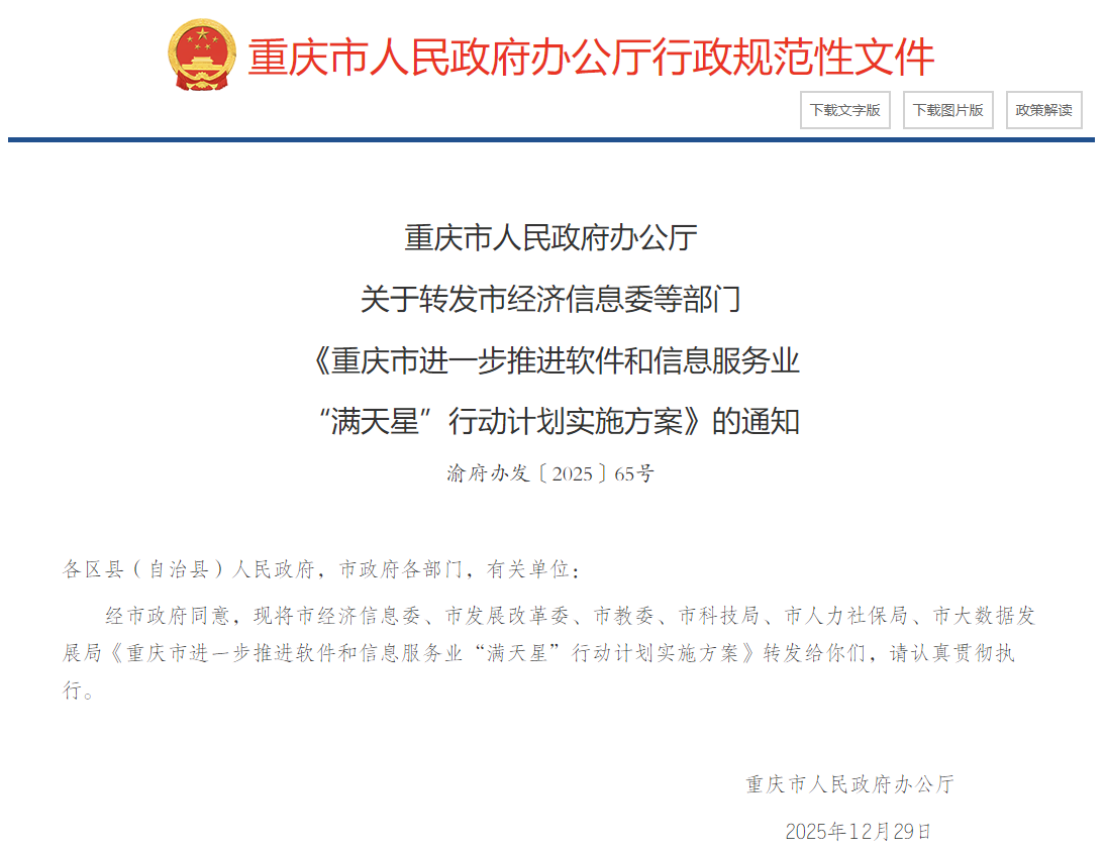 According to the Plan, Chongqing will encourage gaming enterprises to integrate and apply Generative AI (AIGC), Reinforcement Learning, Natural Language Processing (NLP), Assistive Development, and Code Generation within their development and operational processes to create "Lean, Agile, and Precise" (轻快准) gaming products. This policy provides opportunities for high-efficiency R&D and innovation for the gaming industry, particularly for small and medium-sized teams.
Furthermore, the Plan demonstrates a systematic approach to ecosystem building:
Talent Cultivation: A mechanism of "Recognition by Enterprises, Acceptance by the Government" will be established to provide targeted talent pipelines for the industry.
Application Scenarios: The application of AI technology will be promoted through the publication of "Opportunity Lists" and the implementation of the "Open Competition for Selection of Best Candidates" (揭榜挂帅) system.
The Plan will remain in effect until December 31, 2027.
 2023年5月,咪咕在微博平台发布电视剧《温暖的,甜蜜的》宣传视频时,在未经官方许可的情况下,擅自使用了《恋与制作人》原创的游戏角色名称、宣传PV、音乐、特效及原版配音。
 游戏行业犯罪案件还呈现犯罪手段多样化且技术依赖性强、犯罪行为共犯化或依赖网络“黑灰”产业链、犯罪场域集中化(“梦幻西游”“蛋仔派对”等热门游戏成高发场域)以及认罪认罚比例高(91.46%)四大特征。
 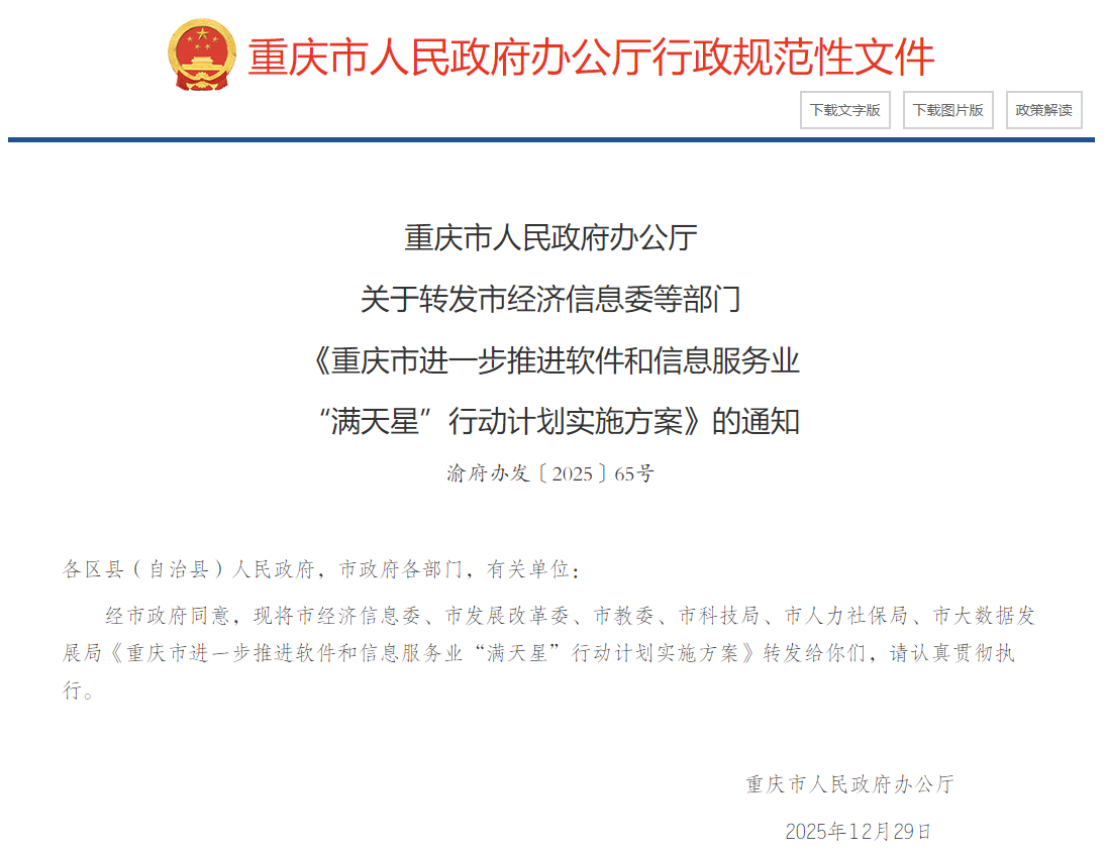 根据《方案》,重庆市将鼓励游戏企业在游戏开发运营等环节融合应用生成式AI(AIGC)、强化学习、自然语言处理、辅助开发与代码生成等软信技术,开发“轻快准”游戏产品。这一政策为游戏产业,特别是中小型团队带来了高效研发与创新机遇。