(I) Game Voice Acting Companies Issue Statements Opposing AI Voice Training and Usage
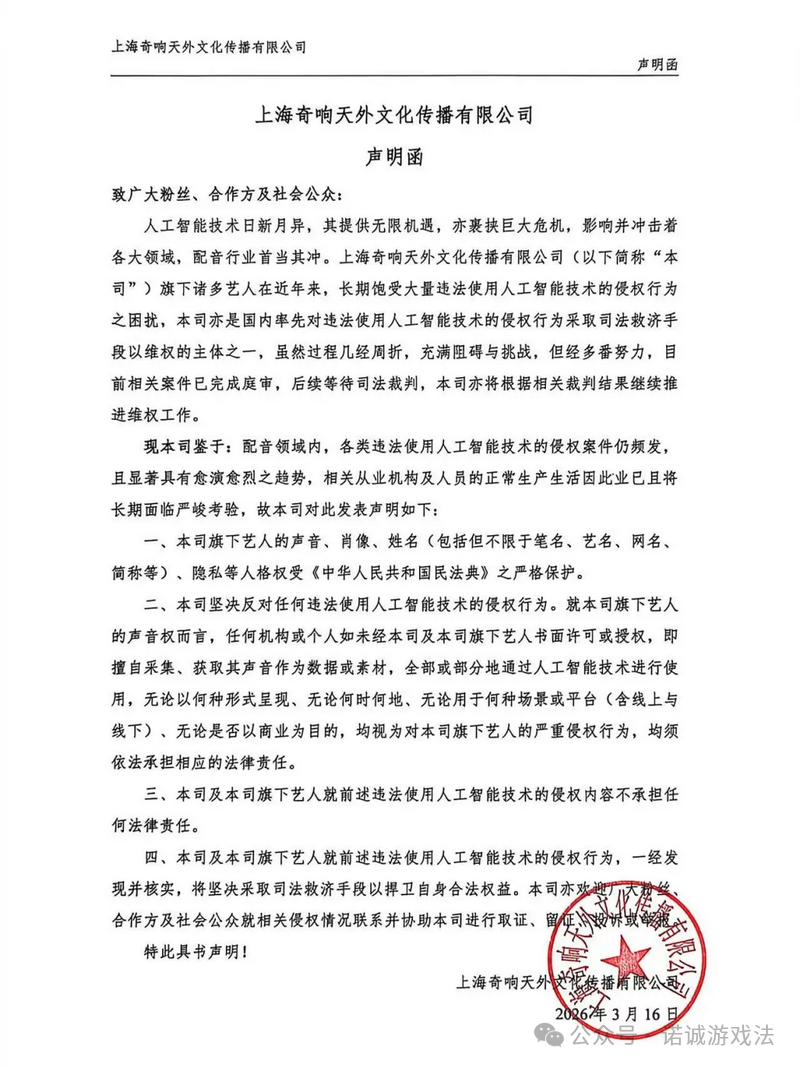
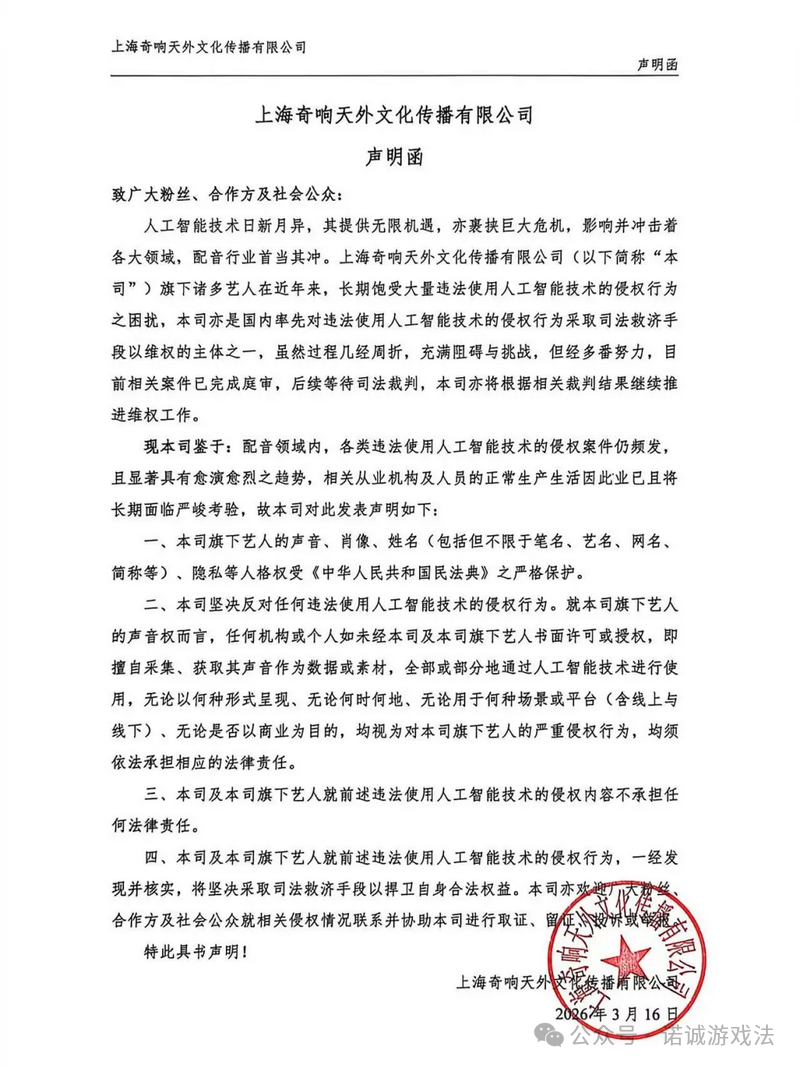
Recently, leading Chinese voice acting company “Qixiang Tiankong,” which has provided dubbing services for Genshin Impact, Honor of Kings, and Infinity Nikki, issued an official statement publicly opposing any unauthorized AI voice infringement.
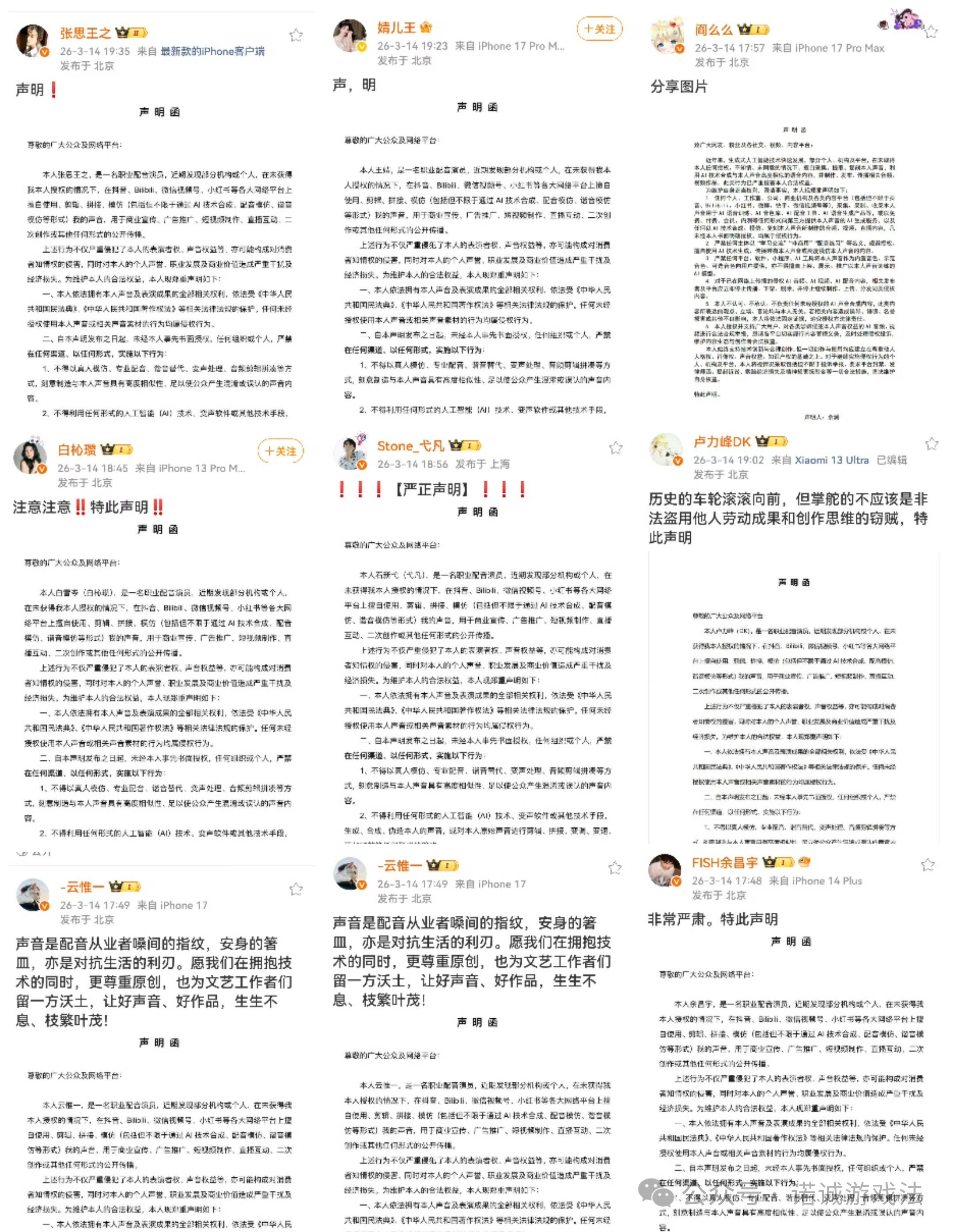
Prior to this, voice actors under “729 Voice Studio,” known for projects such as Fox Spirit Matchmaker and JX3 Online, collectively issued a statement on March 14, declaring that any unauthorized use of AI to replicate voices is strictly prohibited and will be pursued through legal action.
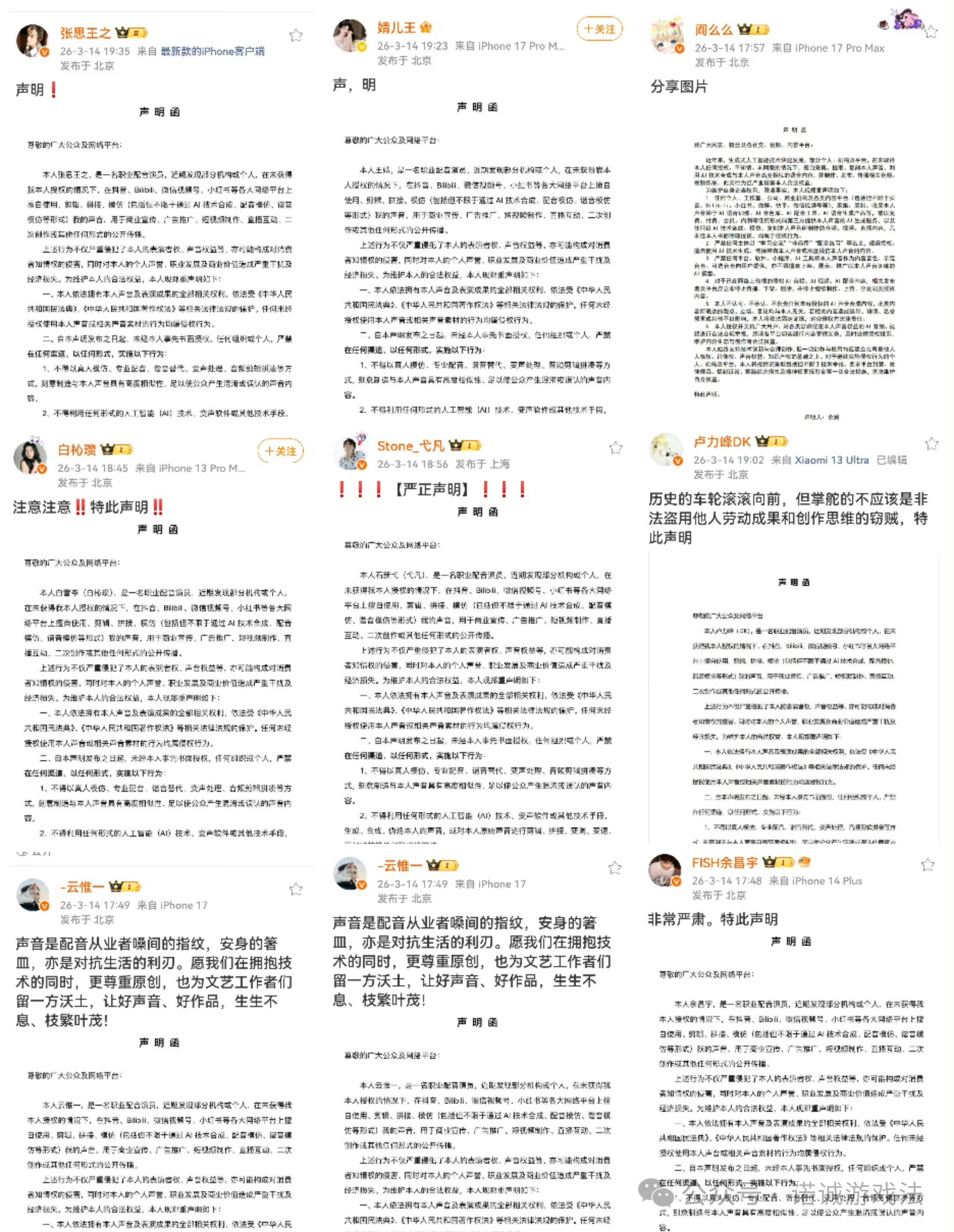
These statements clearly emphasize that any entity or individual engaging in the collection, training, synthesis, or use of voice data via AI technologies without written authorization, regardless of commercial intent, constitutes a serious infringement of personality rights (in particular, the right to voice), and will be subject to legal liability.
Nuocheng Commentary:
This phenomenon is global in nature. In the United States, SAG-AFTRA has already incorporated the licensing of “digital personas” as a core issue in labor negotiations, advocating for compensation and authorization frameworks governing AI usage.
The essence of these collective statements lies in establishing legal and commercial boundaries in a regulatory vacuum, laying the groundwork for future licensing and revenue-sharing mechanisms.
For the gaming industry, balancing the operational demand for AI dubbing with legal compliance is critical. On one hand, globalization and long lifecycle operations create massive multilingual voice demands, making AI dubbing highly attractive for cost reduction and efficiency gains.
On the other hand, many AI voice services lack transparency regarding the lawful source of underlying voice datasets and authorization chains, and providers rarely offer compliance warranties or indemnification against infringement.
As a result, game companies procuring such services may effectively operate in a legally unassessed risk environment, facing potential litigation for infringing the personality rights of voice actors.
This case highlights the necessity for companies to verify whether service providers can provide clear compliance assurances and indemnity mechanisms regarding voice rights.
(II) Ministry of Industry and Information Technology Names 24 Apps for Personal Data Violations, Including Multiple Game SDKs
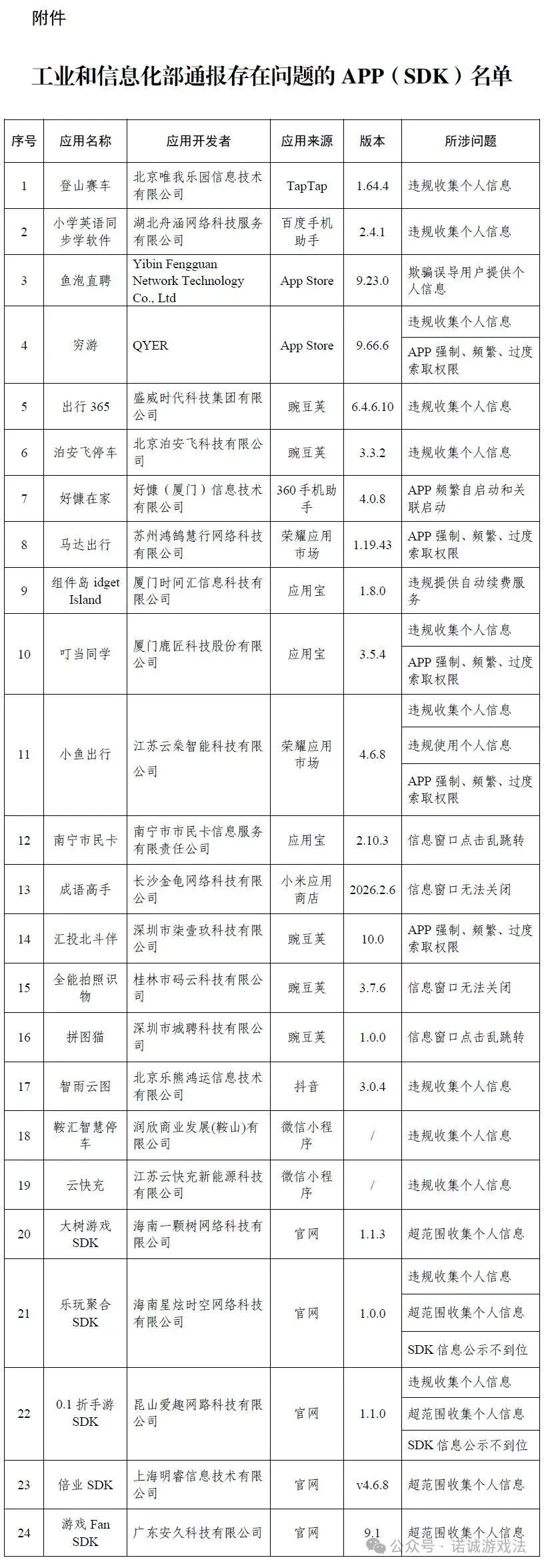
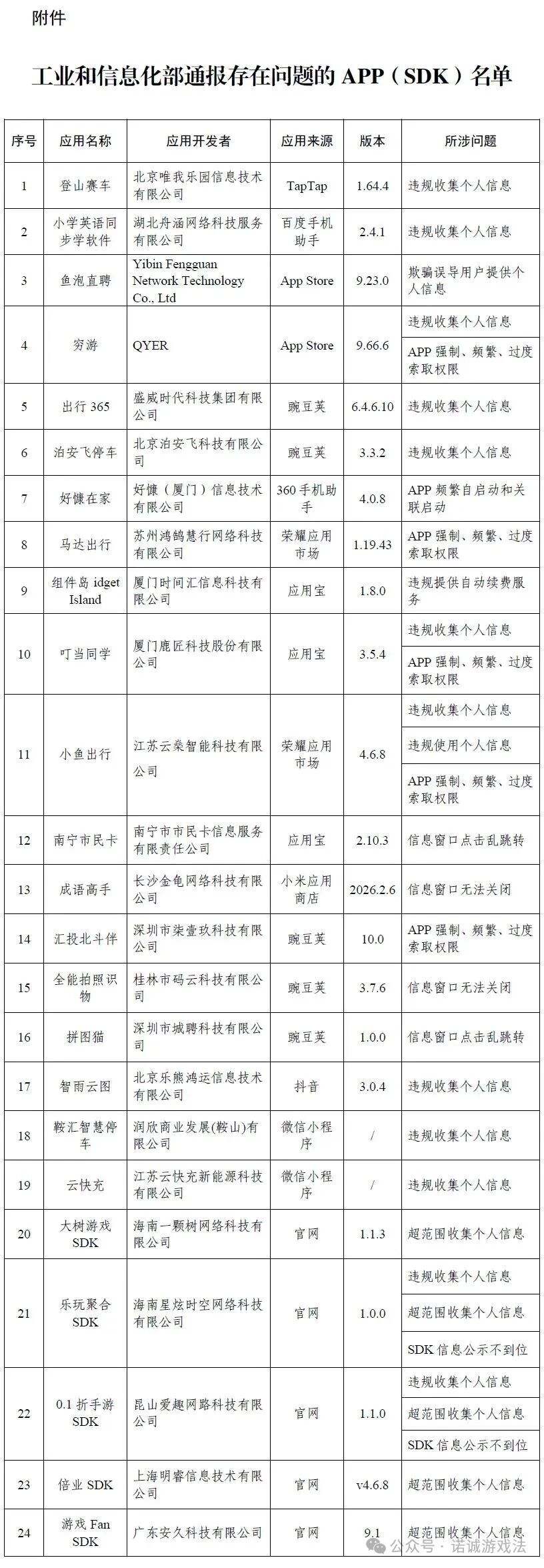
On March 13, 2026, China’s Ministry of Industry and Information Technology (MIIT) announced the second batch of 24 apps (including SDKs) that were found to infringe user rights, including several game-related SDKs and applications.
The violations primarily involve:
Illegal collection of personal information
Excessive collection beyond necessity
Insufficient disclosure of SDK data practices
Improper use of personal information
This underscores that online games, as high-frequency data processing environments with strong user engagement, have become a key focus of personal data protection enforcement.
Nuocheng Commentary:
SDK compliance represents a high-risk area. As embedded third-party components, SDKs often involve opaque data collection practices and complex accountability chains.
Game companies, as personal information processors, bear legal responsibility for SDK behavior integrated into their products.
It is recommended that companies:
Review all SDK data processing rules and security commitments;
Clearly disclose SDK-related practices in privacy policies;
Establish SDK exit mechanisms to promptly remove non-compliant components.
Failure to do so may result in joint liability for infringements of user personal information rights.
(III) “Lack of Emotional Value” in Game Companion Service? Court Rejects Refund Claim
The Jiangsu High People’s Court recently published a typical case involving a dispute over a game companion (boosting/陪玩) service contract.
In November 2024, a companion service provider (Gong) and a user (Zhu) entered into an oral agreement at RMB 30 per match. After several months of service, Zhu refused to pay the remaining RMB 4,200, claiming that Gong failed to provide “emotional value” and performed poorly in-game.
Gong filed a lawsuit before the Suzhou Industrial Park People’s Court.
The court found that:
Gong had actively communicated with the user and received feedback such as “acceptable”;
Evidence including chat records, gameplay logs, and payment records formed a complete evidentiary chain;
The service contract had been fully performed in fact.
The court held that a valid service contract relationship had been established and performed. The claim of “lack of emotional value” was deemed highly subjective, and in the absence of clear contractual standards, could not justify refusal of payment.
The court ultimately ordered full payment of the outstanding service fees.
Nuocheng Commentary:
Although this case involves individuals, it provides important insights for platform-based companion service providers.
Such services are characterized by intangibility, subjective evaluation standards, and online performance, making disputes highly likely.
Key compliance recommendations include:
Establishing automated evidence preservation systems, including communication logs, gameplay records, and transaction data;
Clearly defining legal relationships between platform, service providers, and users.
Where platforms exert greater control over pricing, task allocation, or service standards, they may face heightened liabilities, including potential exposure to labor law and tax compliance risks.
(IV) Indonesia to Ban Social Media Use for Users Under 16
In March 2026, Indonesia’s Ministry of Communication and Digital Affairs (Komdigi) announced restrictions on social media use for minors under 16, effective March 28.
The policy is based on a ministerial regulation issued on March 6, 2026, implementing child protection provisions under Government Regulation No. 17 of 2025 (PP Tunas).
According to major media outlets, the first batch of restricted platforms includes:
YouTube, TikTok, Facebook, Instagram, Threads, X, Bigo Live, and Roblox
Accounts of underage users will be gradually suspended or terminated.
The regulation adopts a “presumption of high risk” principle, classifying platforms with user interaction, content publishing, or social networking features as high-risk. Such platforms are generally prohibited for users under 16 unless strict child protection requirements are met.
Platforms must implement compliance measures including:
Age verification
Content moderation
Minor protection mechanisms
The policy aims to prevent exposure to pornography, cyberbullying, fraud, and internet addiction.
Nuocheng Commentary:
This regulation establishes a multi-layered child protection framework (“statutory law → government regulation → ministerial rules”).
At the statutory level, amendments to Indonesia’s Electronic Information and Transactions Law impose obligations on electronic system operators (PSEs) to protect minors, including age verification and abuse reporting mechanisms.
The ministerial regulation further operationalizes these requirements through age stratification, risk assessment, parental controls, and data retention obligations.
From a compliance design perspective, two viable approaches exist:
De-socialization of features: limiting interaction to controlled, non-networked communication;
Controlled social functionality: restricting discovery, disabling stranger interaction, limiting UGC, and preventing open dissemination.
However, given the early stage of enforcement, such measures reduce but do not eliminate regulatory risk, as final determinations remain with authorities.