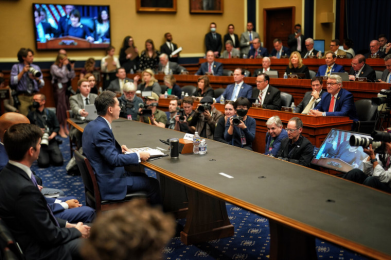
On March 5, local time, 19 members of the U.S. House of Representatives introduced a 13-page bill targeting TikTok, requiring ByteDance to divest control over TikTok within 165 days. Otherwise, TikTok would be banned from operating in the U.S., app stores would delist the app, and TikTok would be blocked from U.S.-based hosting services.
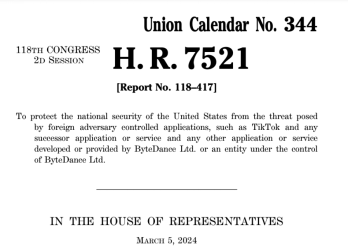
Source: U.S. Congress official website
In response, TikTok issued a strong rebuttal two days after the bill’s release. Hours before the March 7 House vote, TikTok pushed an in-app pop-up notification to its 170 million American users.
The pop-up title was brief and direct: “Stop TikTok from Being Shut Down.”
Its content warned users: “Congress is planning to ban TikTok entirely. Before your government strips 170 million Americans of their constitutional right to free expression, speak up! This ban will hurt millions of businesses, disrupt countless creators’ livelihoods, and erase your community. Tell Congress what TikTok means to you and say you’ll vote no.”
At the bottom of the screen was a single red button labeled “Call Now.” Upon clicking, users were prompted to enter their zip code and automatically connected to their local congressional office.
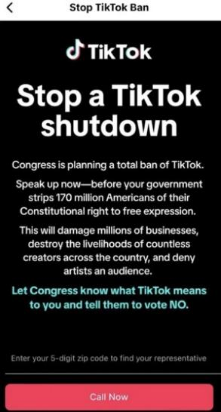
Source: X (formerly Twitter)
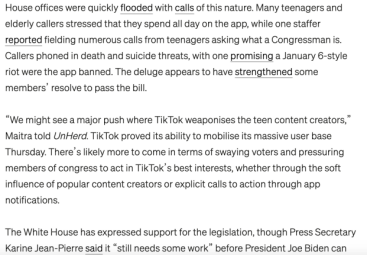
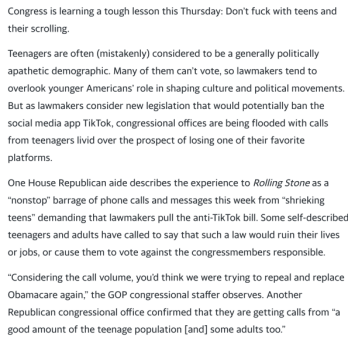
According to UnHerd, after this pop-up was released, many callers—including teens and the elderly—told congressional staff they spend all day on TikTok. Alarmingly, some threatened suicide and disclosed detailed plans. This only seemed to strengthen lawmakers’ resolve to pass the bill.
Foreign media outlets noted that the surge of calls from teenagers, meant to support TikTok, ironically validated U.S. concerns about TikTok’s influence on youth political opinion.
Sources: UnHerd; Rolling Stone
The bill, titled the “Protecting Americans from Foreign Adversary Controlled Applications Act,” passed unanimously in the House Energy and Commerce Committee by a vote of 50–0.
Under U.S. legislative procedure, the bill must undergo further review in the House, proceed to the Senate, and finally be signed by the President. President Biden stated on March 8, “If they pass it, I’ll sign it.”
The next House vote is scheduled for March 13, which will be expedited under suspension rules.
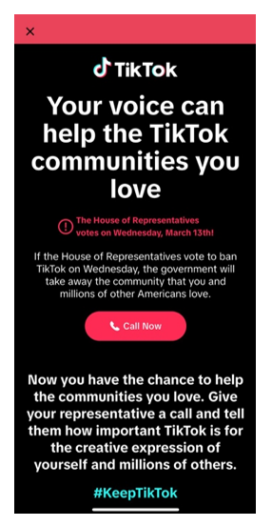
In preparation, TikTok launched a second pop-up message:
“Your voice can help protect the community you love. This Wednesday, the House will vote on banning TikTok. The government is trying to take away a place that you and millions of others love. But you still have a chance to help. Call your representative and tell them how much TikTok matters to your creativity and self-expression.”
This pop-up again included a red “Call Your Representative” button and a campaign tag: #ProtectTikTok.
Source: X (formerly Twitter)
Compared to the previous pop-up, the second message was more emotive and empathetic, shifting its language from “freedom of speech” to “protecting creativity and the community you love.” The goal was to use emotional appeal and hashtags to emphasize TikTok’s grassroots influence and sway congressional votes.
Pop-Up Campaigns as a Common U.S. Lobbying Tool
In fact, TikTok’s response is not unprecedented. In the U.S., contacting lawmakers by phone is a standard form of citizen engagement.
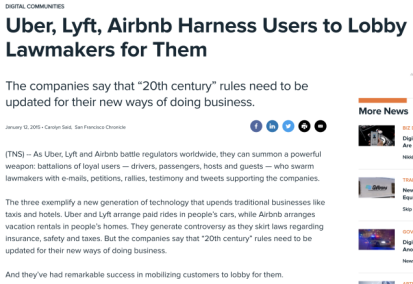
Other companies have lobbied users in similar ways:
Uber and Lyft, in 2015, mobilized users to oppose two California bills concerning insurance, background checks, and drug testing.
They embedded messages in app homepages, sent mass emails, and provided tools for contacting lawmakers. Ultimately, drug testing and background check bills failed, while insurance requirements were watered down.
Airbnb launched a successful user lobbying campaign in San Francisco supporting a short-term rental legalization bill known as the “Airbnb Law.”
Source: Government Technology
As of now, the U.S. government has not taken enforcement action against TikTok’s use of pop-ups or its efforts to influence public opinion.
However, such tactics are not risk-free.
For example, X (formerly Twitter) came under regulatory scrutiny in 2016 for facilitating the spread of misinformation. By 2020, the platform adjusted its recommendation algorithm and labeled policy-violating posts to mitigate its role in election manipulation.
Thus, while mobilizing users may not directly violate U.S. law, using vast user bases to affect public policy or legislation could raise concerns over electoral integrity and platform governance, prompting future regulation.
Would Such Pop-Ups Be Legal in China?
It is currently unclear how effective TikTok’s campaign will be in swaying the U.S. House vote. However, this raises an important question: Would a similar large-scale, politically motivated pop-up campaign be lawful in China?
First, under China’s Provisions on the Governance of the Online Information Content Ecosystem (effective March 2020), using pop-up messages to mobilize opposition to government action may violate platform obligations for information dissemination.
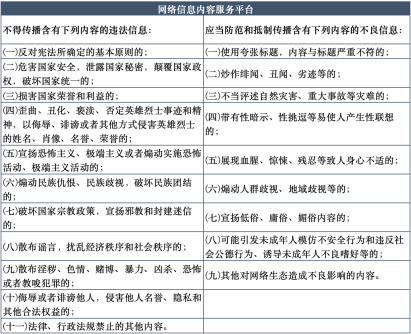
Such behavior may constitute:
A violation under Article 6, which prohibits content “damaging to national honor and interests,” and
A violation under Article 7, which bans content likely to encourage unsafe behavior or improper conduct among minors, thus harming the online ecosystem.
If a platform is found to have breached these duties, possible enforcement actions include:
Official warnings or compliance orders from the Cyberspace Administration of China (CAC), or
Fines, service suspension, or site shutdowns under the Cybersecurity Law or Administrative Measures on Internet Information Services.
Furthermore, most social media platforms in China do not mandate real-name verification for all users outside of youth modes. This raises additional concerns under China’s minor protection framework.
Pop-up content could violate the Regulations on the Online Protection of Minors, which prohibit placing emotionally manipulative or harmful content in UI areas that are prominent or likely to attract minors, such as pop-up messages.
In the “Clear & Bright 2023” summer enforcement campaign, regulators forced major app stores to audit short video apps and delisted 324 non-compliant apps. Over 4,700 violating accounts were penalized through bans, suspensions, or live-stream restrictions.
Lastly, regarding pop-up delivery methods, the CAC, Ministry of Industry and Information Technology (MIIT), and the State Administration for Market Regulation jointly issued the 2022 Regulations on Internet Pop-Up Information Push Services, which provide that:
Platforms without a news license may not push news content via pop-ups;
Pop-ups must reflect mainstream positive values and avoid sensationalizing sensitive incidents;
Malicious redirects or embedded QR codes are prohibited.
Following MIIT’s enforcement campaigns, by Q2 of 2023, complaints about pop-up ads dropped by 50%, and misleading redirects by 80%, demonstrating China’s strong stance on content, data safety, and youth protection.
Conclusion
Compared to TikTok’s battle for survival in the U.S., online platforms operating within China’s jurisdiction still function under a more top-down, state-defined governance model.
Pop-up tools in China are generally reserved for product information or advertising, not grassroots political mobilization. Thus, TikTok’s U.S.-style “pop-up resistance” appears highly unlikely to emerge in the Chinese regulatory environment anytime soon.