
SteamPolicyAIGCGameRegulationCopyrightLaw

Steam Eases Restrictions on AI-Generated Games: Community Rules Updated

AI游戏限制放宽 Steam社区规则更新

March 2, 2026
26 views

Summary

In July 2023, Valve restricted the release of games containing AI-generated content (AIGC) on Steam due to copyright concerns. Recently, however, Valve announced an update to its Steam community policies, relaxing restrictions on AI usage in game development. Under the revised framework, developers must disclose how AI is used during both development and runtime. AI-generated content is categorized into pre-generated content (e.g., art, code, audio created during development) and live-generated content (produced during gameplay). Developers must certify that such content does not contain illegal or infringing material and, for live AI systems, must implement safeguards to prevent unlawful outputs. Steam will disclose AI usage on store pages and introduce a reporting system for real-time AI violations. However, Valve continues to prohibit real-time AI-generated adult sexual content. The policy reflects Valve’s effort to align with evolving copyright law while accommodating AI innovation.

Steam Eases Restrictions on AI-Generated Games: Community Rules Updated

In July 2023, in order to avoid copyright disputes related to AI-generated content (AIGC), Valve blocked games containing AIGC from being listed on the Steam platform.

Recently, Valve published a new announcement within the Steam community, relaxing its restrictions on AI-related content. Valve stated that it would adjust its policies regarding games that utilize AI technologies and update the content survey developers must complete when submitting games to Steam, with the aim of allowing most games that use AI technologies to be distributed.
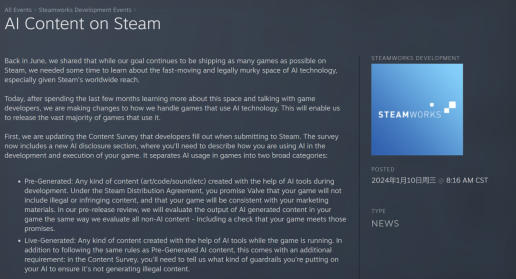
From the updated information currently available, developers are required to disclose how AI technologies are used during both the development and runtime phases of the game when submitting the content survey.

AI-related content is divided into two categories:

1. Pre-Generated Content

This refers to content generated using AI tools during the game development process (such as artwork, code, audio, etc.).

For pre-generated content, developers must certify that the game does not include “illegal or infringing” material and that the game is consistent with its marketing materials. During the review process, Valve will evaluate whether the AI-generated content in the game complies with the developer’s representations.

2. Live-Generated Content

This refers to content generated using AI tools during the operation of the game.

In addition to complying with the same requirements applicable to pre-generated content, developers must also disclose in the content survey what technical safeguards are implemented to prevent the generation of illegal content.

Valve has stated that relevant AI-related disclosures will be displayed on the game’s Steam store page, enabling users to understand how AI technology is used in the game.

Furthermore, Valve will introduce a new reporting system that allows users to report illegal real-time AI-generated content within games.

Although Valve has relaxed its listing policy for AI-based games, it has expressly stated that adult-only sexual content generated by real-time AI systems remains prohibited from publication.

Last year, when developers claimed that Steam would no longer publish games containing AIGC, Valve responded that its objective was “not to discourage the use of AI on Steam; rather, we are working on figuring out how to integrate it into our existing review policies.” Valve further stated that its review process “reflects current copyright law and policy, not our personal views. As these laws and policies evolve, our process will evolve accordingly.”

From the current announcement, it is evident that Valve has relaxed its restrictions on AI content, creating new opportunities for developers to publish games containing AI-generated content on Steam.

At the same time, Valve emphasized in the announcement that “we will continue to learn from the games submitted to us and from the legal developments surrounding AI, and we may revisit this decision as necessary.”

Official announcement link:

https://store.steampowered.com/news/group/4145017/view/3862463747997849618

分享文章

相关文章

General

Game Licensing (ISBN Approval): Can Cultural Enforcement Be Exercised Across Regions?

游戏版号,文化执法也能异地?

This article analyzes the legality and rationality of cross-regional administrative enforcement in game licensing cases in China. It argues that, under the current legal framework, enforcement should follow the principle of territorial jurisdiction, as the place of illegal conduct is typically tied to the location of the game company. Cross-regional enforcement may lead to jurisdictional conflicts, increased compliance burdens, and risks of profit-driven enforcement, thereby undermining the business environment and procedural fairness.

6 views
General

Twitch bans streamers from “promoting or sponsoring” CS:GO skin gambling

Twitch禁止主播“推广或赞助”CSGO皮肤赌博

Twitch has updated its community guidelines to further restrict gambling-related content, explicitly banning the promotion and sponsorship of skin gambling websites, particularly those مرتبط with Counter-Strike: Global Offensive. Since 2022, Twitch has prohibited the promotion of gambling sites that are not licensed in jurisdictions with consumer protections, naming platforms such as Stake, Rollbit, and Roobet. The latest update expands these restrictions to include CS:GO skin gambling sites and their free social versions, while also banning links, promo codes, and visual displays of such content. Twitch stated that the move responds to renewed interest in CS:GO skin gambling.

3 views
General

U.S. Market Expansion: New Age Verification Method Under COPPA

美国出海:COPPA下新的年龄验证方法

To facilitate compliance with the Children’s Online Privacy Protection Act (COPPA), the Entertainment Software Rating Board (ESRB), together with other U.S. institutions, has proposed a new mechanism for obtaining verifiable parental consent (VPC). The proposal relies on privacy-protective facial age estimation technology, developed with technical support from Yoti and SuperAwesome. The U.S. Federal Trade Commission (FTC) is currently soliciting public comments on whether this method falls within existing COPPA-approved verification methods, whether it satisfies the statutory requirements for parental consent, and whether it introduces privacy risks, including those related to biometric information. The proposal signals a potentially significant development in age verification compliance for online platforms and gaming services operating in the United States.

5 views