Since the implementation of new regulations on in-game probability disclosure in 2024, the Korea Fair Trade Commission (KFTC) has intensified its enforcement efforts. Following penalties against Gravity and Wemade, two more Korean game companies have been sanctioned for violations related to probability disclosure.
In May last year, the Korea Fair Trade Commission (KFTC) launched investigations into Krafton Inc. and Com2uS Co., Ltd. for falsifying in-game probability rates in their titles PUBG and Starseed. A year later, the KFTC finalized its penalties, imposing a combined fine of 5 million won on both companies and issuing corrective orders (including future prohibition orders and reports on measures to prevent recurrence).
 PART 1
Detailed Analysis of PUBG and Starseed Game Penalties
Krafton sold two types of probabilistic items in PUBG, including Processing and the PUBG x New Jeans set. From March 22 to April 8, 2024, Krafton falsely informed users that 31 items obtainable through Processing had actual drop rates ranging from 0.1414% to 0.7576%, despite their actual rates being 0%.
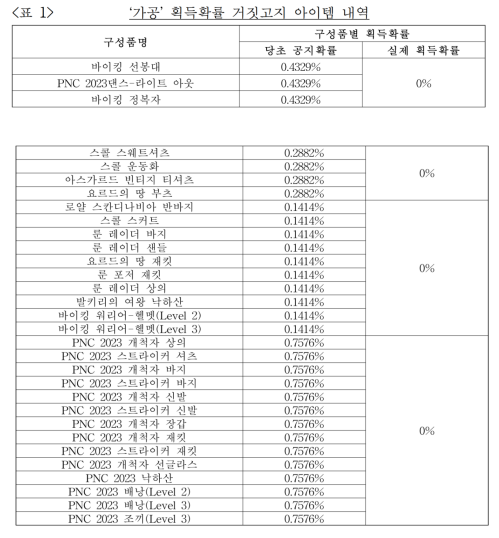 (Processing Probability of False Claims)
During the PUBG x New Jeans bundle event held on June 12, 2024 (for sales on June 13, 2024), the official guarantee mechanism promised: if the item fails to drop after 4 attempts, the 5th attempt guarantees a 100% drop rate. However, actual calculations reveal that the probability of obtaining the item on the 5th attempt is only 9%.
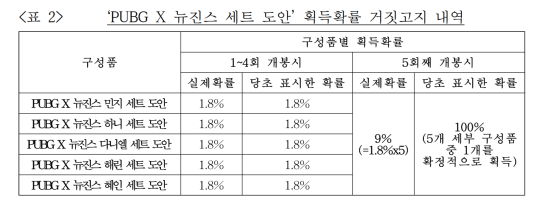 (PUBG x New Jeans Set Event Probability Misrepresentation)
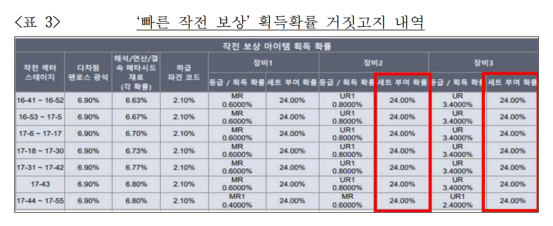
During the period from March 28, 2024, to May 9, 2024, Com2us falsely advertised that the “Quick Battle Compensation” items sold to Starseed game users would grant a 24% probability of enhancing the equipment worn by the game character upon purchase. However, actual testing revealed that only Equipment 1 had a 24% probability of this effect, while the other two equipment types completely lacked such benefits.
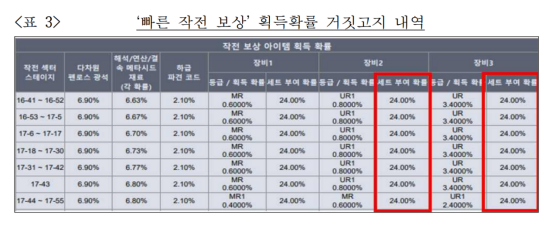 (Starseed Game Event Probability Misrepresentation)
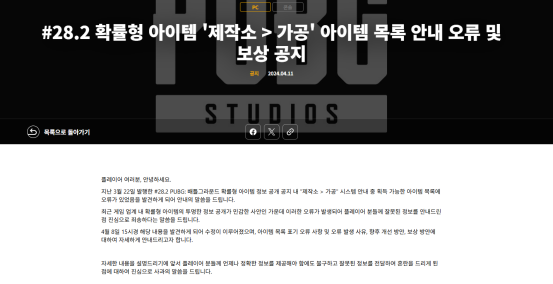
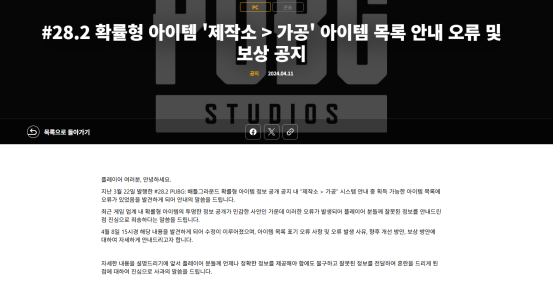
Both companies had already implemented corrective measures prior to the KFTC investigation. PUBG updated its probability disclosure on April 11, 2024, to address the inaccuracies and provided compensation to affected players.
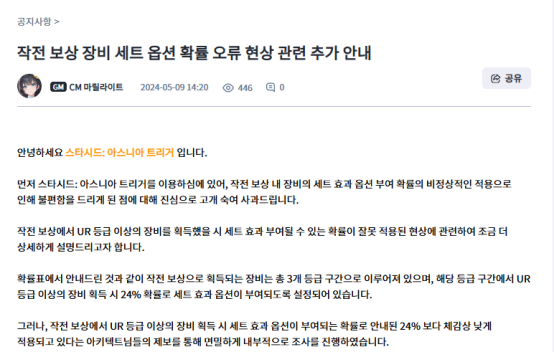
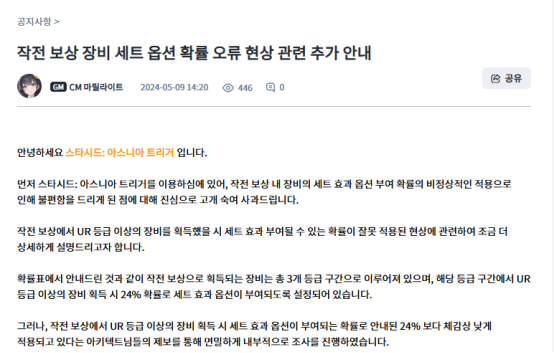
 Starseed Games corrected errors and announced a related compensation plan on May 9, 2024.
 PART 2
Proactive Compensation Avoids Service Suspension Penalty
Similar to previous penalties imposed on Gravity and Wemade, the KFTC has only fined both companies 2.5 million won each this time, without mandating a business suspension.
Regarding penalties for violating the Consumer Protection Act for E-Commerce, Article 32 stipulates that the KFTC may order operators to take corrective measures for illegal activities. These measures typically include: ceasing illegal conduct, fulfilling legal obligations, publicly disclosing the corrective actions taken, implementing necessary measures to prevent and remedy consumer losses, and taking necessary steps to rectify other violations.
These corrective measures are also frequently employed by the KFTC in cases involving penalties for falsifying probability disclosures. Beyond these measures, Article 32(4) of the Act actually specifies circumstances under which the KFTC may order a business operator to suspend all or part of its operations for up to one year:
1. When, despite a corrective measure order issued under the first item, the illegal act recurs and the severity of the violation exceeds the standards stipulated by Presidential Decree.
2. Failure to comply with the corrective action order.
3. When it is determined that corrective actions alone are insufficient to prevent consumer harm or compensate for damages incurred.
Legally speaking, if a suspension order is imposed, the circumstances of the violation must be exceptionally severe. Of course, suspension of business is not the only option. Pursuant to Article 34 of the Act, if the KFTC determines that imposing suspension under Article 32(4) would cause significant inconvenience to consumers or others, it may instead impose a fine not exceeding the sales amount related to the violation. Where no relevant sales amount exists or cannot be calculated, a fine not exceeding 50 million won may be imposed.
Returning to the current penalty outcome, the KFTC considered that both companies voluntarily corrected the violations, the duration of the violations was relatively short, and both companies provided compensation measures to consumers. Consequently, the KFTC ultimately did not impose the business suspension penalty.
PART 3
Probability Disclosure Remains a Key Focus of Korean Regulation
From the first game company penalized last year to the present, Korea's oversight of probability disclosure has never relaxed. Coupled with the implementation of the agent system for overseas companies, the previous difficulty in regulating and penalizing foreign game companies will also change. Whether domestic Korean companies or overseas game companies, none can escape regulatory penalties.
However, this year's penalty cases suggest that proactively implementing compensation measures may mitigate the severity of KFTC sanctions—depending on the compensation plans offered by game companies. Notably, KRAFTON refunded a total of 1.173 billion KRW (approximately 6.15 million RMB) to affected users and restored or compensated in-game items valued at 9.858 billion KRW. Com2uS went further by compensating all players with 200,000 KRW (approximately 1,000 RMB) each, plus additional in-game item compensation for some users. Of course, the final compensation amount isn't the sole criterion. The KFTC comprehensively evaluates the company's attitude and the nature of the violation (including whether it was persistent and the extent of profits gained).
For the Korean market, we remind companies that probability disclosure issues should not be taken lightly, especially with the implementation of the agent system this year, which demands even greater caution.
 PART 1
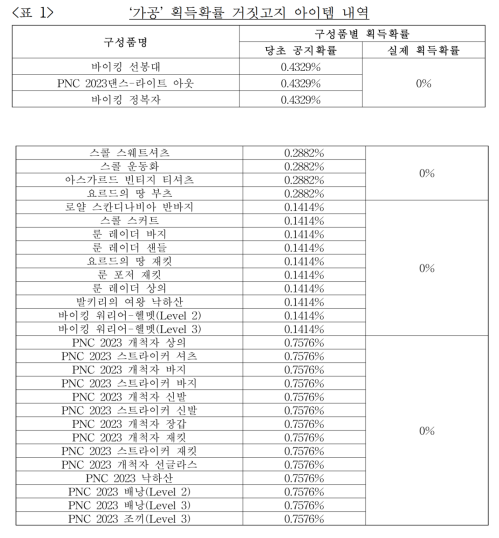 (Processing概率虚假情况)
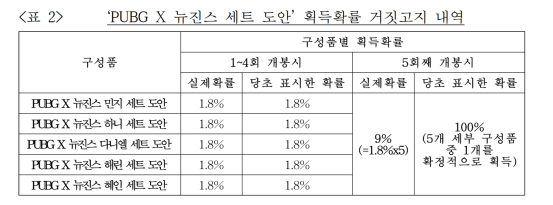 (PUBG x New Jeans 套装活动概率虚假情况)
 (Starseed游戏活动概率虚假情况)
 Starseed游戏于2024年5月9日更正错误并公布相关补偿方案。
 PART 2