Age VerificationRobloxAI

Roblox Updates Age Verification System with Dual Safeguards: Scrolling Wheel + Facial Recognition

【出海】Roblox更新年龄验证机制,滚轮+扫脸双保险

January 9, 2026
7 views

Summary

In July 2025, Roblox launched a new age-verification system alongside its “Trusted Connections” feature, marking a shift from content filtering to identity-based governance. Users aged 13+ must submit a selfie for AI age estimation provided by Persona to unlock unfiltered chat with other verified users, while teens aged 13–17 must also link with a real-world adult (18+) via QR code or phone number. If AI verification fails, users can submit government ID, and biometric data is deleted after 30 days. Age changes require parental or ID verification. By making age verification a prerequisite for key features, Roblox is responding to child-safety concerns and to evolving global regulations such as COPPA reforms, U.S. state laws, and the UK Online Safety Act.

As one of the world's most popular teen UGC gaming platforms, Roblox officially launched a new age verification system in July 2025 to complement the rollout of its “Trusted Connections” feature.
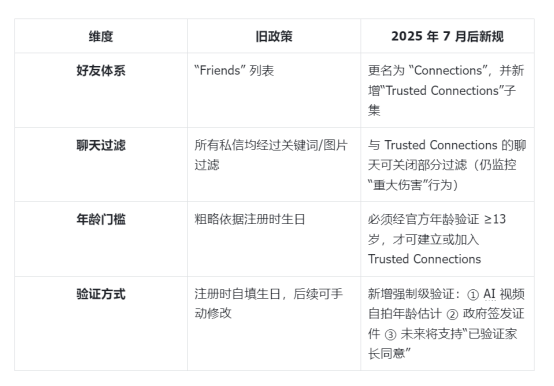
Notably, Roblox has implemented an age verification solution.

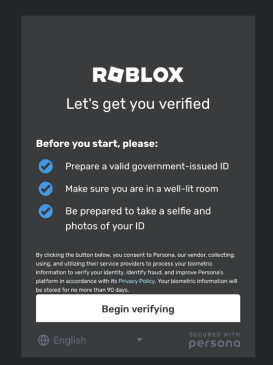
First, users aged 13 and above must record a selfie video. Artificial intelligence then estimates their age based on a “diverse dataset,” a service provided by identity verification company Persona. Users who pass age verification can engage in unfiltered chat with other verified users.

Second, teens aged 13–17 must establish Trusted Connections with verified users aged 18 or older whom they know in real life. This requires verification via QR code or phone number, ensuring a safer environment for minors.
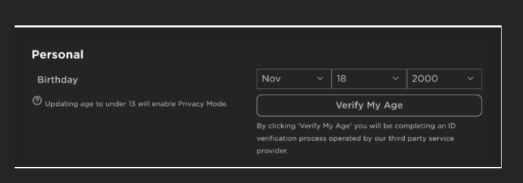
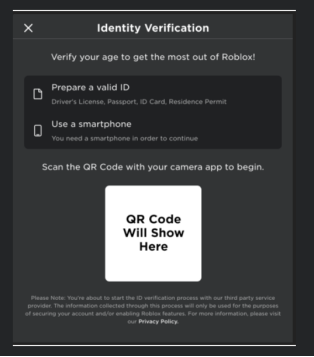
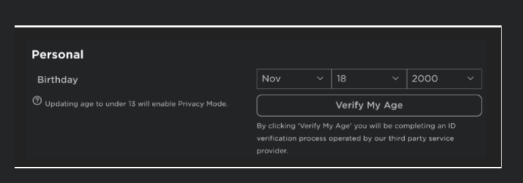
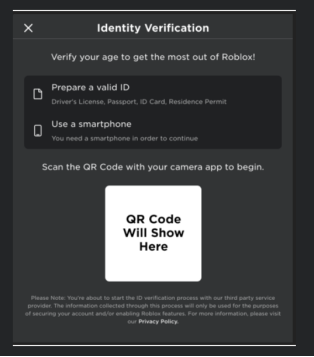
(In addition to the standard age verification process using a scroll wheel, Roblox has updated and added a selfie video verification procedure.)
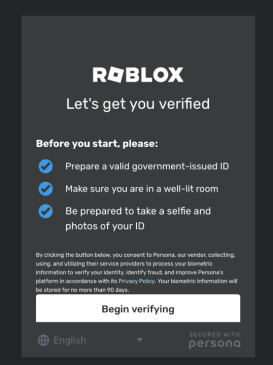
Considering the potential error rate of AI recognition, if users aged 13 or older fail to verify their age through selfie video verification, they may use government-issued identification documents for secondary age confirmation. To meet data compliance requirements, biometric data from selfie videos will be deleted after 30 days. Additionally, if users need to update or correct their registered age, they must submit an adjustment request either through a Roblox account with parental control permissions or by providing valid identification documents.

Roblox's upgrade of age verification from an “optional feature” to a “prerequisite for unlocking functionality” signifies a shift in platform governance from “content filtering” to “identity trust.” We believe this move also responds to recent criticisms regarding the platform's content moderation and issues of harm to minors through practical mechanism changes.

Concurrently, legislative developments—including the revised U.S. COPPA, state-level age verification requirements in jurisdictions like Utah and Texas, and the implementation of the UK Online Safety Bill—are progressively placing child protection and minor user identification/filtering at the core of regulatory focus. Striking a balance between enhancing youth safety and safeguarding user privacy will require ongoing observation of technological iterations and global regulatory interactions.
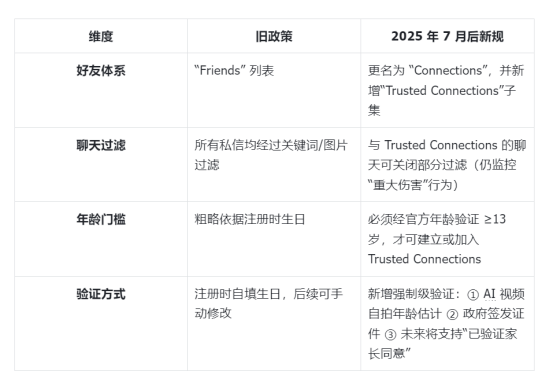
中文原文

作为全球最受欢迎的青少年UGC游戏平台之一,Roblox 于 2025 年 7 月正式推出全新的年龄验证体系,以配合其“Trusted Connections(可信联系人)”功能的上线。

其中值得关注的是Roblox实装的年龄验证的方案。

首先,13 岁以上用户需拍摄自拍视频,由人工智能基于“多样化数据集”进行年龄估算,该服务由身份验证公司 Persona 提供。通过年龄验证的用户可与经过验证的其他用进行无过滤聊天。

其次,13-17 岁青少年需通过二维码或电话号码验证与现实生活中认识的 18 岁以上用户建立可信连接,确保未成年用户使用安全,建立或加入Trusted Connections。

(除了常规年龄滚轮验证方案,Roblox更新并增加了自拍视频核验的流程)

考虑到AI识别可能存在的错误率,若13岁以上用户通过自拍视频验证年龄失败,用户可使用政府颁发的身份证件二次确认年龄,同时为满足数据合规要求,自拍视频的生物识别数据将在 30 天后删除。同时,如用户需要更新或更正自己的注册年龄,则需要通过家长控制权限的Roblox账户或提供合法身份证件的方式进行调整申请。

Roblox 此次将年龄验证从“可选项”升级为“功能解锁的前置条件”,标志着平台治理从“内容过滤”向“身份可信”转型。我们认为此举也是在通过实操机制的变化,以回应近年来对于该平台内容管控及未成年人侵害问题的质疑之声。

同时,随着美国COPPA修订、诸如犹他州、德州等多个州立法开始逐渐在不同的网络场景中引入年龄验证要求、英国《在线安全法案》的落地等立法动态,逐渐将未保以及未成年用户识别过滤纳入监管重心。如何在提升青少年安全与保护用户隐私之间取得平衡,仍需要持续观察其技术迭代及全球监管互动。

分享文章

相关文章

General

【Weekly Gaming Law】Lawyers Comment on miHoYo’s Anti-Fraud Actions; Infringing “Reskinned” Game Ordered to Pay RMB 5 Million

【每周游戏法】律师评米哈游反舞弊;侵权游卡被判赔500万

This weekly update examines three recent legal developments in the gaming industry: miHoYo’s anti-fraud enforcement and supplier blacklist measures; a “reskin” infringement case involving a Three Kingdoms-themed card game resulting in a RMB 5 million damages award based on unfair competition; and Roblox’s launch of AI-powered interactive content generation tools. The article outlines the legal considerations arising from supply chain compliance, the boundary between public domain materials and protectable game design, and the intellectual property and compliance implications of AI-generated interactive content within UGC platforms.

0 views
General

How to Build Official Game Payment Systems in a Compliant Manner (Part II): Overseas

游戏官方支付如何合规搭建(二)海外篇

Against the backdrop of a global economic slowdown and evolving regulatory scrutiny over major app distribution platforms, an increasing number of overseas-oriented game companies are exploring the establishment of official website top-up platforms to reduce reliance on channel commissions. Building on the prior discussion of platform policies regarding payment redirection and third-party payment access, this article reviews practical cases of official website payment models adopted by several game companies, including their login mechanisms, purchasable content, regional availability, and qualification disclosures. Based on these practices, it outlines compliance considerations that overseas game companies should focus on when constructing official website payment systems, particularly in relation to account management, price display, promotional methods, and refund policy design across different jurisdictions.

6 views
General

EU’s DMA Enforcement Push: Apple and Epic Games Reach Temporary Truce

欧盟DMA强监管,苹果与Epic Games暂时握手言和

Since 2020, Apple and Epic Games have been locked in a global antitrust dispute over App Store policies. While Epic lost its U.S. lawsuit, it continued its resistance through noncompliance, resulting in a developer account ban. However, the dynamics shifted with the EU Digital Markets Act (DMA) coming into force on March 6, 2024. Epic reported that Apple, under pressure from the European Commission, agreed to reinstate its developer account in the EU. The DMA’s provisions, especially Article 5(3) and Article 6(4), require gatekeepers like Apple to allow third-party app stores and payment systems on iOS. Apple’s attempt to ban Epic amid DMA implementation triggered regulatory attention, leading to rapid Commission intervention. This incident not only highlights the DMA’s enforcement teeth but also signals a broader shift in platform governance within the EU. For global developers and digital exporters, especially those dependent on app store distribution, DMA compliance represents a strategic inflection point. Non-compliance risks include fines of up to 10–20% of global turnover, exemplified by the €1.84 billion fine Apple recently faced. As more third-party app stores (e.g., Mobivention, MacPaw) emerge, the EU’s digital market is poised for structural transformation.

5 views