
Editor’s Note
Recently, Roblox Corporation has been involved in a significant lawsuit. Guardians have alleged that Roblox assisted minors in participating in online gambling.
The plaintiffs argue that the settlement channels for virtual currency within the Roblox platform were connected to third-party gambling platforms, that Roblox had actual knowledge of such activities, and that it profited therefrom.
The prominence of a leading platform has also enabled third-party platforms to grow by leveraging its ecosystem. Major platform operators should remain vigilant: failure to intervene promptly against such third-party platforms may result in backlash, and the company’s exposure may extend far beyond mere intellectual property misuse.
This case has not yet been adjudicated, and we will continue to monitor its developments.
Recently, Roblox became involved in a class action lawsuit. Parents filed the action in the U.S. District Court for the Northern District of California, alleging that Roblox conspired with companies such as Satozuki, Studs, and RBLXWild to provide minors with access to third-party online gambling websites and to profit from such activities.
The claims are brought under, among others:
the Racketeer Influenced and Corrupt Organizations Act (RICO),
the Unfair Competition Law (UCL), and
the Consumer Legal Remedies Act (CLRA).
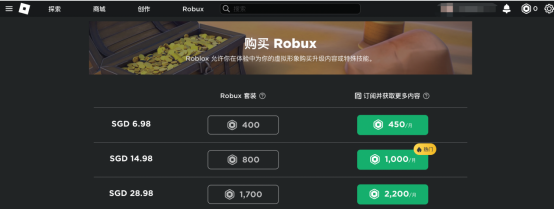
The plaintiffs allege in the complaint that minor users, under parental supervision, purchased thousands of dollars’ worth of Robux (Roblox’s virtual currency) through gift cards on the Roblox platform.
Subsequently, however, the minors allegedly accessed third-party gambling websites through Roblox and used Robux to place bets and participate in gambling games, ultimately losing thousands of Robux.
Meanwhile, the parents were entirely unaware that the minors had been participating in gambling activities.
“Robux” is the virtual currency used within the Roblox platform and has real monetary value. One Robux is allegedly equivalent to USD 0.0125.
The plaintiffs further allege that users under the age of 18 are able to purchase Robux on the platform using their parents’ credit cards, and that Roblox in fact monitors each such transfer.
This, according to the plaintiffs, means that Roblox is capable of real-time tracking of Robux consumption occurring on gambling websites.

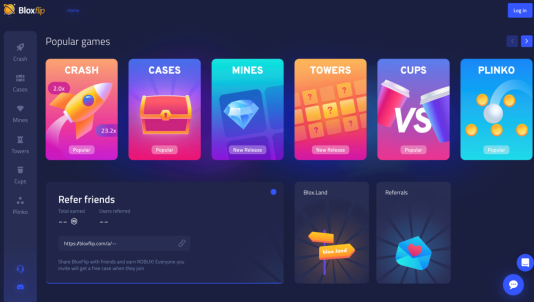
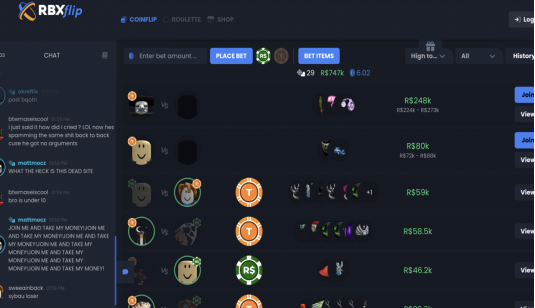
After minors purchase Robux through the Roblox platform, they are allegedly able to jump to third-party virtual casino websites and link their Robux accounts with such gambling platforms.
The plaintiffs argue that these gambling websites are visually highly similar to Roblox, thereby making it easier for Roblox users to register accounts,link Roblox accounts, and participate in gambling.
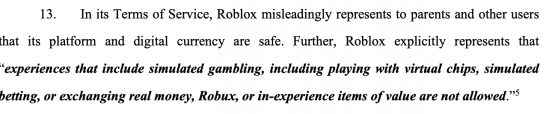
Based on this, the plaintiffs contend that Roblox’s statements in its user agreement are false or misleading, as the relevant terms allegedly cause parents to believe that the platform itself and its virtual currency system are safe.
The plaintiffs further allege that Roblox, as the platform operator, could have taken measures to restrict or block the use of its platform and virtual currency by third-party gambling websites, but failed to do so.
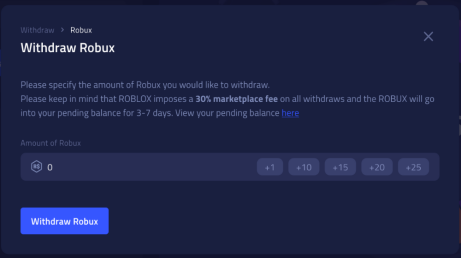
According to the complaint, the reason for such inaction is that Roblox profits substantially under the existing gambling framework.
Specifically, when users withdraw Robux obtained through third-party gambling websites, Roblox allegedly charges a 30% handling fee.
The plaintiffs maintain that Roblox could not possibly have been unaware of the existence of these gambling websites.
In support of this argument, the complaint cites statements made by key opinion leaders (KOLs) associated with the Roblox ecosystem.
For example, in 2019, well-known Roblox creator KreekCraft posted on Twitter:
“Heard a lot about rbxflip today. In case people don’t know, it’s a Roblox bot gambling website.
Gambling by anyone underage is illegal.
Don’t use it, you’ll get banned.”
In response to the case, Roblox stated that the gambling websites are third parties with no legal affiliation to Roblox, and that their conduct constitutes unlawful use of Roblox’s intellectual property and brand, in serious violation of platform rules.

At present, the case has been accepted by the court and is expected to proceed to an online hearing in November.
Attached is the complaint: https://www.bloomberglaw.com/public/desktop/document/ColvinetalvRobloxCorporationetalDocketNo323cv04146NDCalAug152023C?doc_id=X41IKMCJH909KG8UE5VJLPN1NOB