
In today's rapidly evolving digital entertainment industry, mini-games have gained widespread popularity due to their convenience and entertainment value. However, infringement issues surrounding mini-games have become increasingly prominent, causing significant distress for original developers. When developers unfortunately encounter mini-game infringement, how can they effectively leverage legal tools to safeguard their rights? Below, we provide a comprehensive analysis of strategies throughout the entire process—from preserving evidence and channel complaints to applying for injunctions and pursuing litigation—to serve as a reference for developers.
PART 1
Preserving Evidence—Laying the Foundation for Rights Protection
Upon discovering signs of mini-game infringement, preserving evidence becomes the primary and critical step.
 First, conduct digital forensics on the infringing mini-game to ensure preserved evidence remains unaltered or fabricated. Authoritative methods like timestamping and notarization are recommended to secure evidence. Common digital forensics tools include Rights Guardian, Feiluoyin, and IP360. Developers may also visit notary offices for professional evidence collection by notary officers. During evidence collection, it is essential to document the entire lifecycle and comprehensive information of the mini-game, particularly focusing on:
1. Entity Information
Elements such as the mini-game link, login interface disclosures, user agreements/privacy policy disclosures, and operational entities handling in-game purchases and payments can fully reveal details about both the infringing party and the rights holder. Many mini-games also feature promotional guilds, which may also be considered as potential defendants.
2. Game Operation Screenshots
Evidence-gathering videos should dynamically showcase the operational processes of both the infringing and legitimate games from all angles. This includes opening animations, level/task settings, gameplay instructions, character movements, and special sound effects. During recording, ensure a quiet environment with adequate lighting to guarantee clear video quality and audible audio.
Through comprehensive evidence collection covering the infringing game and the rights holder's game—including names, icons, interface layouts, character designs, gameplay introductions, and more—screenshots extracted from the evidence video can be compared to clearly and precisely demonstrate the similarities between infringing elements and the original work.
 Additionally, if feasible, attempt to obtain the infringing game's installation package to further verify hidden infringements such as code plagiarism or data theft. However, during evidence preservation, strictly adhere to the principles of legality and authenticity. Never employ illegal methods—such as hacking to access game backend data—as such evidence risks being excluded in subsequent legal proceedings.
PART 2
Channel Complaints—Leveraging Platform Resources
After completing evidence collection, submitting complaints to relevant distribution channels is a crucial method to prevent further infringement.
Taking WeChat Mini Program infringement complaints as an example: Upon discovering an infringing mini-game, log into the WeChat Official Account Platform (https://mp.weixin.qq.com). Click “Infringement Complaint” at the bottom of the page and truthfully fill out detailed complaint information.
The complainant must provide authentic and valid identity information to verify their legal standing. Subsequently, the WeChat Mini Program account being reported and the specific form of infringement (e.g., content infringement, code plagiarism, or trademark infringement) must be detailed, along with supporting evidence.
Beyond basic rights certificates, for content infringement in mini-games, developers are advised to provide detailed comparative materials. Visual comparisons offer the platform an intuitive illustration of the infringement, facilitating faster review.
Upon receiving a complaint, the WeChat platform will review and determine whether infringement has occurred. If the complaint is upheld, the infringing content will be removed or the mini-program may be taken down depending on the severity of the violation.
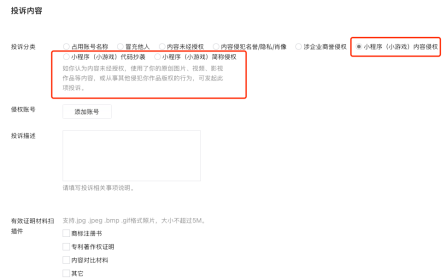
Complaint procedures through other channels follow a similar process. Utilizing these channels allows developers to leverage the platform's management and oversight functions to swiftly and effectively curb the spread of infringing activities.
PART 3
Preliminary Injunction—Mitigating Losses Promptly
Should developers incur losses due to infringement—such as user attrition or negative public sentiment—or if platform complaints prove ineffective, we advise promptly initiating litigation to protect rights. Particularly when infringement is egregious and likely to cause irreparable harm, developers may seek temporary judicial relief by petitioning courts for a preliminary injunction prior to formal litigation.

Developers must thoroughly articulate the urgency and severity of the infringement to the court. This includes demonstrating how the infringing mini-game's rapid dissemination has already inflicted substantial damage on the original work's market share, reputation, and other critical aspects. Failure to halt the infringement promptly would result in immeasurable economic losses for the rights holder, which even subsequent compensation efforts might struggle to fully remedy.
Simultaneously, developers must provide the court with sufficient and conclusive evidence to substantiate the application. This includes previously preserved evidence of infringement, such as screenshots, videos, and links, along with materials proving the infringement of their legitimate rights and interests. Such materials may include copyright registration certificates, trademark registration certificates, and other proof of rights documents, as well as comparative documentation of the infringing content. Upon receiving the application, the court will conduct a careful review, comprehensively considering factors such as the urgency of the infringement and the actual damage to the applicant's rights and interests, before ruling on whether to grant the application for a preliminary injunction.
Once the court grants the preliminary injunction, it will order the infringer to immediately cease the infringing activities. This prevents the subsequent litigation process from becoming excessively prolonged, thereby effectively interrupting the chain of infringement and preventing further escalation of the developer's losses. Of course, a pre-litigation injunction requires substantive review by the court and is difficult to obtain in practice. It is still recommended that developers seek professional legal counsel before pursuing this measure.
PART 4
Litigation Claims — Compensating for Infringement Damages
Following an infringement, rights holders are legally entitled not only to demand cessation of the infringing acts but also to claim compensation for damages. When determining the scope of compensable losses, multiple key factors must be comprehensively considered. From the rights holder's perspective, these include losses such as a sharp decline in paid game downloads, a significant reduction in advertising revenue, and reasonable expenses incurred to stop the infringement—such as attorney fees, notary fees, travel expenses, and costs for evidence preservation. Additionally, profits derived by the infringer from the infringing activities may be included in the compensation calculation.
 When claiming damages, the rights holder must provide evidence to the court demonstrating the scope and specific amount of their losses. This evidence may include financial statements, market research reports, data analysis reports, expense invoices, and other relevant documentation.
When facing infringement by mini-games, developers should not choose to endure or ignore it. By skillfully employing a series of effective measures—such as preserving evidence, filing channel complaints, applying for pre-litigation injunctions, and pursuing damages through litigation—they can effectively, efficiently, and powerfully protect their legitimate rights and interests while severely cracking down on infringing activities.
 首先,针对侵权小游戏进行电子取证,确保所保存的证据未遭篡改或伪造,建议采用时间戳、公证等权威方式对证据予以固定。常见的电子取证工具有权利卫士、飞洛印、IP360等,开发者也可以选择前往公证处,由公证人员进行专业取证。在取证时,需要注意存证小游戏全流程、全方位的信息,尤其是涉及到:
 此外,如果条件允许,可以尝试获取侵权游戏的安装包,进一步确认是否存在代码抄袭、数据盗用等隐蔽性侵权行径。但在保全证据过程中,务必严守证据的合法性与真实性底线,切不可采用非法手段获取证据,诸如通过黑客攻击等违法途径获取游戏后台数据,否则此类证据在后续法律程序中将面临被排除的风险。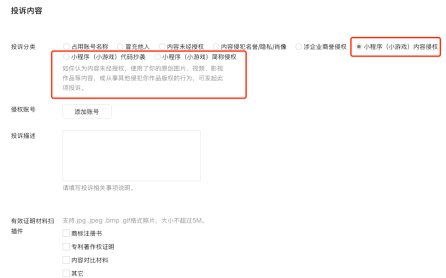
 开发者需要向法院详尽阐释侵权情形的紧迫性与严重性,例如侵权小游戏传播速度,已对原作品的市场份额、声誉等关键方面造成了极为巨大的冲击,若不及时加以制止,权利人所遭受的经济损失将难以估量,且后续即便通过赔偿途径亦难以完全弥补。
 在主张赔偿损失过程中,权利人需向法院提供证据以证明自身的损失范围与具体金额,可包括财务报表、市场调研报告、数据分析报告、费用发票等多类形式。