
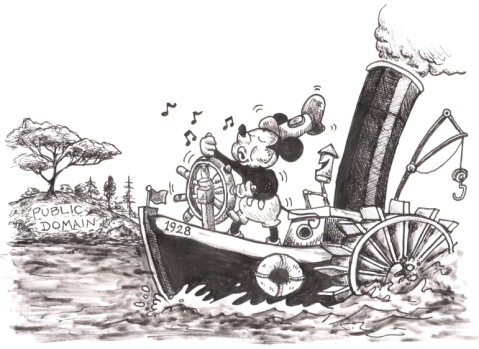
On January 1, 2024, after nearly a century of copyright protection, the original version of Mickey Mouse entered the public domain in the United States.
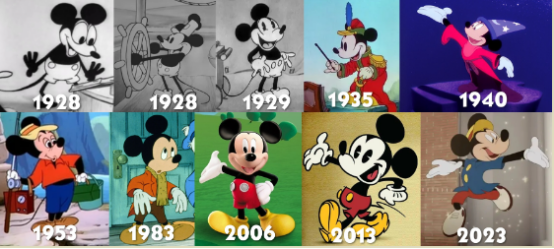
The Mickey character as first depicted in the 1928 animated short Steamboat Willie and the silent film Plane Crazy has now completed its 95-year copyright term and entered the public domain as of New Year’s Day 2024.
In fact, in order to maintain copyright protection over the character for as long as possible, Disney actively lobbied for legislative extensions. The 1976 revision of the U.S. Copyright Act and the 1998 Sonny Bono Copyright Term Extension Act extended the copyright term of the 1928 Mickey to 95 years. The latter was widely nicknamed the “Mickey Mouse Protection Act.”
While Disney has vigorously protected its own animated characters, it has also been a successful practitioner of public domain adaptation. For example, Frozen was inspired by Hans Christian Andersen’s The Snow Queen; The Lion Kingdrew from Shakespeare’s Hamlet and biblical narratives.
Mickey himself was influenced by public domain sources. His personality and comedic movements drew inspiration from silent film stars such as Charlie Chaplin and Douglas Fairbanks. Walt Disney once stated in an interview with American Magazine:
“I think we owe a great deal to Charlie Chaplin… We wanted something appealing, and we thought of a mouse that would have some of Chaplin’s wistful qualities.”
Even the title Steamboat Willie was a tribute to Buster Keaton’s earlier 1928 film Steamboat Bill, Jr.
What Can Creators Do with Mickey After January 1, 2024?
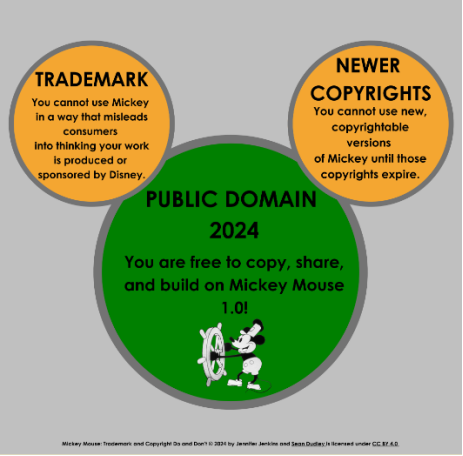
Steamboat Willie and the characters depicted therein (including Mickey and Minnie) are now part of the public domain. This means that anyone may copy, adapt, remix, or otherwise reuse this material.
However, creators must avoid infringing existing rights that remain protected:
Creators may use only the original 1928 version of Mickey and Minnie and may not incorporate copyrighted elements introduced in later versions (such as updated costumes, visual designs, or character refinements).
Under trademark law, creators must avoid creating consumer confusion regarding whether a new work is produced, sponsored, or affiliated with Disney. One effective method is to clearly identify the true creator on the title screen or cover and include a prominent disclaimer stating that the work is not produced, endorsed, or licensed by Disney.
The safest approach is to remain faithful to the 1928 depiction. However, U.S. copyright law allows use of non-copyrightable creative elements. For example:
A creator may give the 1928 Mickey an audible speaking voice (the original film was silent).
The character may be given personality traits such as cheerful dancing movements.
The black-and-white color scheme may be altered without infringing copyright.
Does Disney’s Trademark in Mickey Restrict Derivative Uses?
The legal analysis becomes more complex when Disney’s trademark rights are implicated.
Some commentators claim that although the 1928 Mickey has entered the public domain, it cannot be used because it remains a registered trademark. This view is overly absolute.
Under U.S. trademark law, the use of a trademarked character is prohibited only where it is likely to cause confusion, mistake, or deception regarding the source or sponsorship of goods or services.
The U.S. Supreme Court unanimously held in Dastar Corp. v. Twentieth Century Fox Film Corp., 539 U.S. 23 (2003):
“Trademark law cannot be used to create a species of mutant copyright law that limits the public’s federal right to copy and use expired copyrights.”
In other words, trademark rights cannot override the freedoms granted once copyright expires.
Similarly, the Ninth Circuit held in Comedy III Productions v. New Line Cinema, 200 F.3d 593:
“Once a work enters the public domain, it belongs to everyone,” and trademark law cannot be used to circumvent copyright law by extending protection over public domain material.
Therefore, in evaluating fair use of trademarked animated characters, it is crucial to distinguish different uses of Mickey. For instance, if a work uses Mickey in a way that implies Disney sponsorship, such as placing the character prominently as a brand identifier in an animation or video game, consumer confusion may arise.
To mitigate such risks, creators should clearly indicate that they—not Disney—are responsible for the new work and include appropriate disclaimers.
Although U.S. trademark law contains doctrines such as nominative fair use that protect expressive uses and prevent trademark law from superseding copyright law, copyright holders may still attempt to rely on trademark law to interfere with lawful reuse of public domain materials.
Whether Disney will actively pursue enforcement actions against creators using the now-public-domain version of Mickey remains to be seen.
This article is adapted from “Mickey, Disney, and the Public Domain: A 95-Year Love Triangle” by Jennifer Jenkins, Director of the Duke Center for the Study of the Public Domain.