
Legal Risks
Self-produced card-based blind box products generally fall into the following three categories:
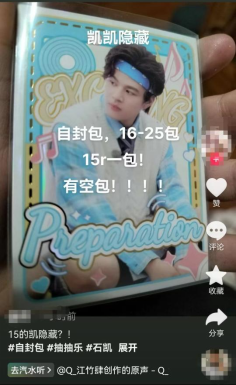
Merchants manufacture card products without authorization and package them in blind box format.
Non-blind-box products are re-packaged by merchants into blind boxes.
Factory-made blind box products are unpacked by merchants and then repackaged in new combinations.
The potential risks associated with self-made card-based blind boxes include the following:
1. High Risk of Prohibited Content
Using the example of adult-themed cards, merchants may sell prohibited goods or services disguised as blind boxes.
According to the Guidelines for Blind Box Business Operations (Trial), products or services explicitly banned from sale or circulation under laws and regulations shall not be sold or provided in blind box format.
This means that if self-made blind boxes involve prohibited items, the merchant may be subject to administrative penalties or, in serious cases, criminal liability.
At the same time, live-stream platforms, as supervisory entities, may be held liable for their failure to detect or intervene in such illegal activity in a timely and effective manner.

2. High Risk of Consumer Disputes
On one hand, operators of self-made blind boxes often fail to meet compliance requirements in information disclosure, thereby infringing on consumers’ right to know.
According to relevant laws, blind box operators must fully disclose product information.
Articles 8 and 20 of the PRC Law on the Protection of Consumer Rights and Interests provide that business operators have a duty to proactively inform consumers, who are entitled to know the true condition of the goods or services.
The Blind Box Business Guidelines (Trial) specify that operators must disclose key information such as: product name, type, style, extraction rules, distribution information, number of limited-edition items, probability of extraction, and price range—prominently and publicly.
Enforcement actions demonstrate that failure to disclose such key information is a major regulatory concern.
For instance, on March 14, 2023, the Shanghai Market Supervision Bureau issued four blind box-related penalty cases, all involving failure to disclose extraction probabilities, with fines ranging from RMB 1,000 to 34,000.
Self-made blind boxes often lack rigorous production standards, making it difficult for merchants to comply with disclosure requirements.
If forced to comply, some may fabricate or falsify information to meet public disclosure standards, resulting in further risks such as false advertising and consumer fraud.
On the other hand, if a live-stream merchant unpacks and repackages card packs in order to withhold high-value cards for personal gain, altering the draw probability, this could mislead consumers and constitute fraud.
For example, in [Fudong Market Enforcement Case No. (2022) 18], a distributor removed winning tickets from food packaging to meet downstream distributors’ preferences and repackaged the items. Authorities found this constituted consumer fraud and imposed an administrative fine of RMB 50,000.
3. High Risk of Intellectual Property Infringement
Merchants who manufacture and sell self-made card-based blind boxes frequently do so without proper authorization, creating significant IP infringement risks, including:
(1) Infringement of Card Images
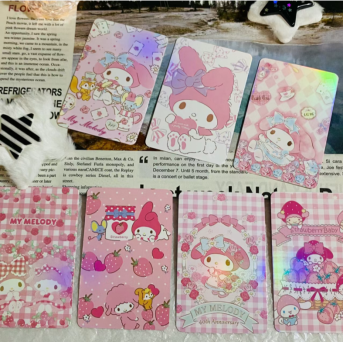
If the design uses third-party content—such as illustrations, images, or photographs—without authorization, it may constitute copyright infringement.
Unauthorized reproduction and sale may infringe upon reproduction rights, distribution rights, or information network dissemination rights.
If derivative works are created based on copyrighted material, adaptation rights may also be infringed.
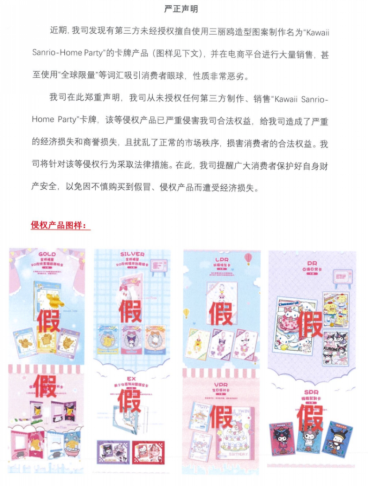
For instance, in 2023, the WeChat public account “HelloKittyFamily” issued a formal statement regarding copyright violations involving card products.
(2) Infringement of Card Names
If the card names use registered trademarks without authorization, it may infringe the exclusive rights to use registered trademarks.
If the merchant fails to indicate that the cards are “self-made” and uses well-known names that mislead consumers into believing the products are official, this may violate Article 6 of the Anti-Unfair Competition Law, constituting unfair competition.
Policy Review: Douyin’s Blind Box Regulation Updates
Douyin (TikTok China) has clearly prohibited blind box sales that involve non-blind-box factory products, second-hand packaging, recombination, or resold unboxed items, as outlined in its:
[Merchant – Prohibited Goods/Information Rules], and
Blind Box Commodity Management Specifications.
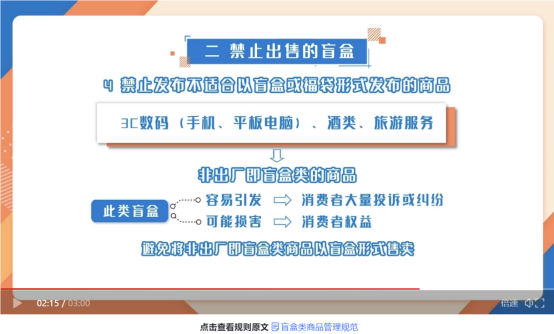
Per the Notice on Spring Festival Enforcement Campaign Against Illicit Blind Boxes and Blind Box Violations and Penalty Disclosures, Douyin specifically targets the following self-made blind box violations:
Ordinary products sold in blind box format.
Products repackaged, recombined, or restyled by merchants and still sold as blind boxes.
These updates show that Douyin’s current approach reiterates previously established restrictions without substantive changes.
Moreover, the term “self-made” as used by Douyin focuses primarily on repackaging and post-production rather than on the manufacturing process itself.
Douyin’s punishment for unauthorized use of third-party rights is governed by its [Merchant – Improper Use of Third-Party Rights] rulebook.
Policy Recommendation
From the perspective of regulatory frameworks and platform cost efficiency, platforms should prohibit the sale of self-made card-based blind boxes.
However, given that such behavior may not always pose significant harm, platforms should avoid absolute bans and instead adopt tiered disciplinary measures based on the severity of violations.
1. Clearly Define Violation Levels
Platforms should create a detailed classification of violations, considering factors such as:
Duration of the violation
Number of violations
Response time
Sales volume
Total revenue generated from the violating product
For example, assuming this is a first-time offense:
If the violation was short in duration, the revenue under RMB 1,000, and fewer than 100 units sold, and the merchant removes the product upon notice, this may be deemed a minor violation.
Conversely, violations that may constitute criminal offenses—such as copyright infringement—should be treated as extremely serious and judged according to standards for initiating criminal investigations (e.g., under IP crime statutes).
2. Implement Tiered Penalty System
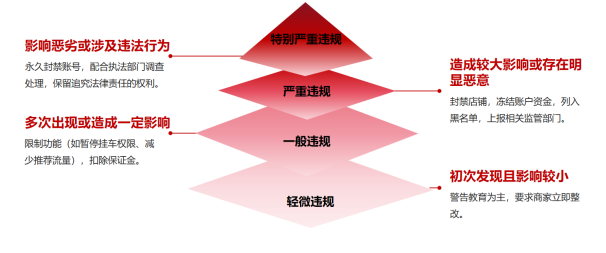
A structured disciplinary framework should be introduced, aligning penalties with the severity and impact of the violation.
Final Note
Live-streamed “card unpacking” has rapidly emerged as a popular sales method on online platforms, attracting wide participation.
Yet, this booming economy carries inherent legal and compliance risks, urging platforms to strengthen risk management and enforcement.
Previous articles have examined compliance from the perspective of platforms.
In subsequent writings, the author intends to explore the entire collectible card game (CCG) industry chain, analyzing legal risks and compliance obligations from the standpoint of different market actors, with the goal of supporting lawful and sustainable business development.