
On February 19, 2024, the Ministry of Culture, Sports and Tourism of South Korea (hereinafter referred to as “MCST”) issued an explanatory note regarding the disclosure of probability information for randomized in-game items.
Following the amendment to Article 33 of the Game Industry Promotion Act and Annex 3 of its Enforcement Decree, game companies are required to disclose information concerning random mechanics. In response, the MCST released detailed guidelines to help game developers adjust their loot box and probability-based mechanisms accordingly.
In this article, we summarize and comment on key points from the guidelines, including the classification of random item types, the categories of games subject to mandatory disclosure obligations, and specific in-game scenarios requiring compliance.
Under the Act, a random item is defined by three essential elements:
The game item (object of extraction);
Paid or unpaid consideration (direct or indirect);
The element of chance in the mechanic.
Only items acquired for completely free consideration—such as through in-game promotions, giveaways, or coupons—are exempt from disclosure obligations.
However, it should be noted that:
(1) If a game item can also be obtained through direct or indirect payment (e.g., if in-game currency can be purchased via real money), it does not qualify as a completely free item and is subject to probability disclosure.
(2) Items without any element of chance (e.g., simply accumulating play counts) do not meet the definition of a random item and are exempt from disclosure.
(3) Arcade games, and games developed for non-commercial purposes such as education, exhibitions, religious or charitable activities, are not within the scope of the regulation.
(4) SMEs with an average annual revenue under KRW 100 million, or companies that cannot calculate average revenue over the past 3 years due to new establishment or closure, are also exempt from the obligation.
To ensure compliance, the Game Industry Promotion Act prescribes penalties: If a company fails to disclose the probability of obtaining random items or discloses false information, the regulatory authority may issue a warning or correction order. Continued non-compliance may result in substantial administrative fines.
Although such enforcement may not directly impact overseas game companies without a local presence, the Korean regulator could pressure distribution channels, potentially leading to delisting of non-compliant titles.
Types of Random Items Requiring Probability Disclosure
The requirement is not limited to traditional gacha-style loot boxes. According to the guidelines, the types of probability-based mechanics include:
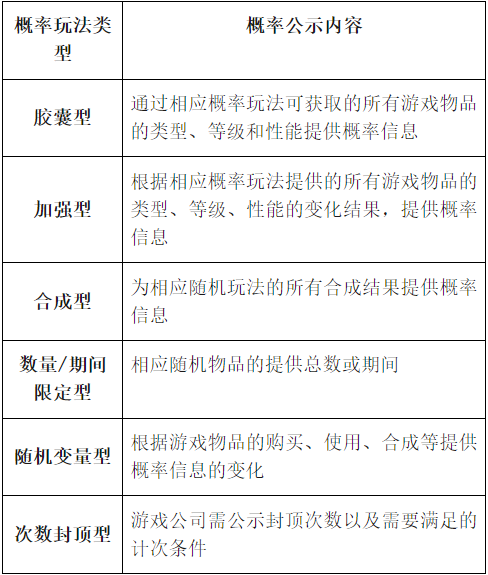
Examples of Required Probability Disclosure by Random Item Type
Each type of randomized item requires a distinct disclosure format. The guidelines specify:
① Capsule-Type (Gacha)
The following must be disclosed:
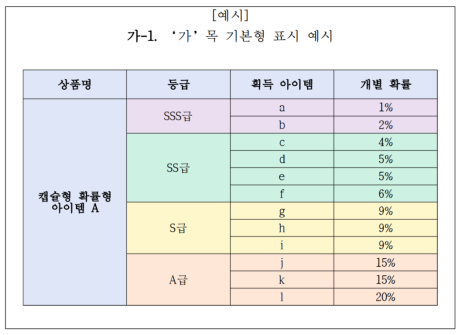
The types, grades, and performance of all items available through the random mechanic,
The probability of obtaining each item—even where item types and attributes vary.
Example:
If Treasure Chest A contains 12 items (a–l) of various rarities, the individual probability and grade for each item must be disclosed.
② Enhancement-Type
The following must be disclosed:
The probabilities for changes in type, grade, or performance of items, pets, or characters upon enhancement.
If the possible outcomes are altered or extended with added materials, the full list and probabilities for each variation must be disclosed.
If the enhancement applies to a randomly selected item, the probability of each item being selected must also be included.
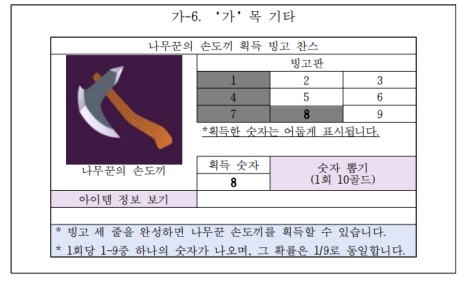
Example - Bingo Minigame Loot Disclosure:
The purple box displays the cost per draw (10 gold per number);
The blue section shows that each draw yields one number from 1 to 9 with equal chance (1/9). The axe item is awarded when the player completes three rows in the bingo grid (achieved by unlocking all numbers through paid draws).
③ Combination-Type
As per the Enforcement Decree and guidelines, when players combine multiple items to receive a new item with randomized outcomes in terms of type, grade, or performance, the probabilities for all possible combination resultsmust be disclosed.
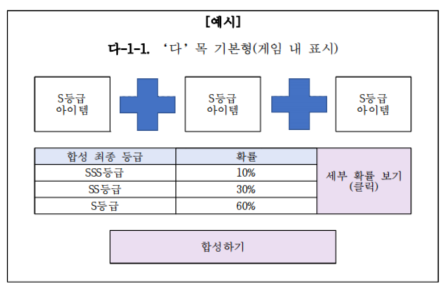
Example - Item Combination Disclosure Page:
Display the combination formula (e.g., S-grade item + S-grade item + S-grade item);
Show probability of results: SSS-grade 10%, SS-grade 30%, S-grade 60%.
④ Composite-Type (Conditional Probability Variants)
If the following factors impact probability or user purchasing decisions, additional disclosures are required:
Total quantity or time limits on the availability of the random items.
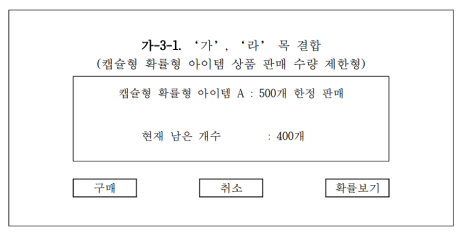
Example - Quantity Limit Scenario:
If only 500 units of item A are available through a random event, the remaining count must be displayed. Additionally, a popup window must disclose individual item probabilities.
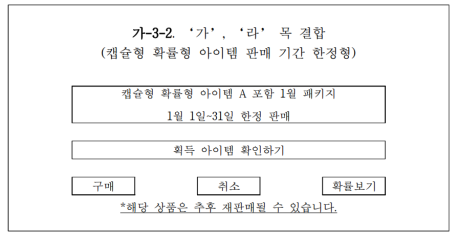
Example - Time Limit Scenario:
If a random item is only sold during a limited-time event, the start/end time must be clearly indicated, and detailed probability disclosures must be available through a popup window.
Format Requirements for Probability Disclosure
① Format of Display
Probability must be disclosed in percentages (rounded or to four decimal places or more).
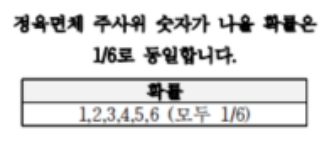
Where percentages cannot reasonably be used, fractions, text, or mathematical functions understandable by users are permitted.
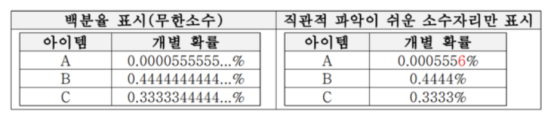
Examples:
Decimal-based: “0.5% chance to obtain item X”
Fraction-based or textual: “Each dice face has a 1/6 chance of appearing”
② Design Requirements Across Platforms
1. In-Game Disclosure:
Probability information must be directly shown on the purchase, query, or usage screen of the random item.
“Purchase screen” refers to all screens from the moment the user initiates a purchase action until completion.
Thus, probability info must be visible on the screen each time a random mechanic is used.
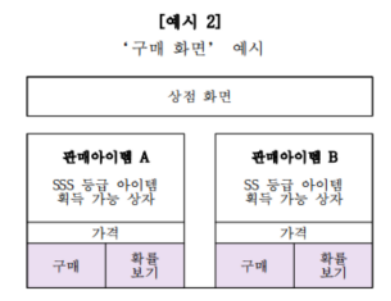
Example: In-game shop interface must display the name of the random item, its price, and its corresponding probability information.
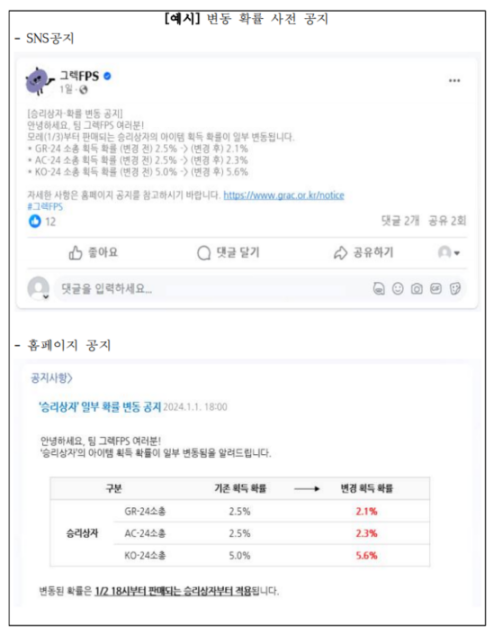
2. Notification of Changes:
If probability information is revised, the new content and implementation date must be publicly disclosed in advancevia the game’s official website and in-game UI.
3. Advertising and Promotional Materials:
Ads and promotional content must indicate the presence of random items in the game.
Importantly:
If materials are not directed at Korean users, this requirement does not apply.
However, if materials contain Korean language, they are presumed to target Korean consumers and the disclosure obligation applies.
Although the format may be waived in cases where the ad’s size or format makes it impractical, the general rule is that ads should state that the game includes randomized mechanics.
Implications for Overseas Game Developers Targeting Korea
This new disclosure framework covers not only in-game content, but also official websites and marketing assets. Although enforcement may begin with a grace period, regulatory actions for violations—particularly false disclosure—will continue.
As of publication, a complaint has already been filed against Gravity, the publisher of Ragnarok Online, with the Korea Fair Trade Commission over inconsistencies in their published probabilities. This may become the first test case under the new probability disclosure regime.