
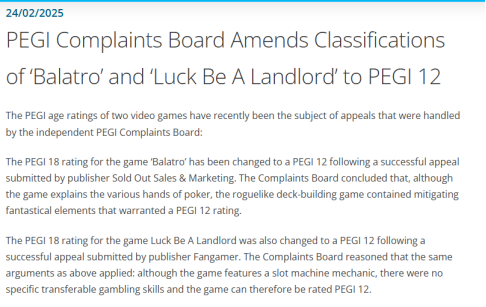
In February 2025, PEGI issued an announcement stating that the fantasy elements in Balatro, a card-based roguelike game, reduced its gambling content. Consequently, the game's age rating was revised to 12+.
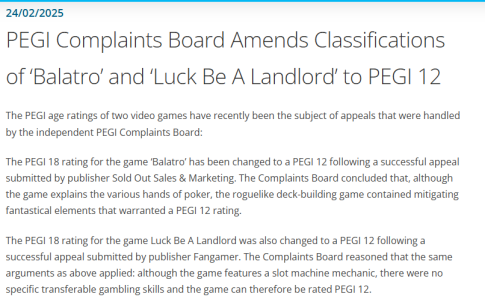
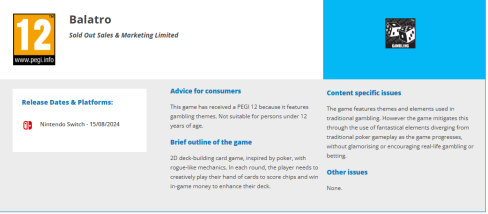
Currently, the publicly displayed age rating for Balatro has also been adjusted to 12+.
 PART 1
Balatro's Age Rating Faces Unexpected Setbacks
Balatro (commonly known as the Joker Card game) has experienced a series of unexpected twists in 2024. Within 72 hours of its release, the game surpassed 250,000 copies sold across all platforms. It continues to receive overwhelmingly positive reviews on Steam and has garnered multiple awards in the gaming industry.
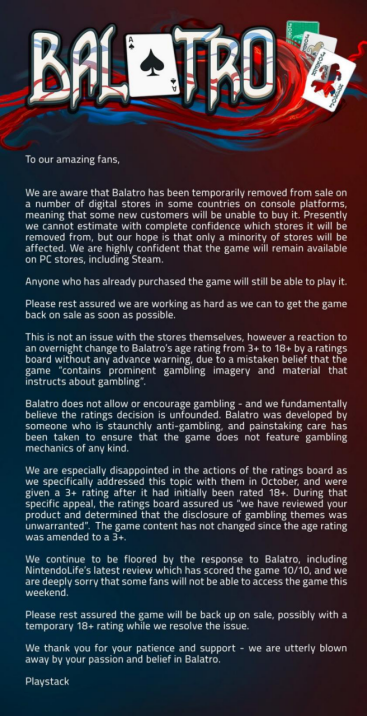
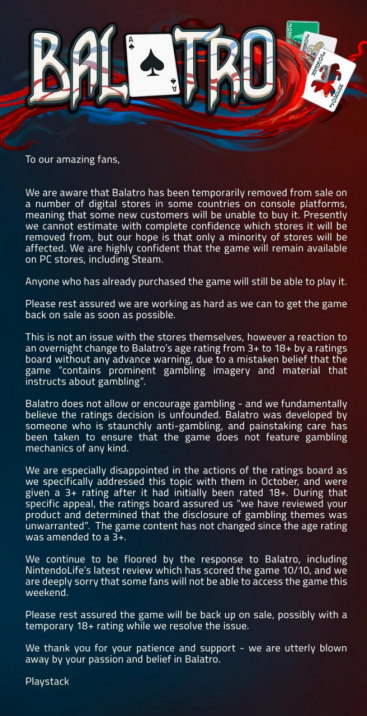
However, shortly after its release, the game was abruptly pulled from console stores in regions including Europe, North America, and Japan. According to publisher Playstack, this removal stemmed from regulators deeming the game to involve gambling. Rating authorities abruptly changed its age rating from 3+ to 18+ without prior warning.
A closer look at Playstack's announcement reveals that Joker Cards was initially rated 18+ during its submission for review. Following Playstack's appeal, the rating committee stated that classifying the game as gambling-related was unfounded and ultimately set the rating at 3+.
Just when Playstack thought they could breathe easy, another blow struck: the rating agency once again changed the rating to 18+. The rating agency's back-and-forth changes on this game's classification are truly baffling.
 PART 2
The “Awkwardness” of Gambling Elements in Rating Systems
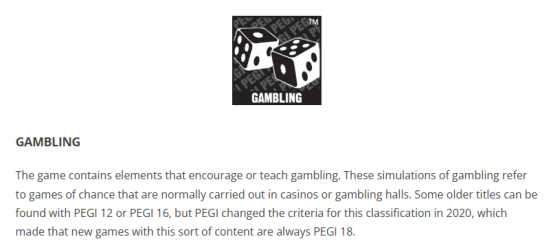
PEGI's recent revision also represents a reassessment of its existing rating criteria. According to PEGI's official standards, content such as violence, profanity, fear, gambling, sexuality, drugs, and discrimination all influence a game's rating. Regarding gambling-related content, PEGI evaluates games that encourage or teach gambling activities (simulated gambling refers to games typically played in casinos or gambling halls). Since 2020, any game containing such content is uniformly rated PEGI 18. Prior to this, such games might have received a PEGI 12 or PEGI 16 rating.
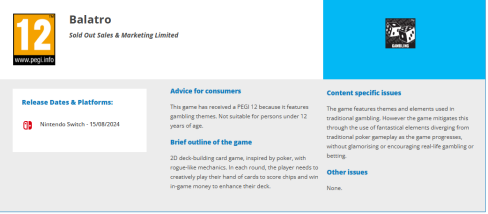
 Notably, while PEGI rated Joker Cards as 12+, its rating statement explicitly states: “This game is rated PEGI 12 due to gambling themes.”
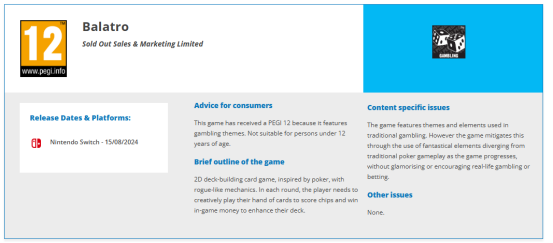 Regardless of whether Joker Cards truly contains gambling elements, the rating body's justification for this classification likely fails to align with existing rating standards. After all, current guidelines mandate a PEGI 18 rating for any game incorporating gambling elements. It's unclear whether PEGI opted for a compromise rating under pressure from multiple appeals by Playstack and public scrutiny. In its “Specific Content” commentary, PEGI justified the rating by stating: “The game employs traditional gambling themes and elements. However, as gameplay progresses, it mitigates this by incorporating fantasy elements distinct from conventional poker mechanics, without glorifying or encouraging real-life gambling or betting.” "PEGI sought to rationalize the game's new rating while simultaneously highlighting its gambling-related content.
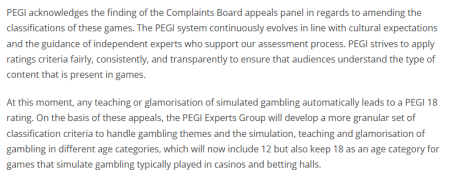
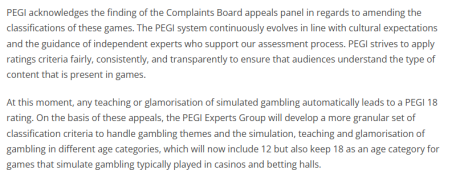
 Of course, PEGI acknowledged in its announcement the existing issues with rating gambling elements under current standards. It also proposed developing a more detailed classification system to address gambling themes, simulations, instruction, and glorification of gambling across different age groups.
 PART 3
Even if it merely borrows the shell of gambling mechanics, it will affect the game's rating.
Although Joker Card's rating has fluctuated, the one constant is PEGI's classification of its gambling elements. On the surface, Joker Cards appears to blend Texas Hold'em poker with tower-climbing roguelike mechanics. However, at its core, it merely borrows the shell of Texas Hold'em while retaining roguelike DBG gameplay as its fundamental mechanics. Despite this, the rating committee prioritized evaluating its gambling elements during assessment, which remain a significant factor influencing Joker Cards' classification.
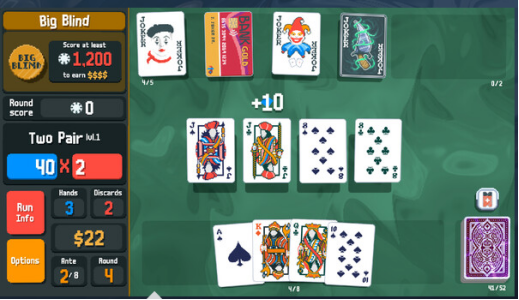 This rating revision also reveals PEGI's stance: any game incorporating gambling elements or mechanics may be deemed to contain gambling factors. In other words, based on the game's external presentation, the mere presence of gambling elements—even if merely borrowing the shell of a gambling mechanic—will fall under the “gambling” category in ratings. However, future ratings may not necessarily all fall under PEGI 18.
Beyond PEGI, similar practices exist in other countries and regions. Previously, a limited-time guessing game event in a certain title was flagged by South Korea's GRAC for containing gambling elements, leading to a rating correction. This occurred even though user participation required completing tasks to earn access, and rewards consisted solely of virtual goods with no monetary value. This illustrates that even limited-time events with uncertain probability factors can attract regulatory scrutiny and trigger changes to a game's overall rating.
In certain jurisdictions, gambling elements directly impact game classification. For instance, the ESRB in the United States assigns games featuring simulated gambling mechanics a minimum rating of T (Teen), while conventional simulated gambling games are typically rated T. In Taiwan's rating standards, gambling mechanics primarily appear in ratings of 12+ and above. The key distinction lies in whether such mechanics involve the gain or loss of in-game currency. Therefore, game companies must exercise extreme caution when implementing gambling mechanics. Even the slightest misstep could result in an element being labeled as “gambling,” leading to an inappropriate rating classification.
 目前,小丑牌游戏对外显示的游戏年龄分级也已调整为12+。
 PART 1
 然而,小丑牌发行没多久后,却突然在欧洲、北美和日本等地区的主机游戏商品被下架。根据游戏运营商Playstack的说法,此次下架主要是因为监管机构认为小丑牌游戏涉及赌博,评级机构在没有提前警告的前提下,将小丑牌游戏的评级从3+变成了18+。
 PART 2
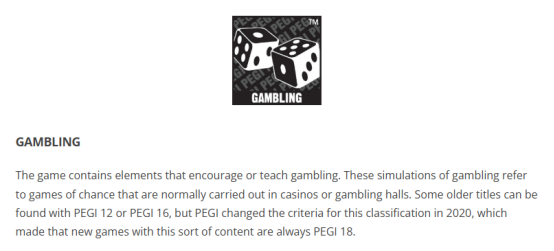 而特别微妙的是,虽然PEGI评级机构将小丑牌游戏评为12+,但在评级信息中却又再一次提出“这款游戏因涉及赌博主题而被评为PEGI 12”。
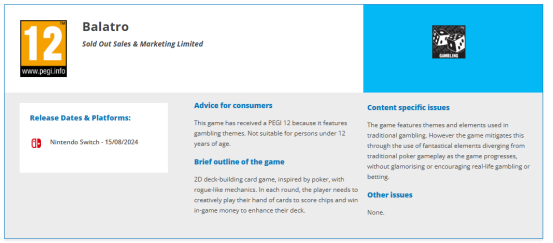 且不论小丑牌游戏是否真的包含赌博内容,评级机构对于评级的理由也恐怕难以符合现有分级标准。毕竟按照现有分级标准,只要包含赌博元素的一律评为PEGI 18。难说PEGI在playstack多次申诉和舆论关注下,选择了相对折中的评级,毕竟在“具体内容”评述时,PEGI给出了这样的理由,“游戏采用了传统赌博的主题和元素。 不过,随着游戏的进行,游戏通过使用与传统扑克玩法不同的奇幻元素来缓解这种情况,而不会美化或鼓励现实生活中的赌博或下注。”PEGI以期将该游戏的新评级相对合理化,但却又突出强调了游戏中包含的涉赌元素。
 当然,PEGI在公告中也知晓现有评级标准下涉赌因素评级存在的问题,也提出后续将制定一套更细化的分级标准,以处理不同年龄段的赌博主题以及模拟、教授和美化赌博的游戏。
 PART 3
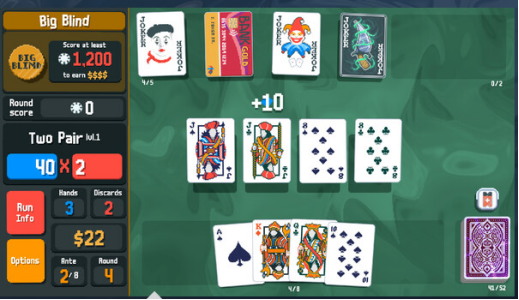 此次评级修正也透露出了PEGI的态度,游戏中只要借鉴了赌博元素或赌博玩法,都可能会被认定为具有赌博因素。也就是说,从游戏的外在表现来看,只要存在赌博元素,哪怕只是借用了某个赌博玩法的壳,都会落入评级中的“赌博”因素,只是未来评级可能未必全落入PEGI 18。