In today's thriving gaming culture, guzi (game merchandise) has become a vital vessel for players' emotional attachment. Many creative enthusiasts craft their own character badges, postcards, and other merchandise—selling them at fan conventions or sharing them on social media. Yet behind this passion fueled by love lies a significant legal risk: unauthorized commercial production and sales may violate copyright and trademark rights, potentially constituting unfair competition.
Yet in practice, a subtle tacit understanding has emerged between game developers and players: most developers tolerate small-scale, self-produced sales for profit. This stems from the tension between official production capacity and player demand, as well as the balancing act between fan economy ecosystems and commercial interests. How should we interpret this discrepancy? This article explores how to strike a balance between creative passion and legal boundaries through three dimensions: analyzing legal risks, examining industry ecosystems, and offering compliance practice recommendations.
PART 1
Does creating and selling custom game merchandise constitute infringement?
From a purely theoretical risk perspective, unauthorized commercial production and sale of custom game merchandise certainly carries the following legal risks:
1. Copyright Infringement Risk
Core elements such as game character designs and scene layouts typically meet the originality requirements of copyright law. Unauthorized reproduction of character images on merchandise like pins or trading cards may infringe upon distribution rights for game characters.
Even stylized adaptations (e.g., chibi versions) could still constitute substantial similarity and be deemed infringing if key identifying features—such as signature clothing, hairstyles, or facial traits—remain recognizable as the original character.
 2. Trademark Infringement Risks
Using official game trademarks in self-made merchandise—such as the game's official logo, marks similar to official trademarks, or the game title—may mislead consumers into believing an association with the official entity, potentially constituting trademark infringement.
3. Unfair Competition Risks
From an unfair competition perspective, the market saturation of player-made merchandise not only encroaches on the market share of officially licensed products but may also tarnish the game IP's reputation due to OOC (Out Of Character) content or poor quality. This risks damaging the brand value meticulously built by the developer over the long term.
PART 2
The Unspoken Understanding Between Developers and Players in Reality
However, in reality, game developers (especially indie and second-tier developers) rarely make a big deal out of or aggressively enforce rights against players who create and sell unofficial merchandise. Delving into the reasons behind this phenomenon can be analyzed from multiple perspectives:
1. Official Merchandise Fails to Meet Player Demand
Official merchandise is often constrained by industrial production processes and brand consistency, leading to issues like limited designs, insufficient production capacity, high prices, and slow updates. This fails to meet players' immediate demand for diverse, personalized items.
Player-made goods, however, can swiftly respond to popular characters and plot points, offering creative designs like chibi versions or couple pairings. This fills the gap left by official releases in niche markets.
2. Balancing Fan Enthusiasm and Reputation Risks
Players of niche and indie games exhibit exceptionally high loyalty to developers and a strong sense of community belonging, serving as vital forces for sustaining game popularity and long-term operations. These games' revenue models heavily rely on players' emotional investment—such as character cultivation and story consumption. Fan-made merchandise, as a key carrier of fan culture, strengthens users' emotional connection to the IP.
Should developers rashly sue players, it could trigger collective resentment and boycotts, potentially escalating into public relations crises.
3. Balancing Litigation Costs
Determining whether player-created sales constitute infringement isn't always straightforward. In some cases, players substantially reinterpret or innovatively fuse game elements, creating works that share connections yet differ significantly from the original. Such scenarios complicate infringement assessments.
If evidence collection proves insufficient during litigation or legal interpretations become contentious, resulting in a lost case, it could instead provoke even more negative public sentiment.
Conversely, most player-created sales activities are small-scale, with monthly revenues typically ranging from a few thousand to tens of thousands of yuan. and many are likely non-profit ventures. Even if a lawsuit is won, the compensation often pales in comparison to the litigation costs incurred (including legal fees, notarization fees, and time investment), making it a drop in the bucket. This reality leads companies to carefully weigh the pros and cons before pursuing legal action, considering factors such as the severity of the fan-made sales activity, whether it genuinely impacts the company's reputation, or causes other serious consequences.
4. Prioritizing Long-Term Benefits and Ecosystem Collaboration
Game developers should focus their primary efforts on core business areas such as continuous game optimization, new content development, and operational maintenance—stimulating in-game player spending (e.g., character gacha draws, skin purchases). In contrast, expending substantial resources to combat player-generated content sales appears counterproductive.
The company fully recognizes the positive role player-generated content plays in spreading awareness of the game. It maintains a tolerant stance toward non-commercial fan art, fan fiction, and other derivative works created by players. The organic dissemination of such content on social media serves as free advertising for the game, generating significant word-of-mouth marketing effects—particularly influential among younger user demographics.
Forward-thinking developers are now embracing “player co-creation” models—where creative players may collaborate on officially endorsed merchandise or contribute ideas for game expansions.
For instance, Idolmaster held a fan art contest that secured copyright while offering winners cash prizes and even employment opportunities, achieving a win-win for player creativity and commercial value. If developers resort to heavy-handed tactics that alienate players, they risk squandering potential collaborative opportunities.
5. The Gray Area of Industry Norms
Within the ACG sphere, non-profit fan works enjoy de facto exemption as an established industry practice. Some games explicitly permit the circulation of non-commercial or small-scale personal fan creations through guidelines like “Fan Creation Policy” documents, while prohibiting large-scale commercial sales. This flexible regulatory approach maintains essential boundaries while preserving ample space for fan culture to flourish.
PART 3
Advice for Players Interested in Creating and Selling Fan-Made Game Content
For players eager to create and sell fan-made game content, here are some recommendations:
1. Strengthen Copyright Awareness and Pursue Legitimate Authorization
Prioritize copyright issues. Players should actively follow official guidelines like the “Fan Creation Agreement” released by game developers to understand the latest official policies on fan works. This is the safest approach, as it fundamentally involves obtaining permission from the rights holders.
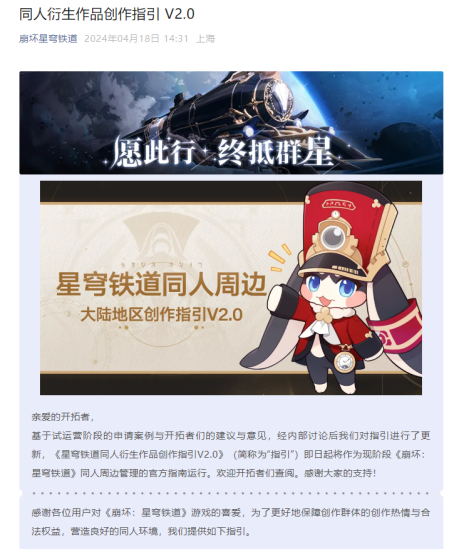 The following excerpt is taken from the “Star Rail Fan Creation Guidelines V2.0.” For specific rules, please refer to the original text:
"(1) Scope of Direct Usage Without Authorization
1. Non-commercial fan merchandise: Refers to original, self-produced merchandise created by individuals or non-commercial teams for non-commercial purposes (e.g., fan exchange), except where otherwise specified in this guideline.
2. Small-scale profit-making fan merchandise: Refers to creations by individual users or teams involving limited physical production, sold through online personal shops or offline conventions, with fewer than 300 units per category (excluding the exact number).
The above two categories of fan merchandise creation fall within the scope of direct creation and distribution without requiring official authorization." (Supplementary Note: Profit-driven bulk production and sales of fan merchandise under the name of companies, studios, or other legal entities—whether online or offline—are strictly prohibited. Examples include: opening Taobao stores under studio/company names; establishing sales points at comic conventions or similar offline venues; or engaging in bulk production of unauthorized merchandise for profit. Such activities will be subject to official enforcement.)
Some developers periodically host fan events, providing authorized creators with official exhibition channels and even integrating them into the official merchandise ecosystem. Participating in the game ecosystem through lawful and compliant means allows creators to unleash their creativity while fostering positive interactions with developers, thereby promoting the healthy development of the fan economy.
2. Non-Profit Priority
If explicit authorization or guidance cannot be obtained, strictly limiting activities to personal non-profit use (self-made for personal use) is more likely to fall within the fair use category of “personal study, research, or appreciation.”
3. Respect IP and Ensure Quality
Prioritize product quality; do not produce shoddy goods solely for profit. While respecting the original work, incorporate personal style or cultural elements—such as designs blending characters with regional culture.
This upholds ethical and community standards, minimizes damage to rights holders' goodwill, and reduces the likelihood of legal action.
4. Honest Labeling and Promotion
When promoting fan-made products, avoid misleading consumers into believing they are official merchandise. Key considerations include:
Clearly labeling the fan-made nature in prominent locations such as product titles and description pages, explicitly stating “fan-made,” “non-official merchandise,” and avoiding sensitive terms like ‘authentic’ or “official collaboration.”
Refrain from using official game logos or names as primary product images or promotional slogans.
Prioritize distribution channels explicitly supportive of fan creation, such as fan conventions.
 2.商标权侵权风险
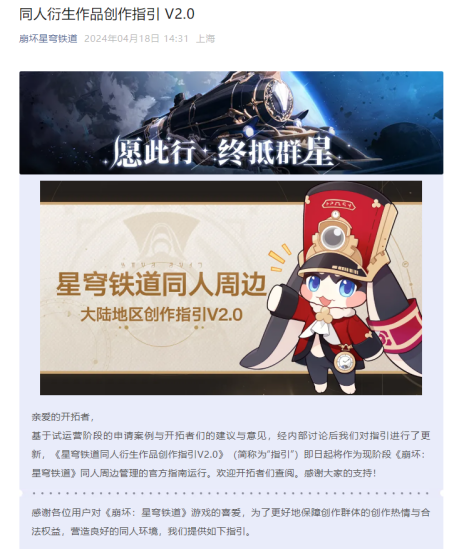 以下片段引自《星穹铁道同人衍生作品创作指引V2.0》,具体规则请查阅原文: