
BlockchainGamesEpicGamesStoreGameRatings

Positive Signal for Blockchain Games: Epic Allows Blockchain Titles on Its Store

链游利好 Epic开放上架链游

March 11, 2026
21 views

Summary

Epic Games Store has historically prohibited games rated “Adults Only” (AO) by the Entertainment Software Rating Board (ESRB) from being distributed on its platform. AO ratings typically apply to games containing explicit sexual content or extreme violence. However, on the 20th of this month, Epic updated its content review policies, introducing a limited exception for blockchain-based games that receive an AO rating solely due to their use of blockchain or NFT technologies. According to Epic, the policy change does not relax restrictions on prohibited content such as pornography, gambling, or hate speech. Instead, it recognizes that some blockchain games receive AO ratings due to their token-based mechanics rather than explicit content. Following the policy revision, previously removed titles such as Gods Unchained and Striker Manager 3 have returned to the Epic Games Store. Despite this development, blockchain game developers must still comply with financial regulations, maintain independent crypto payment systems, and observe regional restrictions, including distribution bans in China and South Korea.

The Epic Games Store typically prohibits games that receive an “Adults Only” (AO) rating from the Entertainment Software Rating Board (ESRB) from being distributed on its platform. This classification generally applies to games that contain excessive nudity or extreme violence, meaning that titles rated AO are normally unable to be published on the Epic Games Store.

However, on the 20th of this month, Epic updated its review policies. While most AO-rated games remain prohibited from being released on the Epic Games Store, the company has created an exception for blockchain-based games that receive an AO rating due solely to their use of blockchain technology. This policy adjustment represents positive news for blockchain game developers.
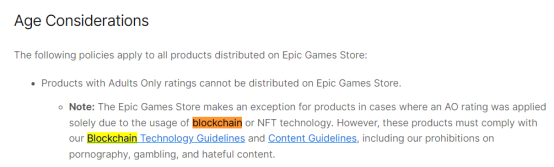
Epic Games spokesperson Brian Sharon stated in a public statement:

“Some blockchain-based games have received an Adults Only (AO) rating from industry rating bodies due to the unique implementation of blockchain technologies. We have updated the Epic Games Store content policy to allow games rated AO solely because of their use of blockchain or NFT technologies. Our policies prohibiting pornography, gambling, and hateful content remain unchanged.”

Blockchain games permitted under this policy must still comply with the platform’s general content review requirements.

Titles such as Gods Unchained and Striker Manager 3, which were previously removed from the Epic Games Store due to AO or higher ratings, have now been reinstated and are once again available for download and purchase following the policy change.

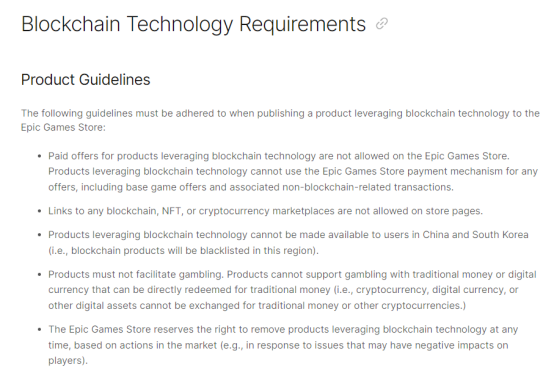
In addition to the content review requirements imposed through the ESRB rating system, Epic Games maintains additional restrictions specific to blockchain games. These requirements may be further updated after Epic gathers more information about how developers intend to integrate blockchain technology into their games.

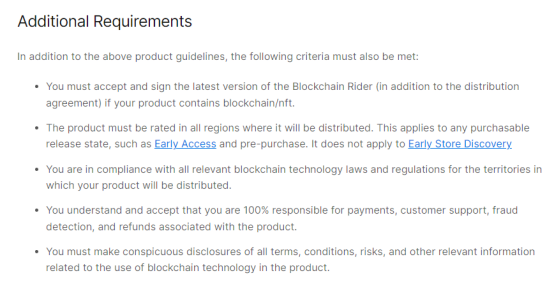
Developers and blockchain game publishers must also comply with applicable financial regulations and clearly explain to users how blockchain technology is utilized within the game.

Furthermore, blockchain games are not permitted to use Epic’s proprietary payment services to process cryptocurrency transactions. Instead, such games must implement their own independent payment systems.

Additionally, due to mandatory legal requirements in certain jurisdictions, games utilizing blockchain technology cannot be made available to users in China or South Korea.
Although this policy update represents a positive development for the blockchain gaming industry, it does not necessarily mean that blockchain developers will flood into the Epic Games Store in the short term.

Currently, the self-publishing program for blockchain games remains in a closed beta stage, and new blockchain game submissions will still be subject to case-by-case review and approval.

分享文章

相关文章

General

Game Licensing (ISBN Approval): Can Cultural Enforcement Be Exercised Across Regions?

游戏版号,文化执法也能异地?

This article analyzes the legality and rationality of cross-regional administrative enforcement in game licensing cases in China. It argues that, under the current legal framework, enforcement should follow the principle of territorial jurisdiction, as the place of illegal conduct is typically tied to the location of the game company. Cross-regional enforcement may lead to jurisdictional conflicts, increased compliance burdens, and risks of profit-driven enforcement, thereby undermining the business environment and procedural fairness.

5 views
General

Twitch bans streamers from “promoting or sponsoring” CS:GO skin gambling

Twitch禁止主播“推广或赞助”CSGO皮肤赌博

Twitch has updated its community guidelines to further restrict gambling-related content, explicitly banning the promotion and sponsorship of skin gambling websites, particularly those مرتبط with Counter-Strike: Global Offensive. Since 2022, Twitch has prohibited the promotion of gambling sites that are not licensed in jurisdictions with consumer protections, naming platforms such as Stake, Rollbit, and Roobet. The latest update expands these restrictions to include CS:GO skin gambling sites and their free social versions, while also banning links, promo codes, and visual displays of such content. Twitch stated that the move responds to renewed interest in CS:GO skin gambling.

3 views
General

U.S. Market Expansion: New Age Verification Method Under COPPA

美国出海:COPPA下新的年龄验证方法

To facilitate compliance with the Children’s Online Privacy Protection Act (COPPA), the Entertainment Software Rating Board (ESRB), together with other U.S. institutions, has proposed a new mechanism for obtaining verifiable parental consent (VPC). The proposal relies on privacy-protective facial age estimation technology, developed with technical support from Yoti and SuperAwesome. The U.S. Federal Trade Commission (FTC) is currently soliciting public comments on whether this method falls within existing COPPA-approved verification methods, whether it satisfies the statutory requirements for parental consent, and whether it introduces privacy risks, including those related to biometric information. The proposal signals a potentially significant development in age verification compliance for online platforms and gaming services operating in the United States.

4 views