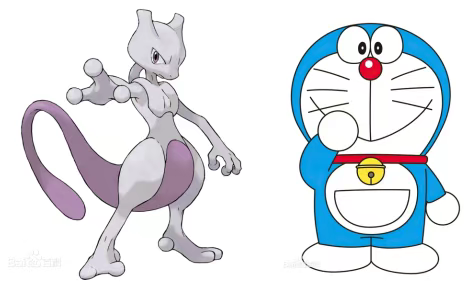
In the game and animation industries, it is extremely common to create animal characters through artistic adaptation based on real-life biological features. For example, Gnar in League of Legends (inspired by dinosaurs), Chocobo in Final Fantasy (inspired by ostriches), Doraemon in Doraemon (inspired by cats), and Mewtwo in Pokémon (also inspired by cats) are all classic characters that originate from real animals and are transformed through secondary creation.
Despite sharing the same real-world prototypes, animal characters in different works often display highly distinctive individualized features due to differences in modeling, color schemes, facial expressions, and other design elements. For instance, although both Doraemon and Mewtwo are derived from cats, they differ significantly in their visual artistic representations.
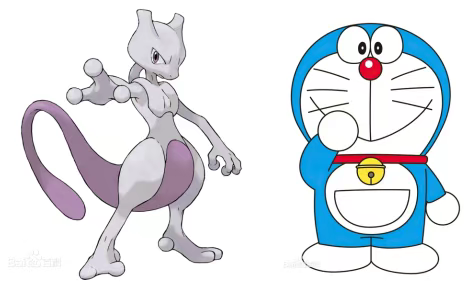
Accordingly, when different works create characters based on the same animal prototype, the key legal issue in distinguishing “reference” from “infringement” lies in whether the original expressive elements of the artistic design have been substantially copied. Drawing on the dispute between Party Animals and Party Animals Simulator, adjudicated by the Chaoyang District People’s Court of Beijing and the Beijing Intellectual Property Court, this article analyzes judicial reasoning rules and offers practical guidance.
Procedural History
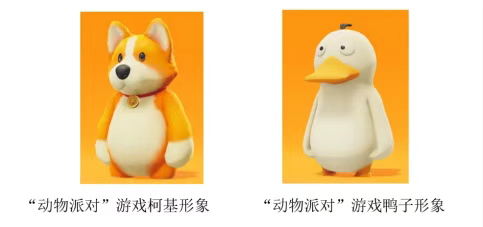
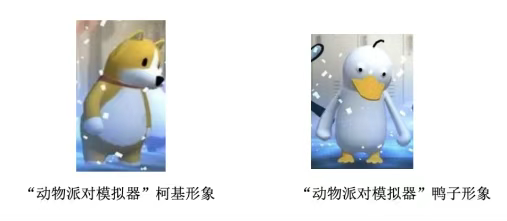
Beijing Suosi Information Technology Co., Ltd. (hereinafter “Suosi”) is the designer and operator of the game Party Animals, while Beijing Mechanical Mouse Technology Co., Ltd. (hereinafter “Mechanical Mouse”) operates the game Party Animals Simulator. Suosi discovered that four artistic works in Party Animals Simulator—namely the martial arts arena map, the character selection interface, and the corgi and duck character designs—were similar to the corresponding artistic works in Party Animals. Consequently, Suosi filed a lawsuit against Mechanical Mouse before the Chaoyang District People’s Court of Beijing.
The court of first instance ordered Mechanical Mouse to cease infringement, stop using “Party Animals” in the game title, and compensate Suosi RMB 150,000 for economic losses and RMB 36,570 for reasonable expenses incurred in safeguarding rights. Dissatisfied with the first-instance judgment, Mechanical Mouse appealed to the Beijing Intellectual Property Court. The appellate court held that the facts were clearly established and the law correctly applied, dismissed the appeal, and upheld the original judgment.
Court Opinions
I. First-Instance Court Opinion
The Chaoyang District People’s Court of Beijing held that determining whether infringement exists between two artistic works requires examination of both “access” and “substantial similarity.” Although Mechanical Mouse had the possibility of accessing the involved game, the determination of infringement still depended on whether substantial similarity existed.
Even if Mechanical Mouse had accessed the game and imitated its artistic works, no infringement would be found if the specific expressions of the artistic works were not identical or substantially similar. Conversely, if the specific expressions were identical or substantially similar, infringement would be established. Regarding the determination of “substantial similarity,” the court provided a clear analytical framework:
Separation and Filtration:
(1) Elements constituting ideas, materials in the public domain, and other objects not protected by copyright shall be separated and filtered out.
(2) The expression of artistic works lies in the specific application of artistic elements such as lines and colors that form visual modeling. Themes, styles, creative ideas, and material selection belong to the realm of ideas and are not protected by copyright.Comparison of Original Expression:
The remaining creative expressions protected by copyright shall be compared with the alleged infringing object.
With respect to the corgi and duck character designs, the court conducted the following comparison:
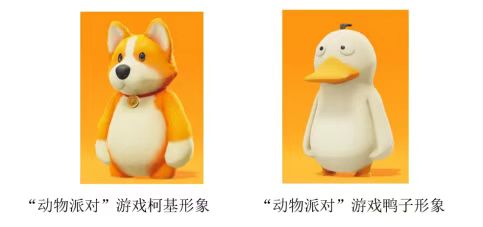
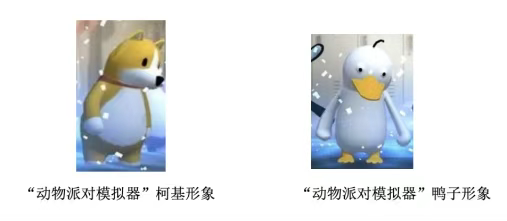
After excluding ideas (overall modeling style and general impression), public-domain elements (real-life corgi dogs and ducks), and common designs (upright walking posture, absence of line outlines, gradient color boundaries, and multiple color options), the court compared the remaining original expressions and found that the corgi and duck characters constituted substantial similarity.
(1) Original Expression of the Corgi Character:
The character wears a red collar around its neck with a metallic circular tag attached; has a cylindrical torso with a slightly protruding abdomen; cylindrical arms that are narrow at the top and wide at the bottom on both sides of the torso; hands that are thicker than the arms; short legs with no foot design.
(2) Original Expression of the Duck Character:
A spherical head nearly equal in width to the torso; a flat and elongated duck bill, wider at the base where it connects to the face and narrower at the tip; a cylindrical torso with a slightly protruding abdomen; slender strip-shaped arms that are narrow at the top and wide at the bottom; hands thicker than the arms, curled inward, with no finger design; extremely short legs.
II. Second-Instance Court Opinion
The Beijing Intellectual Property Court further clarified that, for cartoon artistic characters, originality is embodied in the overall visual modeling formed by elements such as lines and colors. Even changes to local features may alter the overall modeling and thus introduce originality.
Accordingly, when comparing cartoon characters for substantial similarity, the following approach may be adopted:
Overall Observation Principle:
The comparison should focus on the overall image rather than dissecting individual constituent elements for isolated comparison.Priority of Core Elements:
Distinctive components that differ from the public domain and embody the author’s original contribution are more identifiable and make a greater contribution to the overall originality. In determining substantial similarity, emphasis should be placed on whether the allegedly infringing work uses the author’s original artistic processing elements, while adhering to overall observation.
Practical Recommendations
Copyright protection for game art fundamentally concerns the delineation between individualized expression and public-domain materials. Creators should strengthen both originality in design and awareness of rights consolidation, while establishing compliant creation processes to avoid copying combinations of detailed elements from others’ works. From both enforcement and prevention perspectives, the following recommendations are offered:
(I) Strategies for Rights Protection
Establish Creation Archives:
Retain design sketches, storyboards, and other records of the creative process.Fixation of Characteristic Elements:
Systematically identify iconic character features (such as proportions, decorative elements, and color schemes) during the creation stage.Copyright Construction:
Complete copyright registration for core artistic character designs.
(II) Risk Prevention in Compliant Creation
Differentiated Creation Pathways:
Avoid copying combinations of original details. When referencing animal prototypes, avoid directly using characteristic element combinations from protected works (such as fixed combinations of expressions, actions, and color schemes). Differentiation may be achieved by adjusting body proportions or simplifying decorative details.Creation Traceability Mechanisms:
Retain drafts of character designs and source materials of inspiration (such as photos of real animals or artistic style references) to demonstrate independent creation.Fair Use Defense:
Where referencing public-domain elements is necessary, ensure that such references are limited to generic features (such as a corgi’s short legs) and that the overall visual effect is significantly different.Improved Licensing Management:
Standardize authorization procedures for third-party materials.
In summary, while respecting creative freedom in the public domain, game creation should strengthen judicial protection for individualized expression.