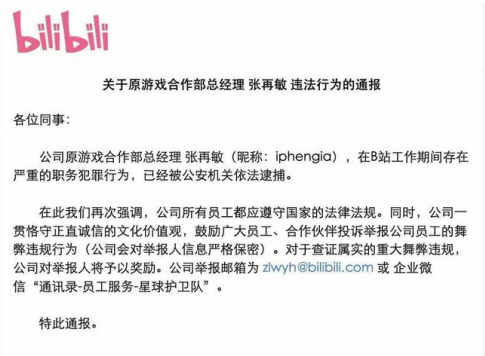
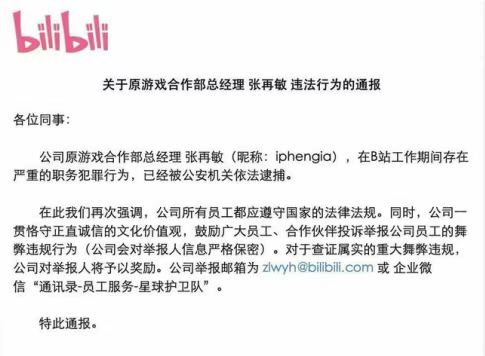
On July 2, 2025, Bilibili sent an internal email to all full-time employees, notifying them of the illegal conduct of Zhang Zaimin, former General Manager of the Game Cooperation Department. The notice stated that during his tenure at Bilibili, Zhang engaged in serious duty-related criminal conduct, and that he has been lawfully arrested by public security authorities.
 On the previous day, July 1, 2025, Perfect World also issued an internal announcement regarding an anti-corruption investigation, stating that multiple individuals had seriously violated company policies and labor contract provisions during their employment, and that certain employees and heads of supplier entities were suspected of criminal offenses. The company has since reported the matter to public security authorities.
Corruption and fraud within game companies have proven difficult to eradicate at the root. Notably, the publishing, user acquisition (UA), and art departments have become high-incidence areas for duty-related crimes. Based on publicly available cases and industry practice, this article categorizes high-risk scenarios by department, outlines specific methods for clue identification, and summarizes key investigative pathways.
Art Department: A High-Risk Area for Outsourcing Corruption
(I) Common Fraud Schemes
Kickbacks in Outsourcing:
Accepting bribes from suppliers in exchange for prioritizing the allocation of high-budget projects.Inflated Labor Costs:
Falsely reporting outsourcing personnel work hours or unit prices, with the price difference shared with suppliers.Related-Party Transactions:
Establishing outsourcing companies under the names of relatives or close associates to undertake company business at inflated prices.
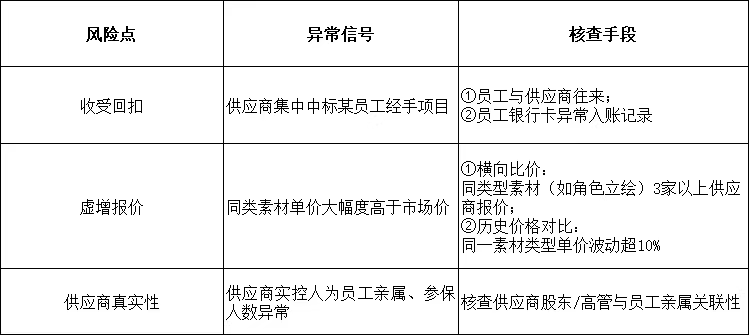
(II) Methods for Clue Identification
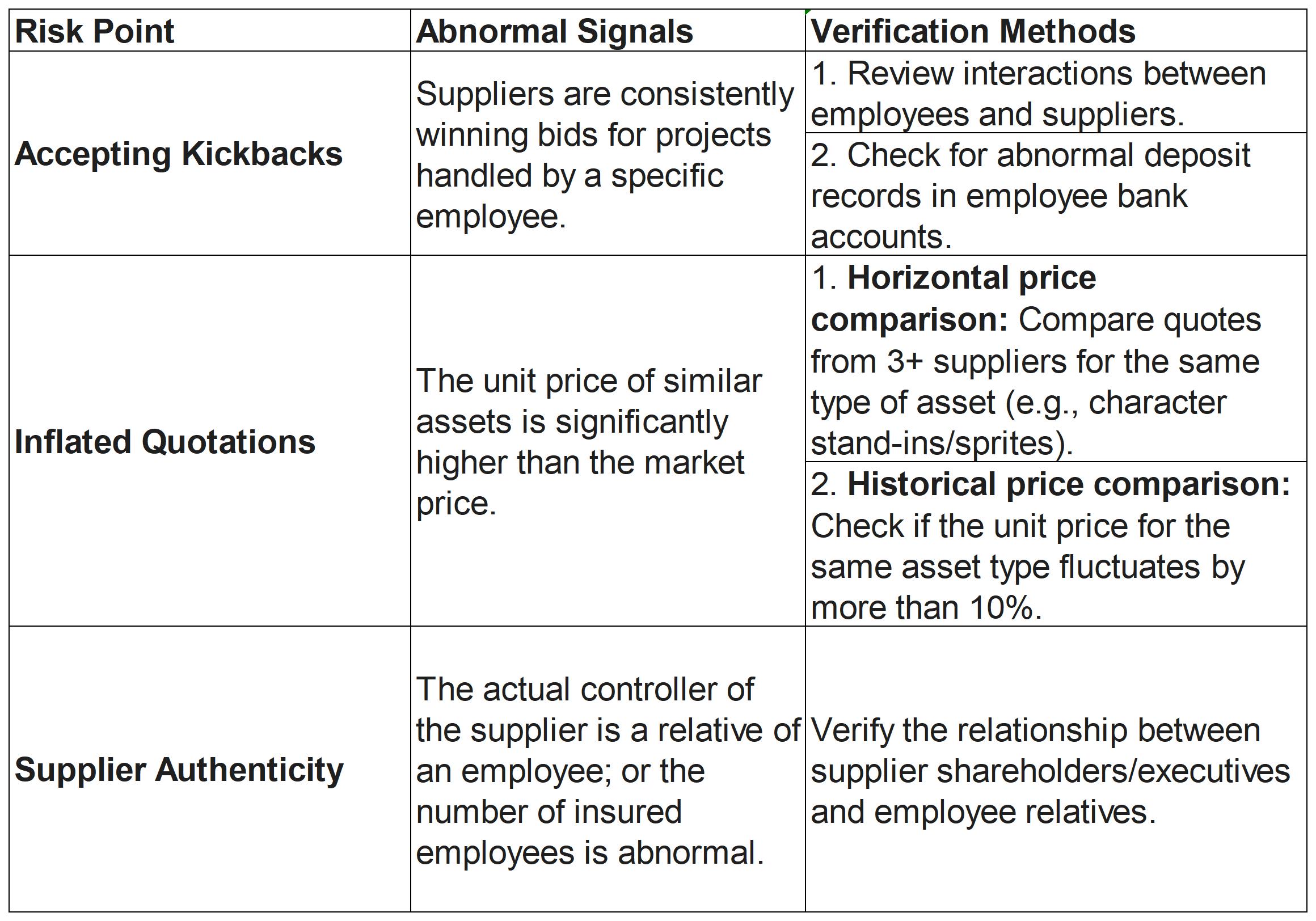 (Translated from the original sheet)
User Acquisition Department: Frequent “Black Box” Traffic Manipulation
(I) Common Fraud Schemes
Falsification of User Quality:
Using low-cost, low-quality users (such as bots or fraudulent traffic) to impersonate high-value users, thereby misappropriating budget differentials.Rebates and Kickbacks:
Receiving rebates from advertising agencies or platforms and concealing such income without recording it in company accounts.Collusion with Channels to Inflate Metrics:
Colluding with distribution channels to artificially inflate download volumes or daily active user (DAU) figures to fraudulently obtain company budgets.
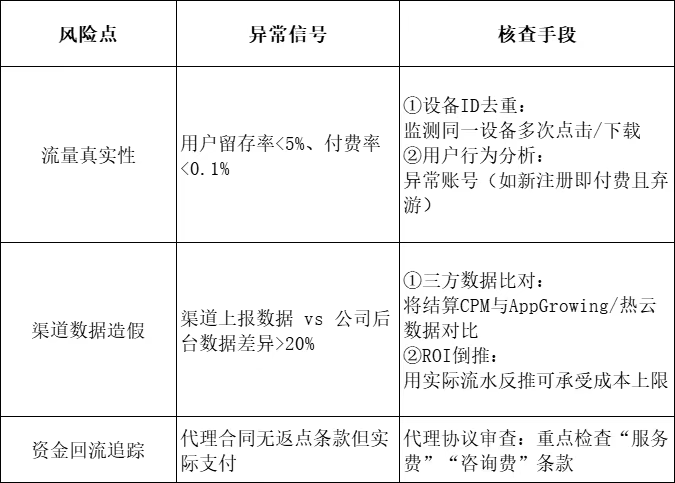
(II) Methods for Clue Identification
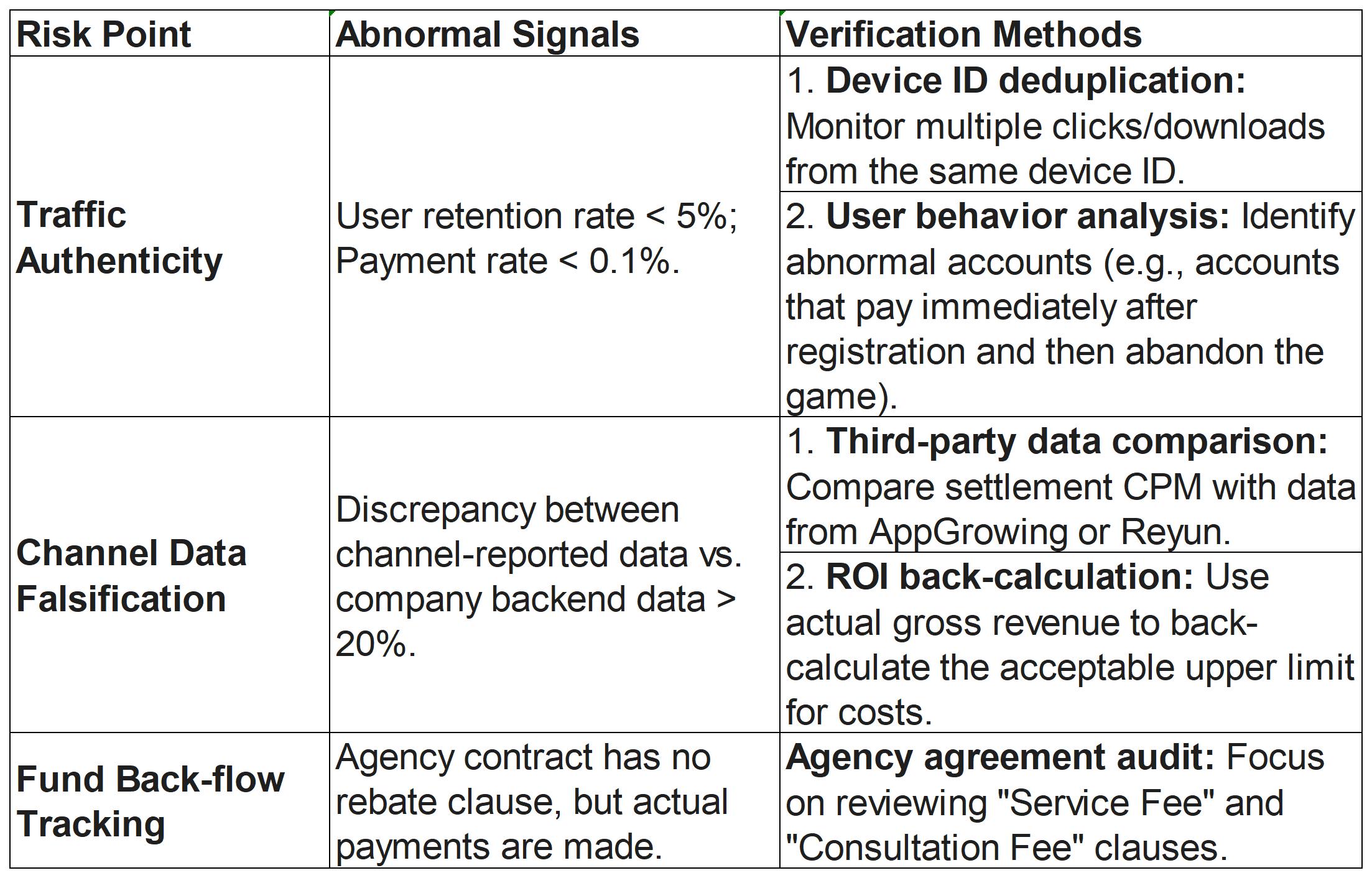 (Translated from the original sheet)
Publishing Department: Resource Exchange and Offline Corruption
(I) Common Fraud Schemes
Channel Resource Favoritism:
Accepting bribes from channel partners and improperly granting recommendation slots or traffic advantages (such as featured exposure on app store homepages).Falsified Marketing Activities:
Fabricating celebrity endorsements or cross-industry marketing projects, inflating marketing budgets, and colluding with suppliers to issue false invoices in order to siphon funds.Supplier Benefit Transfers:
Selecting related-party suppliers and receiving kickbacks.
(II) Methods for Clue Identification
1. Data Penetration and Cross-Comparison
Compare market benchmark prices with actual contract prices (such as celebrity endorsement fees or advertising slot quotations) to identify abnormal contracts with premiums exceeding 30%.
Trace supplier equity structures to identify enterprises affiliated with employees’ relatives, using tools such as Qichacha or Tianyancha to penetrate to the ultimate beneficial owner.
2. Process and Log Audits
Review channel resource allocation logs, focusing on abnormal behaviors such as operations conducted outside working hours or frequent modifications to recommendation rules.
Verify marketing campaign performance data, such as whether user growth during celebrity endorsement periods aligns with the level of investment.
3. Fund Flow Tracing
Conduct spot checks on large marketing expenditures, with particular attention to third-party company accounts, and trace the ultimate destination of funds (e.g., whether funds flow into accounts associated with employees).
Comprehensive Governance Framework: From Clue Discovery to Closed-Loop Management
(I) Technical Safeguards
Blockchain Evidence Preservation:
Upload procurement contracts, user acquisition data, and outsourcing delivery records onto blockchain systems to prevent tampering.AI Behavioral Analysis:
Monitor employee behavior, such as frequent access to sensitive data or bulk downloading of files prior to resignation.
(II) Process Restructuring
Separation of Powers:
Divide authority over supplier selection, contract approval, and acceptance/payment processes.Surprise Rotation:
Implement mandatory periodic rotation for high-risk positions, such as UA operators and art outsourcing managers.
(III) Cultural Governance
Whistleblower Rewards:
Establish anonymous reporting channels and reward verified fraud leads with 10%–20% of the amount involved.Supplier Blacklists:
Create and share industry-wide blacklists to increase the cost of bribery.
Closing Remarks
The root causes of corruption in the game industry lie in opaque resource pricing power and difficulty in supervising closed operational loops. It is recommended to adopt a governance approach centered on data penetration and checks-and-balances of authority. By locking decision traces in publishing, anchoring user value authenticity in user acquisition, and dismantling black-box outsourcing pricing in art departments, companies can effectively compress the space for fraud at its source and shift from post hoc investigation to proactive prevention.
 昨日(2025年7月1日),完美世界也针对反腐调查发布了内部公告,表示多人在职期间严重违反公司制度及劳动合同约定,个别员工及供应商负责人涉嫌违法犯罪,现已向公安机关报案。