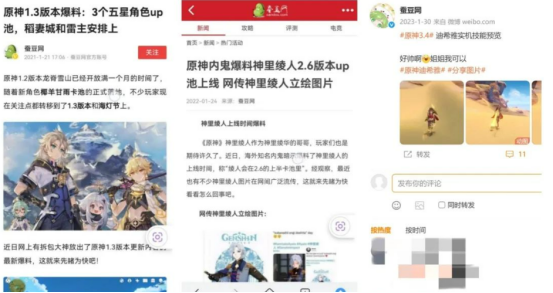
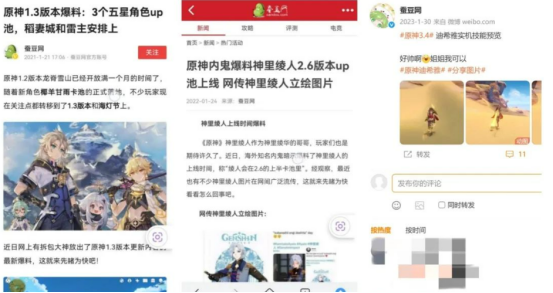
In March this year, the final judgment was rendered in the case of miHoYo suing the game information website "Candou.com" over information leakage. In the two years leading up to the lawsuit, Candou.com and its affiliated self-media matrix accounts published nearly 100 posts featuring confidential game content from Genshin Impact, covering a total of 16 game versions. The Beijing Intellectual Property Court delivered the final judgment, upholding the first-instance ruling. The court determined that the conduct of Candou.com’s operator constituted both copyright infringement and unfair competition, ordering them to pay 330,000 RMB in damages for economic losses. This marks the nation’s first effective judgment to determine that the dissemination of confidential game content constitutes infringement under Article 2 of the Anti-Unfair Competition Law, representing a significant landmark case.
PART 1
Case Review and Focus of Dispute
In the litigation, miHoYo asserted that between 2021 and 2023, "Candou.com" and its affiliated self-media accounts continuously published unreleased content related to Genshin Impact. This content encompassed core information such as character attributes (numerical values), event schedules, and skill mechanics. The key characteristics of the infringement included:(1)Large Scale of Content: Nearly 100 infringing posts were involved.(2)Extended Time Span: The leaks spanned across 16 game versions.(3)Obvious Non-public Sources: The content was clearly obtained through non-official channels.(4)Traffic-Driven Packaging: The content was packaged using sensationalist labels such as "Insider Leaks" (Neigui) and "First-look Exclusives" to drive user traffic.
During the trial, the Court focused on two primary issues:
1. Whether the content involved qualifies for protection under Copyright Law?
miHoYo submitted comparative evidence, including character illustrations, skill descriptions, and UI assets, to prove that the content possessed originality and certainty. The Court ultimately confirmed that the text, artwork, and screen captures involved constitute "works" or elements of works protected by law.
2. Whether a disseminator should bear liability for unfair competition if they are not the original source of the leak?
The Court specifically noted: The act of dissemination, by using methods such as "leaks" and "insider info," attaches itself to the plaintiff’s commercial influence (free-riding) and disrupts unreleased operational arrangements. Such behavior possesses clear illegitimacy. Therefore, even if the defendant was not the original source of the leak, they must still bear legal liability for the act of dissemination itself.
The most profound significance of this case for the industry lies in the following: For the first time, the "dissemination of confidential game content" has been explicitly recognized as an act that can independently constitute unfair competition, effectively removing the requirement to prove that the act of leaking itself was executed by the defendant.
PART 2
Typical Structure of Subjects in Game Leaks:Internal Employees, Outsourced Partners, Beta Testers, and Technical Implementers
Based on public cases in the industry in recent years, subjects involved in leaks can be categorized into four types. Each category differs in terms of burden of proof, legal structure, and judicial determination.
I. Internal Employees
As the group with the most direct access to core development content, internal employees pose the highest risk of leakage. For example, in the Wuthering Waves leak case publicly reported by Kuro Games, an internal employee leaked unreleased character skills and weapon images to platforms, which subsequently spread across social media. Due to the specific identity of these subjects, their liability manifests in several forms:
1.Labor Law Perspective: Breach of confidentiality obligations and violation of internal corporate policies.
2.Civil Tort Perspective: Infringement through the disclosure of confidential content causing economic losses to the enterprise.
3.Criminal Perspective: In severe cases, such actions may trigger criminal liability.
Internal leaks are characterized by high content integrity, high destructiveness, and rapid dissemination, making them the primary risk focal point for game companies.
II. Outsourced Service Providers
Game R&D involves extensive production of art, sound effects, and storylines, often leading companies to outsource non-core or auxiliary work. However, if outsourced personnel unauthorizedly display unreleased character models, illustrations, or weapon settings during their contract or after resignation, it leads to premature exposure. A typical example is the leakage incident involving an outsourced contractor for Mr Love: Queen's Choice, where the individual uploaded unreleased illustrations and models online while claiming project involvement. The complexity of such disputes lies in:
1.Multiple Links: Contact personnel are often decentralized across various stages.
2.Burden of Proof: The game enterprise must simultaneously prove the partnership with the provider, the source of materials, and the fulfillment of confidentiality clauses.
3.Contractual Basis: Since the subjects are not employees, the chain of liability must be established through the service contract. Courts typically assess breach of contract or infringement based on contractual stipulations, access permissions, and authorized scope of use.
III. Beta Testers and KOLs (Key Opinion Leaders)
To improve game quality and market traction, companies often invite influencers or players to participate in Closed Beta Tests (CBT). In practice, some invitees fail to comply with Non-Disclosure Agreements (NDAs), capturing and distributing gameplay footage or mechanics via screenshots and screen recordings. In the judgment (2024) Hu 0115 Min Chu No. 38294, the Shanghai Pudong New Area People's Court ruled that continuous dynamic images (sequential frames) constitute original objects of protection. This means:
Non-asset-based content (e.g., recorded gameplay) can also be the subject of infringement.
The dual liability path of "Contractual Obligation + Copyright Infringement" for beta testers is further clarified. This case is landmark as it represents the first time the judiciary has included "continuous dynamic images" under independent legal protection.
IV. Technical Data Miners (Unpackers)
Beyond active human disclosure, some technical personnel use decompilation and unpacking (reverse engineering) to bypass security mechanisms and extract unreleased skins, maps, or event information. This is known in the industry as "Data Mining." Although some players claim "interest-based research," the essence is unauthorized illegal acquisition and dissemination. This often sabotages official warm-up and marketing plans and, in severe cases, triggers massive claims for damages. For instance, the case where a defendant (Guo) repeatedly unpacked and published test package content for Honkai: Star Rail shows that technical leakers have specific traits:
1、Concealed Infringement: Their methods are technically stealthy.
2、High Integrity: The extracted content is extremely complete.
3、Severe Disruption: They significantly sabotage version release schedules.
4、Circumvention of Technical Measures: Their actions are more likely to trigger severe liabilities related to bypassing technological protection measures (TPMs).
These subjects, by bypassing security to leak test packages, constitute the most harmful group in the game leakage chain.
PART 3
Breakthrough in the "Candou.com" Ruling
Dissemination Alone Constitutes Infringement
The core value of this case lies in the following principle: Even if the disseminator is not the original source of the leak, the mere act of spreading confidential content can trigger comprehensive infringement liability. The court established this reasonableness determination from three perspectives:
1、Objective Disruption of Operational Cadence: The dissemination disrupted the game’s normal operational rhythm. "Premature leaks" cause player expectations to form ahead of schedule, preventing the official team from executing planned marketing and version-based operations.
2、Parasitic and Exploitative Nature of Dissemination: The defendant utilized expressions such as "Exclusive" and "Insider Leaks" to attract attention through confidential content, thereby securing advertising revenue. This behavior is characterized by commercial free-riding.
3、High Commercial Sensitivity of the Content: The premature spread of unreleased content constitutes a substantial interference with the right holder’s commercial interests.
Based on these findings, the court confirmed that the disseminator committed both copyright infringement and unfair competition, and was liable for compensatory damages.
The "Candou.com" case officially integrates game leakage disputes into a formal judicial determination system:
1、Broader Identification of Protected Objects: Artwork, text, and continuous dynamic images within a game are all eligible for legal protection.
2、Expansion of Liable Subjects: Disseminators of leaked game content are no longer in a "safe harbor"; the scope of liability has widened significantly.
3、Increased Judicial Focus on "Disruption of Commercial Rhythm": The judiciary now places higher importance on the malicious disruption of business cycles. Consequently, game companies will become more proactive in seeking litigation-based remedies rather than relying solely on internal measures.
As product lifecycles shorten and content operation cadences accelerate, leakage disputes will increasingly enter judicial proceedings rather than remaining confined to internal management or platform-based take-down notices. In the next part, we will discuss how game enterprises should conduct rights protection and enforcement following a leak.
 (图片来源:米哈游法务部)