Advertising Disclosure ObligationsIn-Game PurchasesLoot Boxes

EA Investigated Again Over Insufficient Disclosure in Game Advertising

游戏广告披露信息不清晰 EA再次被调查

January 29, 2026
7 views

Summary

This article analyzes a recent ASA ruling against an EA game advertisement, focusing on insufficient disclosure of in-game purchases and loot boxes. It highlights the regulatory standards applied by the UK advertising authority and underscores the importance of clear, prominent, and adequate disclosure of probabilistic monetization mechanisms in game advertising.

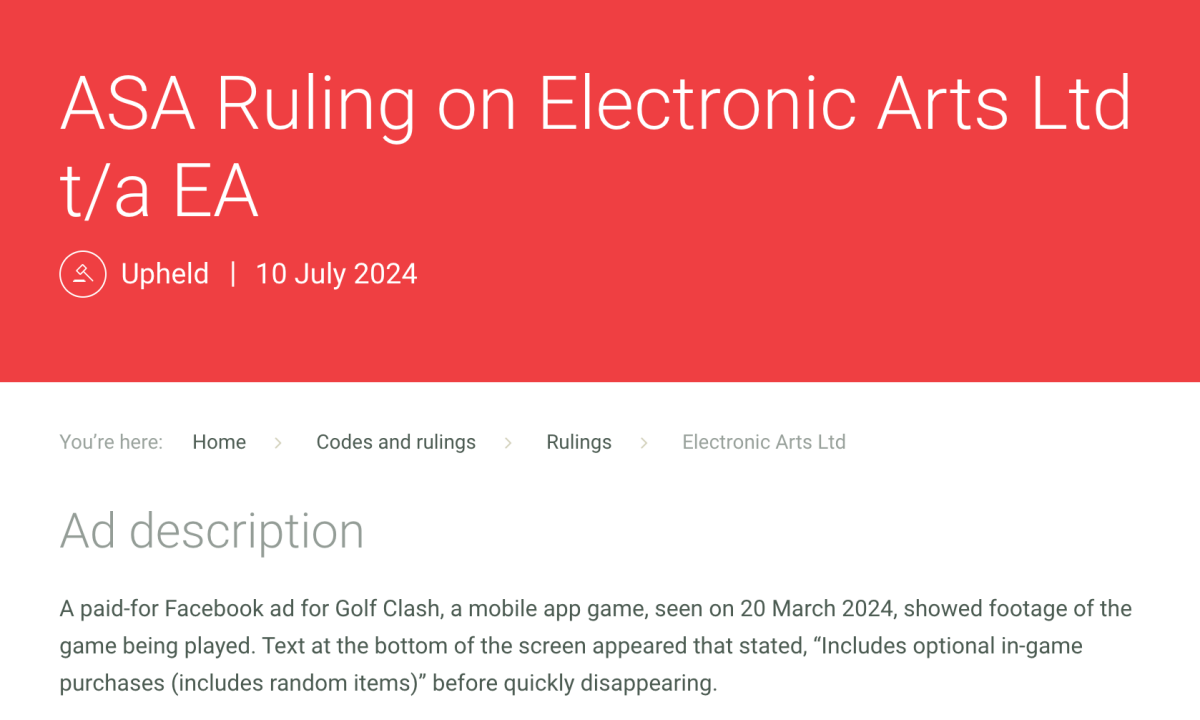
Recently, the UK Advertising Standards Authority (ASA) issued a ruling against a Facebook advertisement for Golf Clash, a game published by Electronic Arts Inc. (EA).
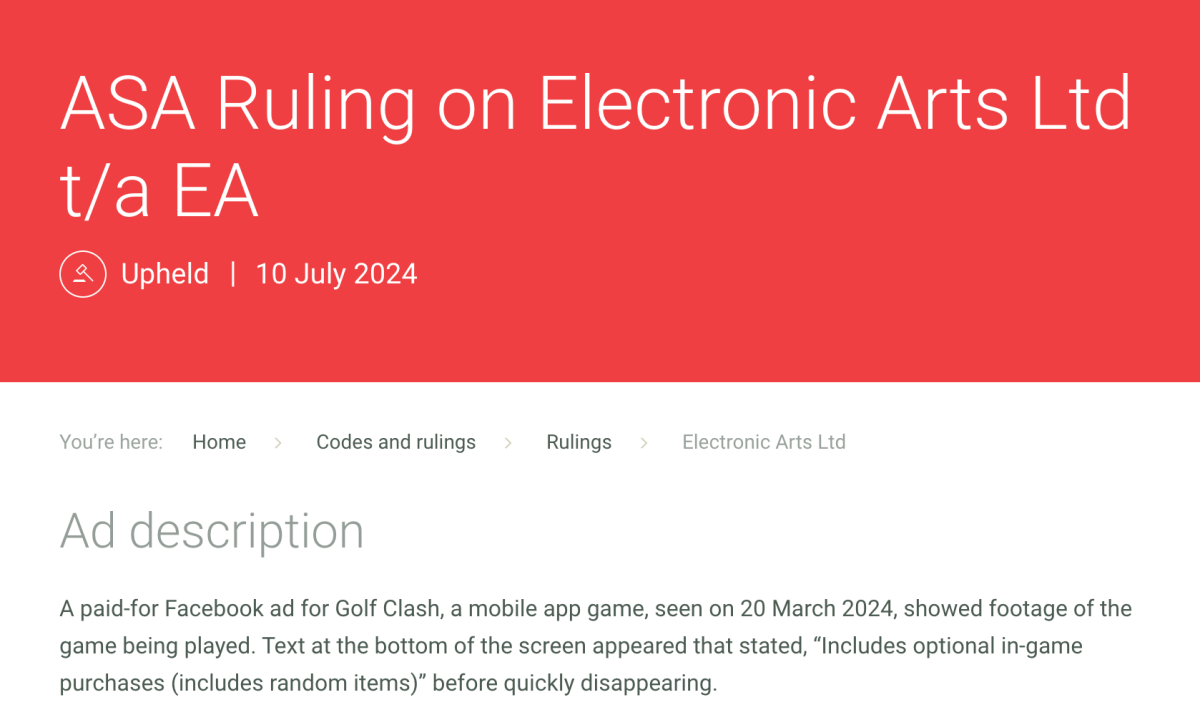
This ruling follows a previous ASA decision issued in March of this year concerning the same game. In the March ruling, one of the two advertisements failed to clearly indicate that the online store contained loot boxes, while the other failed to clearly disclose that the game included in-game purchases or loot boxes. As a result, both advertisements were found to be in violation of Rules 3.1 and 3.3 of the advertising compliance guidelines, as they misleadingly omitted material information. The ASA held that the information provided was insufficient to enable consumers to fully understand the transactional decisions they might make.
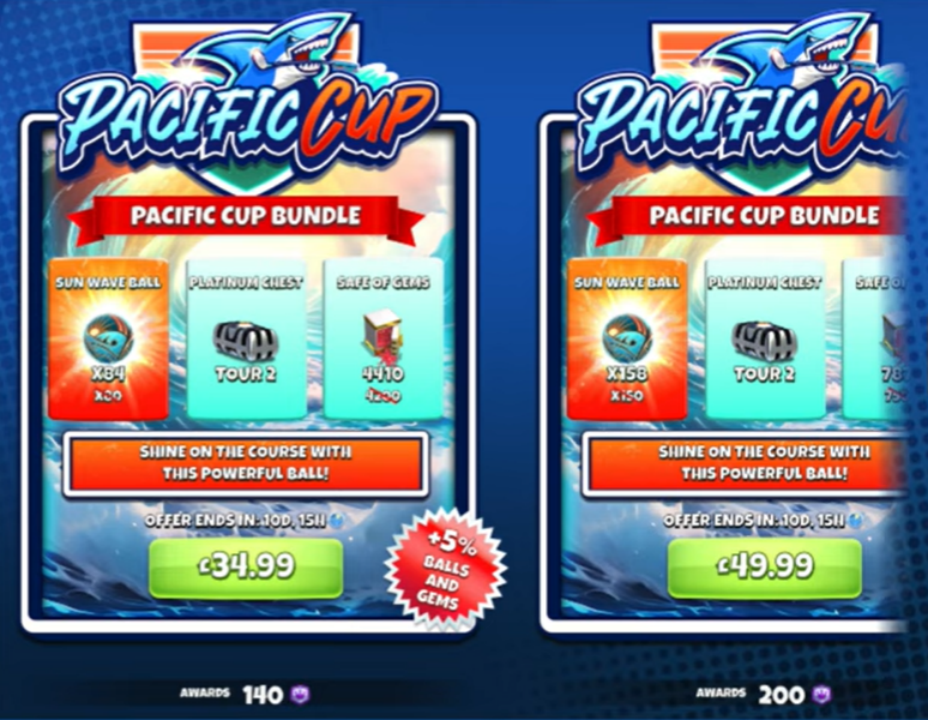
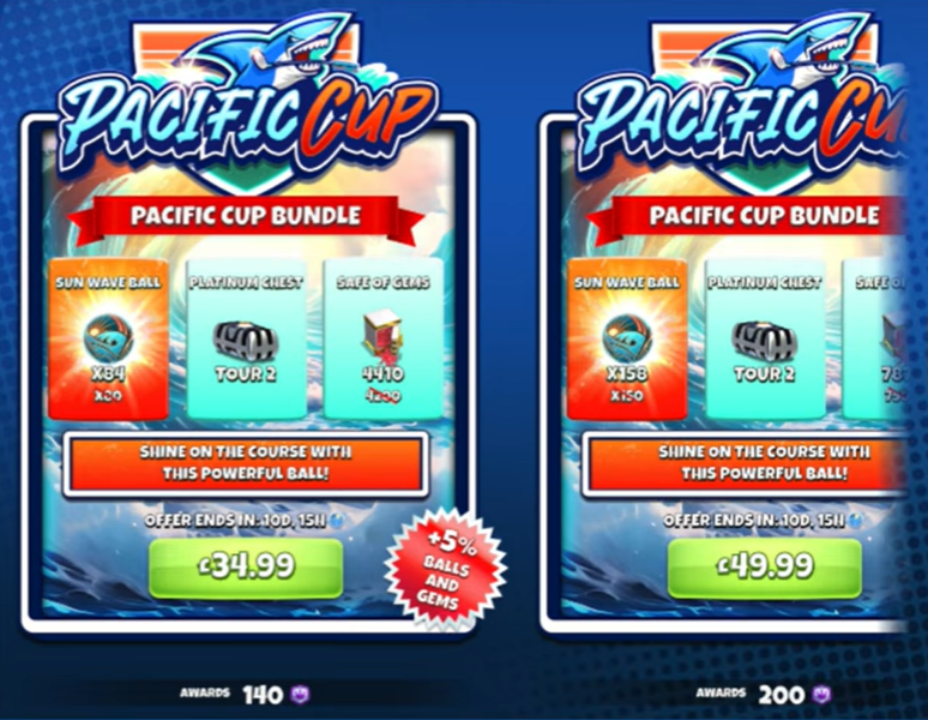
In the ruling published on July 10 this year, the disputed advertisement was posted on Facebook on March 20. The content of the advertisement primarily showcased gameplay footage, with text displayed at the bottom stating “Includes optional in-game purchases (includes random items),” which disappeared after a few seconds.

The complainant argued that the advertisement was similarly misleading, as the disclosure appeared only briefly and failed to clearly and prominently indicate that the game included purchases of random items.

In response, EA stated that the disclosure was clearly visible at the beginning of the advertisement and remained on screen for two seconds. EA further argued that the font, spacing, color, capitalization, and layout of the disclosure were designed to ensure its prominence within the advertisement, and that this was sufficient to allow consumers to easily access and directly notice the information. In addition, EA noted that the product description linked to the advertisement clearly stated that Golf Clash included purchases of random items, allowing consumers to become aware of such features before deciding whether to download the game.

In its assessment, the ASA pointed out that the advertising compliance guidelines issued by the UK Committee of Advertising Practice (CAP) state that the existence of in-game purchases, particularly loot boxes, is “material to consumers’ decisions to purchase or download a game.” However, in the disputed advertisement, the disclosure text appeared in light grey font against a background of brightly colored, fast-changing gameplay footage, which distorted the appearance of the text. Combined with the rapid movement of the video footage, the text was difficult to read. Furthermore, the text was small in size and appeared on screen for only two seconds before disappearing.

The ASA concluded that this presentation was insufficient to clearly communicate the existence of in-game purchases to consumers, particularly purchases of random items (loot boxes).

As a result, the ASA ruled that the advertisement breached Rules 3.1 and 3.3 of the advertising compliance guidelines (misleading advertising), prohibited the advertisement from appearing again in its current form, and instructed EA to ensure that information indicating that Golf Clash includes purchases of random items is presented in a prominent and clear manner.

Although the ASA does not possess compulsory enforcement powers, it exerts significant influence within the industry. This ruling demonstrates the ASA’s stringent standards regarding disclosure requirements for probabilistic gameplay mechanics and in-game purchase systems in game advertising. For game companies publishing advertisements in the UK market, strict compliance with the advertising compliance guidelines is essential. Advertisements must not only disclose whether a game includes in-game purchases, but must also ensure that such information is presented in a clear and transparent manner.

In light of this, we recommend that game companies, when preparing advertisements:
(1) use clear and highly visible fonts;
(2) avoid overly cluttered background visuals and maintain sufficient contrast between text and background;
(3) ensure that key information occupies a sufficiently prominent position within the advertisement to avoid being overlooked; and
(4) ensure that disclosures remain on screen for an adequate duration to allow an average consumer to read and understand the information.
中文原文

近日,英国广告标准局(ASA)对美国艺电(Electronic Arts,EA)旗下游戏《Golf Clash》的一则Facebook广告进行了裁决。

这是继ASA今年3月对EA旗下该款游戏进行裁决后的又一裁决。在此前3月的裁决中,该游戏的两则广告中有一则没有明确表明网上商店包含战利品箱,另一则没有明确表明游戏包含游戏内购买或战利品箱,因此这些广告违反了广告合规指南第3.1及3.3条,误导性地省略了重要信息,同时这意味着广告中包含的信息不足以确保消费者理解他们可能做出的交易决策。

而在今年7月10日公布的此次裁决中,被投诉的广告于今年3月20日在Facebook上发布。该广告内容主要展示了游戏玩法的片段,底部有文字提示“包含可选的游戏内购买(包含随机物品)”(“Includes optional in-game purchases (includes random items”),但几秒钟后就消失了。

投诉人认为该广告同样具有误导性,因为信息转瞬即逝,没有足够清晰明显地表明游戏包含随机物品购买。

对此,EA表示,披露信息在广告开始时清晰可见,持续了两秒钟,且披露信息的字体、间距、颜色、大写和布局都是为了确保其在广告中的突出性,因此他们相信这足以使消费者轻松获取并直接找到该披露信息。此外,广告链接的产品描述也明确了Golf Clash游戏包含随机物品购买,因此消费者能够在决定下载游戏之前意识到其存在。

ASA在评估中指出,英国广告实践委员会(CAP)颁布的广告合规指南(“《广告合规指南》”)表示,游戏内购买的存在,尤其是战利品箱,“对消费者决定购买或下载游戏至关重要”。而涉诉广告中的提示文字以浅灰色字体呈现,背景是色彩鲜艳、快速变化的游戏玩法片段,扭曲了文字的外观,并且与视频片段的快速移动性质相结合,这使得文字难以阅读。且文字很小,仅在屏幕上显示两秒就消失了。

ASA认为,这种呈现方式不足以清晰地向消费者传达游戏内购买的存在,特别是随机物品购买(战利品箱)。

最终,ASA裁定该广告违反《广告合规指南》3.1和3.3(误导性广告),禁止该广告以当前形式再次出现,并告知EA确保Golf Clash将游戏内包含随机物品购买的信息以突出和清晰的方式呈现。

尽管ASA不具备强制性执法权,但对行业具有重要的影响力,且可以看出其对游戏广告中涉及概率性玩法和内购机制的披露标准非常严格。针对在英国发布游戏广告的出海企业,必须严格遵守《广告合规指南》,广告中不仅要包含游戏是否包含内购选项的信息,更要注意确保其广告内容的清晰透明。

对此,我们建议游戏公司在广告中(1)使用清晰、醒目的字体;(2)背景画面不宜过于杂乱,注意保持文字和背景画面颜色的充分对比;(3)确保关键信息在广告中占据足够突出的位置,避免因信息不明显而被忽视;(4)信息应当停留足够的时长,确保一般消费者能够在显示时间内阅读完提示信息。

分享文章

相关文章

General

【Weekly Gaming Law】Lawyers Comment on miHoYo’s Anti-Fraud Actions; Infringing “Reskinned” Game Ordered to Pay RMB 5 Million

【每周游戏法】律师评米哈游反舞弊;侵权游卡被判赔500万

This weekly update examines three recent legal developments in the gaming industry: miHoYo’s anti-fraud enforcement and supplier blacklist measures; a “reskin” infringement case involving a Three Kingdoms-themed card game resulting in a RMB 5 million damages award based on unfair competition; and Roblox’s launch of AI-powered interactive content generation tools. The article outlines the legal considerations arising from supply chain compliance, the boundary between public domain materials and protectable game design, and the intellectual property and compliance implications of AI-generated interactive content within UGC platforms.

0 views
General

How to Build Official Game Payment Systems in a Compliant Manner (Part II): Overseas

游戏官方支付如何合规搭建(二)海外篇

Against the backdrop of a global economic slowdown and evolving regulatory scrutiny over major app distribution platforms, an increasing number of overseas-oriented game companies are exploring the establishment of official website top-up platforms to reduce reliance on channel commissions. Building on the prior discussion of platform policies regarding payment redirection and third-party payment access, this article reviews practical cases of official website payment models adopted by several game companies, including their login mechanisms, purchasable content, regional availability, and qualification disclosures. Based on these practices, it outlines compliance considerations that overseas game companies should focus on when constructing official website payment systems, particularly in relation to account management, price display, promotional methods, and refund policy design across different jurisdictions.

6 views
General

EU’s DMA Enforcement Push: Apple and Epic Games Reach Temporary Truce

欧盟DMA强监管,苹果与Epic Games暂时握手言和

Since 2020, Apple and Epic Games have been locked in a global antitrust dispute over App Store policies. While Epic lost its U.S. lawsuit, it continued its resistance through noncompliance, resulting in a developer account ban. However, the dynamics shifted with the EU Digital Markets Act (DMA) coming into force on March 6, 2024. Epic reported that Apple, under pressure from the European Commission, agreed to reinstate its developer account in the EU. The DMA’s provisions, especially Article 5(3) and Article 6(4), require gatekeepers like Apple to allow third-party app stores and payment systems on iOS. Apple’s attempt to ban Epic amid DMA implementation triggered regulatory attention, leading to rapid Commission intervention. This incident not only highlights the DMA’s enforcement teeth but also signals a broader shift in platform governance within the EU. For global developers and digital exporters, especially those dependent on app store distribution, DMA compliance represents a strategic inflection point. Non-compliance risks include fines of up to 10–20% of global turnover, exemplified by the €1.84 billion fine Apple recently faced. As more third-party app stores (e.g., Mobivention, MacPaw) emerge, the EU’s digital market is poised for structural transformation.

5 views