People’s Court Case Database Inclusion No.: 2023-09-2-158-024
Case:
Certain Publishing Co., Ltd., et al. v. Beijing Certain Network Technology Co., Ltd., et al.
— Judicial Reasoning and Analytical Framework for Determining Adaptation Through the Use of Elements from Others’ Works
Basic Facts of the Case
Plaintiff I, a certain publishing company, is the exclusive holder within mainland China of all exclusive exploitation rights in The Jin Yong Collection—which includes The Legend of the Condor Heroes, The Return of the Condor Heroes, The Heaven Sword and Dragon Saber, and The Smiling, Proud Wanderer (collectively, the Works at Issue)—except for the right to publish and distribute simplified Chinese book editions.
Plaintiff II, a certain software company, acquired by assignment the exclusive right, within a specific territory and for a specific period, to adapt the Works at Issue into mobile terminal game software, as well as the exclusive authorization for the commercial development of the adapted game software.
Defendant I, a certain network company, developed a card-based mobile game, while Defendant II, a certain technology company, and Defendant III, a certain technical company, were responsible for operating the game. The game made extensive use of elements corresponding to the original works, including characters, martial arts skills, formations, and scenes.
The plaintiffs alleged that the defendants, without authorization, adapted the Works at Issue and used them for commercial operation, thereby constituting copyright infringement and unfair competition. They requested that the court order the defendants to cease infringement, issue a public apology, eliminate adverse effects, compensate economic losses of RMB 100 million, and reimburse reasonable enforcement costs of more than RMB 310,000.
Highlights of the Judgment
I. Whether the Game Infringed the Adaptation Right in the Novels at Issue
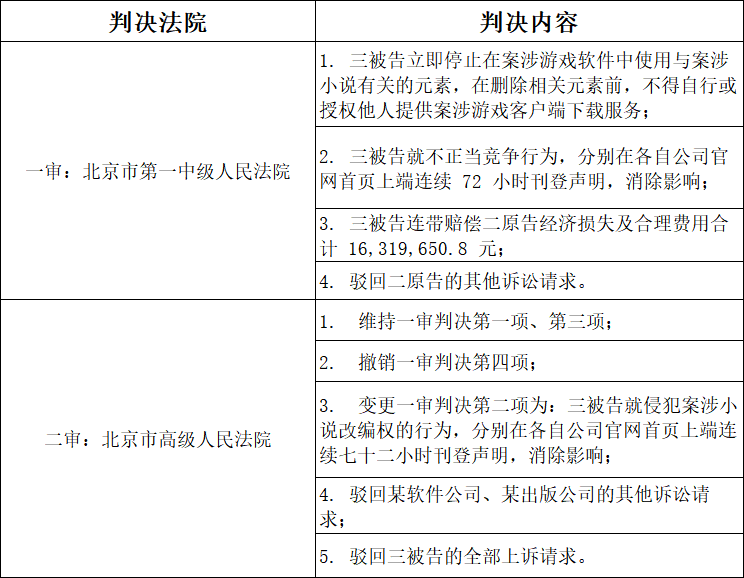
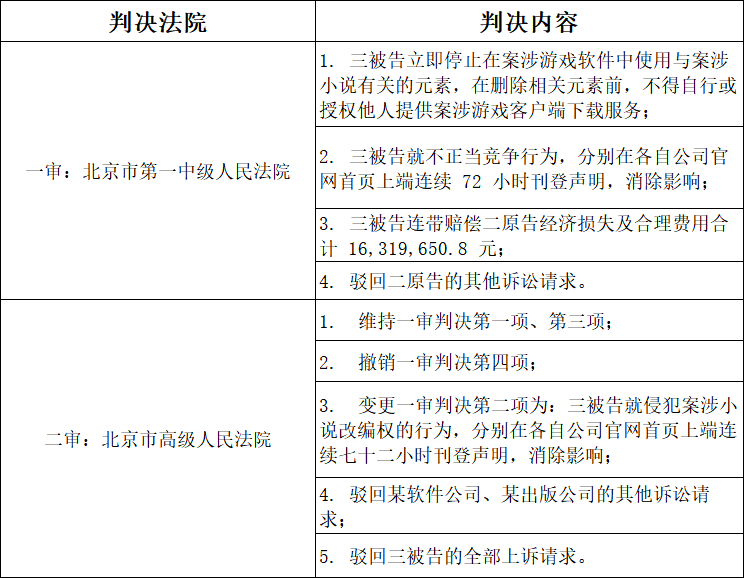
The court of first instance held that the game did not use the core expression of any single novel, nor did the proportion of expression from any individual novel reach a level sufficient to establish correspondence as a whole. Accordingly, the court found that the game did not infringe the plaintiffs’ adaptation rights.
The court of second instance, however, held that:
The game used specific, original expressions from the novels, including characters and plot elements, through selective and combinational use, rather than isolated elements.
The game merely transformed the expression of the novels into a card-game format, without forming a new expression detached from the original works, thereby constituting an adaptation.
The use of the core elements of the novels was sufficient to allow players to obtain an experience akin to reading or appreciating the original novels, thereby impairing the plaintiffs’ commercial realization of their game adaptation rights.
Accordingly, the second-instance court ultimately held that the game infringed the adaptation rights enjoyed by the plaintiffs, corrected the first-instance judgment, and further clarified that the Anti-Unfair Competition Law should not be applied repeatedly to evaluate the same conduct. On this basis, it held that the use of similar content in the game did not separately constitute unfair competition.
II. Determination of Damages Liability
Pursuant to Article 54 of the Copyright Law, damages for copyright infringement shall be determined, in descending order of priority, by the rights holder’s actual losses, the infringer’s illegal gains, or statutory damages. Given the intangible nature of copyright, however, infringement losses are often difficult to quantify precisely. Where actual losses or illegal gains cannot be accurately calculated, courts may exercise discretion based on the evidence on record, and the awarded amount may exceed the statutory upper limit.
In this case, the evidence submitted by the plaintiffs was insufficient to precisely calculate either their actual losses or the defendants’ illegal gains, and thus their claim for full compensation was not fully supported.
The first-instance court had determined damages by reference to twice the RMB 8 million licensing fee paid by the rights holder for relevant authorization. The second-instance court held that such a method lacked a clear legal basis and that it was inappropriate to equate a three-year licensing fee with the total losses caused by the infringement.
Nevertheless, after comprehensively considering all evidence, the second-instance court upheld the damages amount determined at first instance, based on the following factors:
During the infringement period, the defendants’ operating profits from the game exceeded RMB 170 million. Even under conservative estimation, the portion attributable to the novels would far exceed tens of millions of RMB.
The licensing fee paid by the rights holder had reference value in reflecting the market value of the works.
The court further considered the extremely high notoriety and market value of the novels, the defendants’ obvious subjective fault, the nature and duration of the infringement, and the reasonable costs incurred by the plaintiffs in enforcing their rights.
Insights from the Case
I. Free-Riding on IP: Using Aliases Does Not Eliminate Infringement Risks
In practice, some games attempt to avoid infringement findings by using aliases or homophonic names. Such approaches do not eliminate infringement risks. In this case, nicknames such as “Hero Guo,” “Rong’er,” “Guo’er,” “Long’er,” or “Prince of Jin,” as well as homophonic names such as “Yang Tiexin” and “Guo Xiaotian,” were not the original character names, yet their referential relationship to the corresponding characters was clear.
Judicial practice confirms that where a large number of game character names correspond to characters in the original work, or where a unique association can be formed in conjunction with plotlines or character descriptions, the standard of substantial similarity is satisfied. This reasoning applies equally to adaptations of film and television works. Even where developers deliberately avoid using identical character names, infringement or unfair competition may still be found if character images, classic lines, or skill settings closely correspond to the original works.
**II. The Boundary of “Inspiration”:
Non-Infringement? Infringement of Adaptation Rights? Or Unfair Competition?**
In cultural and creative industries, defining the boundary between lawful inspiration and infringing use is central to balancing creative freedom and intellectual property protection. This boundary is delineated by the idea–expression dichotomy under copyright law.
First, original “expression” is not limited to textual wording but may reside in the structural arrangement and organic combination of work elements. In narrative works such as novels and scripts, expression may encompass a specific story system formed through the dynamic interaction of character settings, relationships, key plot points, and distinctive objects. When such elements are sufficiently concrete and arranged through the author’s unique choices and judgment, they transcend abstract ideas and become protected expression.
In this case, the second-instance court emphasized that while story themes and abstract character relationships fall within the realm of “ideas,” specific plot developments and concretized character relationships may constitute protected expression once they reach sufficient specificity. The court held that creative elements such as structure, plot, and character design, where they reflect original selection, arrangement, and design, are protected under copyright law.
Second, the essence of “adaptation” lies not in changing the medium of expression, but in the reproduction of substantially similar original expression. Adaptation involves creating a new form while retaining the core expressive elements of the original work. Even where a work is presented in a completely different medium—such as adapting a novel into a game—adaptation infringement may be found if the combination of characters, plots, and relationships remains highly consistent, allowing audiences to perceive a continuous creative lineage.
In this case, the court found that the game recreated specific relationships between characters and martial arts through card-combination mechanics, enabling players to partially experience the original plot and character dynamics. This constituted a substantially similar reproduction of protected expression and therefore an infringing adaptation.
Conversely, where the use of elements is isolated or fragmentary, without touching the expressive core of the original work, copyright infringement may not be established. The law does not prohibit drawing inspiration from the public cultural domain or using abstract ideas, basic facts, or common elements. However, even where copyright infringement is not found, such conduct may still constitute unfair competition if it involves bad-faith free-riding on the reputation of a well-known work and is likely to cause public confusion.