As an industry organization with an exceptionally high standing in Japan’s gaming sector, the Japan Online Game Association (JOGA) was established in 2010. Its primary objectives are to promote the sound development of Japan’s gaming industry, safeguard consumer rights, and advance industry self-regulation and standardization through the issuance of various guidelines and self-regulatory normative documents.
In July 2024, JOGA, together with the Computer Entertainment Supplier’s Association (CESA) and the Mobile Content Forum (MCF), jointly released the Blockchain Game Guide (hereinafter referred to as the “Guide”). The Guide integrates professional knowledge related to the handling of crypto assets and blockchain-issued tokens in blockchain game distribution with traditional gaming industry knowledge and consumer experience.
As the second article in this series, this article introduces the practical cases attached to the Guide concerning compliant blockchain game operations and provides commentary in conjunction with the relevant compliance requirements set out in the Guide. Due to space limitations, readers seeking the full analysis of the Guide’s examples are invited to contact Norconn Game Law via its official public account.
Terminology Definitions
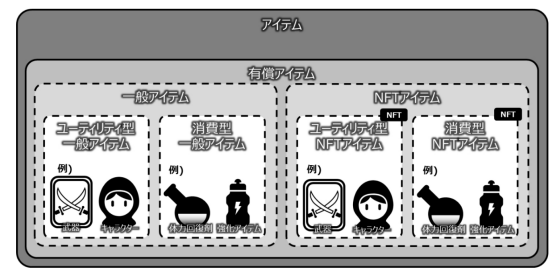
Unless otherwise specified, all in-game items and NFT items referred to in the examples below are paid items.
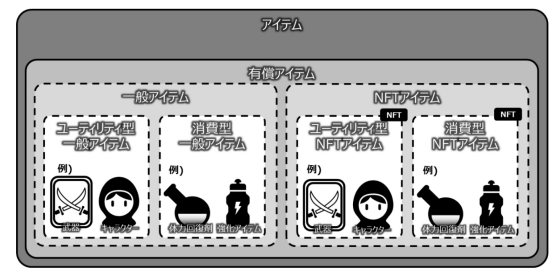
Paid Items:
Refers to items acquired by paying money, paid points, or crypto assets as direct consideration, as well as items obtained on the condition that items acquired through payment of money, paid points, or crypto assets are consumed.
Utility-Type [General/NFT] Items:
Refers to [general/NFT] items that, in principle, can be used in the form in which they are acquired, such as characters and equipment.
Utility-type [general/NFT] items may be obtained through paid purchase, randomized item sales, or in-game gameplay.
In addition, please note that not all [general/NFT] items obtained through randomized item sales are necessarily utility-type items.
Consumable-Type [General/NFT] Items:
Refers to [general/NFT] items such as stamina recovery potions, ability enhancement potions, dungeon entry keys, enhancement materials, and crafting materials. These items are not used directly at the time of acquisition, but are primarily intended to be consumed in order to obtain other items or activate certain functions.
In principle, items with the same name possess the same performance.
Such items may be obtained through paid sales, randomized item sales, or in-game gameplay.
Operational Examples and Compliance Requirements
1. Guide Section 3-5: Specific Examples Requiring Attention Regarding Gambling-Related Crimes under the Criminal Law
1-1. Sale of Utility-Type NFT Items through Randomized Item Sales
(a)
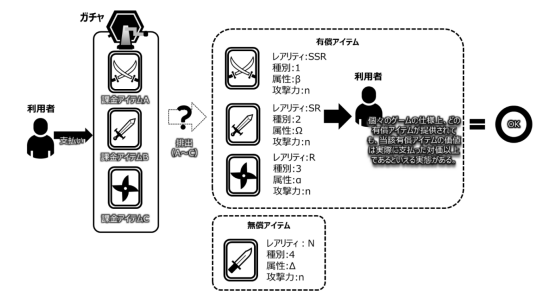
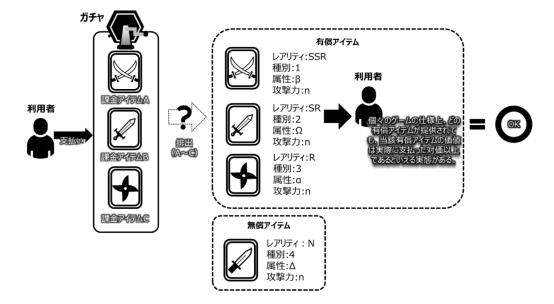
Even where differences such as rarity are established among utility-type NFT items issued through randomized item sales, if no “relationship of competing gains and losses” is deemed to exist between the parties, such conduct is considered not to constitute gambling-related crimes under the Criminal Law.
In order to recognize a “relationship of competing gains and losses,” circumstances must exist in which property or economic value lost by one party is acquired by another party, such that the benefit obtained by one party is evaluated as being based on the other party’s economic burden.
In this context, where the operator receives consideration equivalent to the actual sales price for the utility-type NFT items and provides users with value exceeding the actual consideration paid, such a relationship will not be deemed to exist (i.e., consumers do not lose), and therefore gambling is not established.
(b)
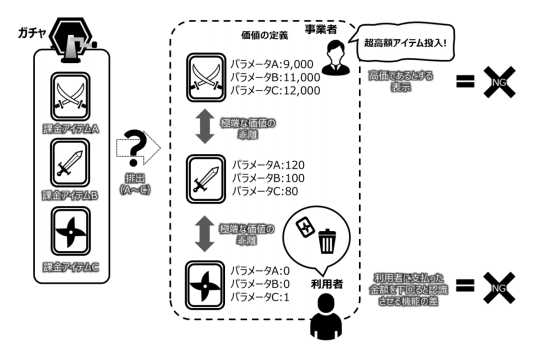
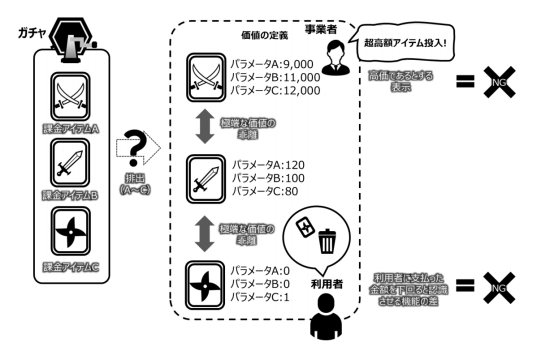
In order to prevent improper evaluations whereby users may be deemed to have failed to obtain value equivalent to their payment, or operators may be deemed not to have obtained consideration equivalent to the sales price, the following matters require attention:
Where utility-type NFT items are provided through randomized item sales at the same price, operators must not assign higher prices to certain utility-type NFT items while rendering other utility-type NFT items of lower value, thereby leading users to believe that the value received is below the amount paid. Accordingly, operators must not establish displays or functional differences that may cause users to perceive disparities in item value.
(c)
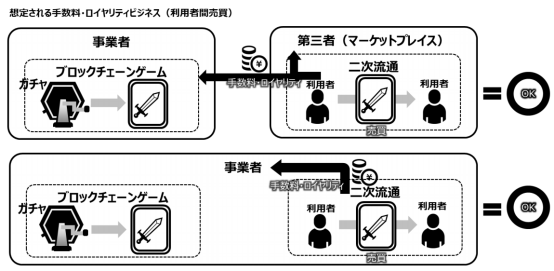
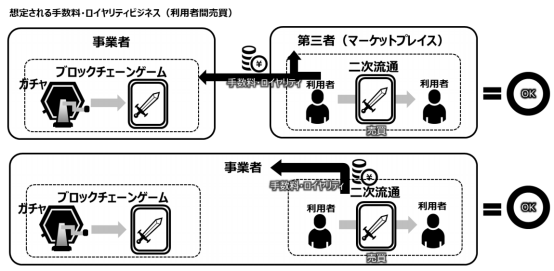
Even where an operator earns commission fees through transactions of utility-type NFT items between users, or between users and third parties, on a secondary market established and operated by the operator itself or by an external third party (including commission fees related to management and operation obtained by the operator in operating its own secondary market), such circumstances alone do not immediately give rise to a “relationship of competing gains and losses” in property between the operator and users.
(d)
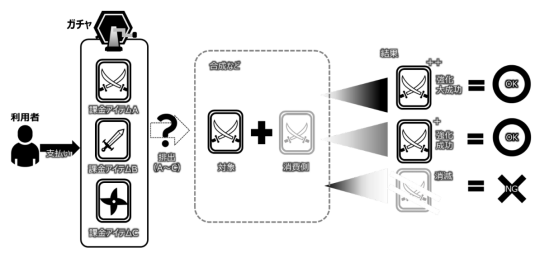
Operators shall ensure that users can obtain value or functionality equivalent to the consideration paid when using utility-type NFT items acquired through randomized item sales in blockchain games.
(e)
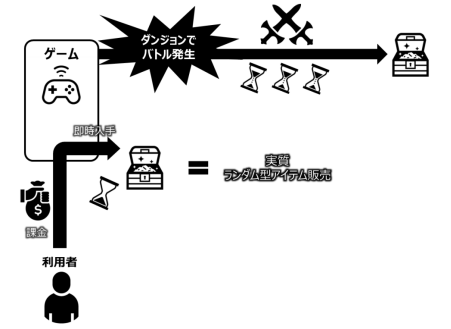
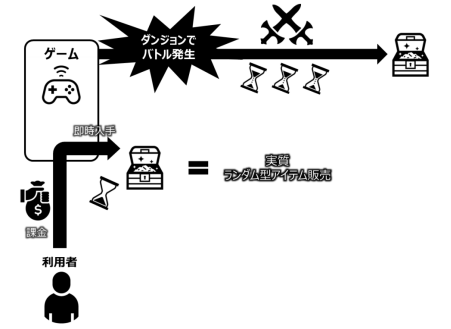
Where utility-type NFT items are dropped through battle or exploration gameplay, care shall be taken to ensure that such interactive acquisition mechanisms do not constitute randomized item sales. If such mechanisms fall within the scope of randomized item sales, the corresponding measures required for randomized item sales shall be implemented.
(f)
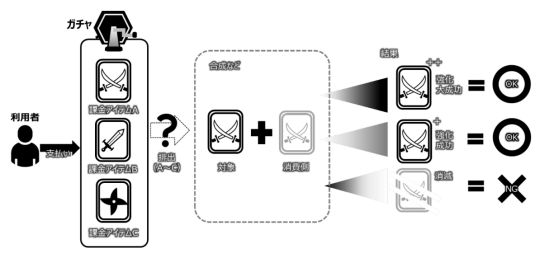
Even where the items provided through randomized item sales are not utility-type NFT items such as characters or equipment, but rather consumable-type [general/NFT] items (such as materials), the above precautions applicable to randomized item sales of utility-type NFT items shall still apply.
Even if items obtained through gacha mechanics do not directly become NFTs and are merely general items, where such items are used within the game to craft or enhance utility-type NFT items such as characters, the precautions applicable to randomized item sales shall likewise apply.
1-2. Sale of Utility-Type NFT Items by User Designation
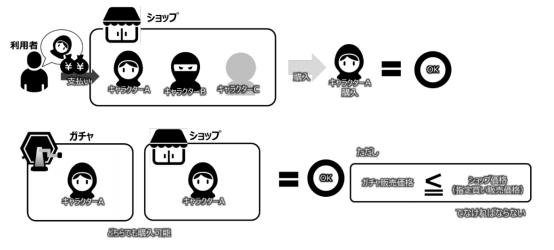
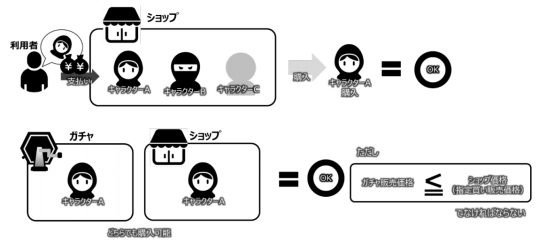
Where an operator sells utility-type NFT items in a manner that allows users to designate the specific item to be purchased, the requirement of chance is not satisfied, and therefore no gambling issue arises.
However, where both randomized item sales and designated sales are conducted simultaneously, the pricing of utility-type NFT items in designated sales must not be lower than the price in randomized item sales (see Section 1-1(c)).
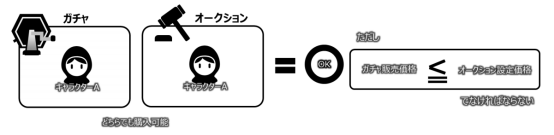
1-3. Designated Sales and Auction Sales of Utility-Type NFT Items
Where an operator sells utility-type NFT items through auctions, the requirement of chance is not satisfied, and therefore no gambling issue arises.
However, where randomized item sales and auction-based sales are conducted simultaneously, the pricing of utility-type NFT items sold by auction must not be lower than the price in randomized item sales.
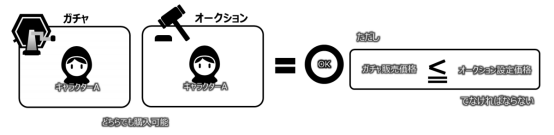
Where utility-type NFT items are sold by auction, as no element of chance exists at the time of acquisition, such sales do not constitute gambling. However, where users are able to designate and purchase utility-type NFT items that are the same as or similar to those obtainable through randomized item sales, the precautions set forth in Section 1-1(c) shall apply. In addition, the precautions set forth in Section 1-1(d) shall also apply to this scenario.
1-4. Sale of Consumable-Type [General/NFT] Items
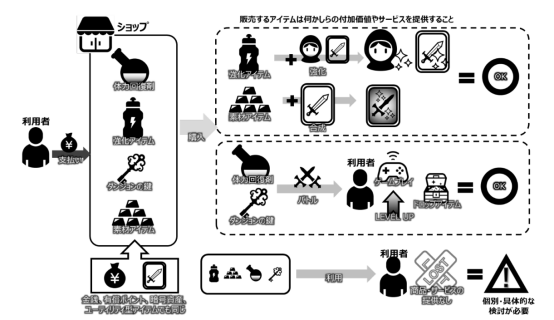
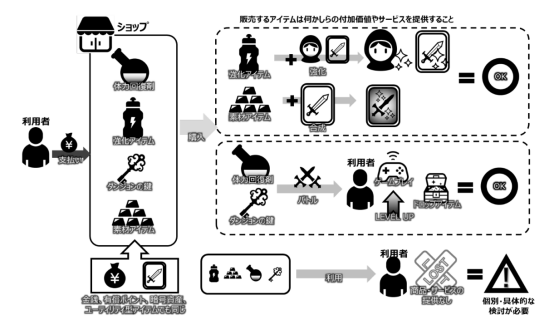
Where an operator sells consumable-type [general/NFT] items—such as stamina recovery potions, ability enhancement potions, dungeon entry keys, or enhancement or crafting materials—in a manner that does not involve chance, gambling issues will not arise in principle.
Furthermore, even where chance is involved in the acquisition of consumable-type [general/NFT] items (including cases where other NFT items are randomly obtained through the consumption of consumable-type [general/NFT] items), gambling issues will not arise in principle, provided that the actual value offered is not lower than the consideration paid.
Conversely, where this is not the case—such as where “nothing is obtained,” the outcome is “failure,” or no effect is produced upon consumption, or where the value obtained may not correspond to the consideration paid—careful attention must be paid to whether the criteria for gambling offenses are satisfied. In such circumstances, it is necessary to conduct a case-by-case analysis based on factors including the amount of consideration paid, the value of consumable-type [general/NFT] items obtainable, the conditions for acquisition, as well as the content, specifications, and mechanisms of the game, in order to determine whether the elements of gambling crimes are met.