
Online game license numbers (game approval numbers / ISBNs) have become a core threshold for compliant operation in the industry. Under the current legal and regulatory framework, games that have not obtained an approved license number may not be launched or operated domestically, and distribution platforms have already made license numbers a mandatory qualification for game listing review.
However, due to the high difficulty of obtaining license numbers, lengthy approval timelines, and high agency costs, many small and medium-sized game companies have chosen to achieve rapid listing by misappropriating license numbers. As a result, numerous games that have lawfully passed approval have instead encountered listing obstacles due to the misuse of their license numbers by others.
Against this background, this article analyzes the legal nature of license number misappropriation in conjunction with existing laws, regulations, and typical cases, with a view to providing game companies with enforcement strategies against such conduct.
Administrative Complaints
Article 51 of the Administrative Provisions on Online Publishing Services provides that where, without approval, an entity engages in online publishing services or publishes online games online (including online games authorized by overseas copyright holders), the conduct shall, pursuant to Article 61 of the Regulations on the Administration of Publishing and Article 19 of the Administrative Measures on Internet Information Services, be banned by the publishing administrative authorities and the administrative authorities for industry and commerce within their statutory powers. In addition, the provincial-level telecommunications authorities at the place where the entity is located shall, based on notifications from relevant authorities, order the closure of websites and impose other penalties in accordance with Article 19 of the Administrative Measures on Internet Information Services.
On this basis, game companies may file administrative complaints with the competent authorities at or above the county level in the location of the misappropriating party (which may include cultural and tourism bureaus, press and publication bureaus, or comprehensive cultural market enforcement teams, depending on the region), thereby initiating administrative enforcement procedures against the infringer.
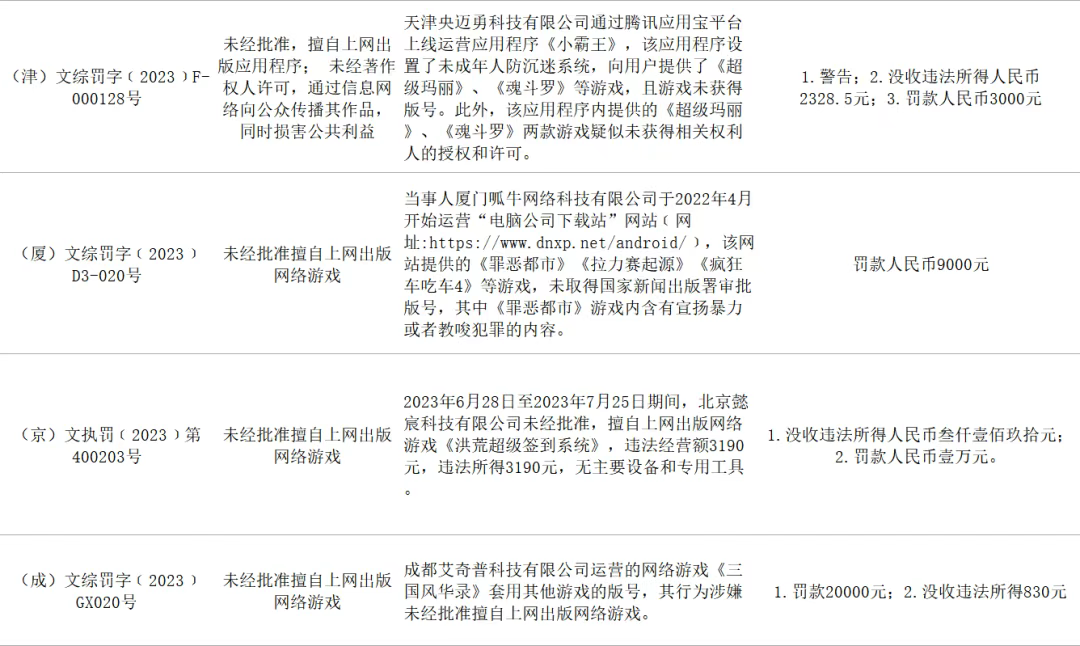 (Cases involving penalties imposed for launching games without a license number or by misusing license numbers)
Game companies may decide the capacity in which to lodge complaints based on the operational status of the misappropriating game. Where the license number, approval number, and operating entity publicly displayed at the bottom of the game’s launch screen are inconsistent, complaints may be filed in the capacity of players. In such cases, the following materials should be prepared:
Registration and public disclosure information of the misappropriating game’s operating entity on distribution platforms;
Evidence of the misappropriating game’s operation interfaces, including the license number and operating entity information displayed on the login screen, in-game operation screens, and in-game payment recipient information;
License number query results from the National Press and Publication Administration.
Where a game company’s own license number is misappropriated, and the company is the operating entity registered in the license approval, it may directly file a complaint as the victim of license number misappropriation, with the following evidence:
Ownership Evidence: software copyright certificates of the authorized game and related authorization documents, license approval replies and ISBN issuance forms, license number query records from the National Press and Publication Administration;
Misappropriation Evidence: records evidencing the infringer’s listing on distribution platforms, screenshots of the misappropriating game’s launch and operation interfaces displaying the victim’s license number, evidence of in-game payment recipient information, and publicly disclosed business registration information of the infringer’s operating and payment-receiving entities.
 (Image source: Internet)
Criminal Enforcement
Operating a game by misusing another’s license number (license number “nesting”) in substance involves multiple acts, including operating without a license number, forging others’ qualifications, and, in some cases, wholesale copying of the rights holder’s game. Given the high similarity in operation screens and game code, such conduct may closely resemble a private server, and also involves copyright infringement.
Upon analysis, license number nesting may potentially implicate the following criminal offenses: illegal business operation, forgery, alteration, or trading of official documents or seals of state organs, forgery of corporate seals, and copyright infringement. Each is analyzed below.
1. Crime of Illegal Business Operation
First, there is a lack of legal basis for characterizing operation without a license number as conduct “in violation of state regulations.”
Article 225 of the Criminal Law provides that the crime of illegal business operation refers to conduct that violates state regulations and disrupts market order, where the circumstances are serious. However, Article 96 of the Criminal Law and the Supreme People’s Court’s 2011 Notice on Issues Concerning the Accurate Understanding and Application of the Term “State Regulations” in the Criminal Law clarify that violations of local regulations or departmental rules may not be deemed violations of “state regulations.”
The primary legal basis requiring license numbers for online game operation lies in the Administrative Provisions on Online Publishing Services and the Regulations on the Administration of Publishing. Although the latter is an administrative regulation and qualifies as a “state regulation,” it only refers to electronic publications in Articles 31 and 61 and does not expressly classify online games as electronic publications. The Administrative Provisions on Online Publishing Services, while explicitly prohibiting unauthorized online game publication in Articles 27 and 51, constitute departmental rules and therefore do not qualify as “state regulations” under Article 225. Accordingly, there is currently no legal basis for treating operation without a license number as illegal business operation.
Second, operating a game without a license number does not constitute serious disruption of market order.
The determination of “serious disruption” should be based on whether the conduct exhibits social harm, criminal illegality, and necessity for criminal punishment comparable to the first three categories enumerated in Article 225.
On the one hand, the first three categories involve violations of special licensing regimes. Violations of ordinary licensing are generally administrative violations rather than criminal offenses. Game license numbers fall within the category of ordinary administrative licenses, and the harm resulting from their absence is not comparable to violations of special licensing regimes.
On the other hand, where a game lacks a license number but does not involve illegal content such as pornography, gambling, or political issues, it lacks sufficient social harm to meet the threshold of “serious disruption of market order.”
Accordingly, the crime of illegal business operation is not suitable for addressing operation without a license number.
2. Crime of Forging or Trading Official Documents of State Organs and Crime of Forging Corporate Seals
With respect to the crime of forging or trading official documents of state organs, Article 280(2) of the Criminal Law provides that forging, altering, or trading official documents, certificates, or seals of state organs shall be subject to criminal punishment. “State organs” include legislative, administrative, and judicial organs, as well as the organs of the Communist Party of China and the Chinese People’s Political Consultative Conference at all levels. “Official documents” are broadly defined to include not only paper documents but also electronic approvals and digital certificates.
Game publication numbers, ISBN issuance forms, and approval documents issued by the National Press and Publication Administration are all lawfully produced by a state organ and directly reflect administrative licensing functions, and therefore constitute official documents or certificates of state organs under this provision.
In license number nesting cases, defendants may purchase approval numbers from intermediaries or alter screenshots of approval documents to falsely claim lawful publication qualifications. By reference to Article 29 of the Regulations on the Administration of Internet Access Service Business Premises (revised in 2019), which criminalizes the alteration or transfer of Internet Culture Business Licenses, treating license number nesting as the crime of forging official documents of state organs is legally reasonable.
In addition, license number misappropriation often involves the forgery of corporate seals. Distribution platforms typically require software copyright certificates and authorization letters bearing corporate seals. In judgment (2020) Yue 73 Min Zhong No. 3761, the court found that the software copyright certificates and game publication issuance forms were forged, and that the corporate seals affixed to authorization documents were also forged, thereby constituting criminal conduct and transferring the case to public security authorities.
Accordingly, game companies may pursue criminal enforcement under the crimes of forging official documents of state organs and forging corporate seals. However, it should be noted that following the promulgation of the Private Economy Promotion Law in May and the June inclusion case (No. 2025-18-1-237-001), prosecutorial authorities have withdrawn prosecutions on the grounds of minor circumstances and limited harm.
As a result, criminal enforcement against pure license number nesting faces significant practical obstacles.
3. Crime of Copyright Infringement
License number nesting not only involves unlicensed operation or forged documents, but is often accompanied by wholesale copying of the rights holder’s game content, in some cases approaching private server operation. Such conduct typically falls within the scope of the crime of copyright infringement.
 In practice, infringers may directly copy the rights holder’s program code, art assets, level designs, or interface layouts. This involves two forms of infringement:
First, rights holders typically implement technical protection measures to prevent access to source code. Article 217(6) of the Criminal Law criminalizes the intentional circumvention or destruction of technical measures protecting copyright or related rights. Where the rights holder can prove the existence of access control measures, this pathway may support criminal liability.
Second, copying the code and art assets onto infringing devices constitutes reproduction, while uploading such content to distribution platforms for player access constitutes information network dissemination, falling under Article 217(1) of the Criminal Law.
The crime of copyright infringement may be pursued through private criminal prosecution, with evidentiary approaches similar to those used in civil enforcement. Although the evidentiary threshold is higher than that for illegal business operation or document-related crimes, the broader scope of protected interests makes criminal enforcement more feasible in practice.
Conclusion
Although China maintains strict control over game license numbers, it adopts a cautious approach to criminal enforcement against license number misappropriation, and multiple non-prosecution cases have emerged. As such, criminal reporting is not the most appropriate primary enforcement method.
Where efficiency is prioritized, administrative complaints are recommended. Where compensation is sought, civil enforcement is preferable. Criminal enforcement should be considered only where the misappropriation extends beyond license numbers to include forgery or extensive copyright infringement.
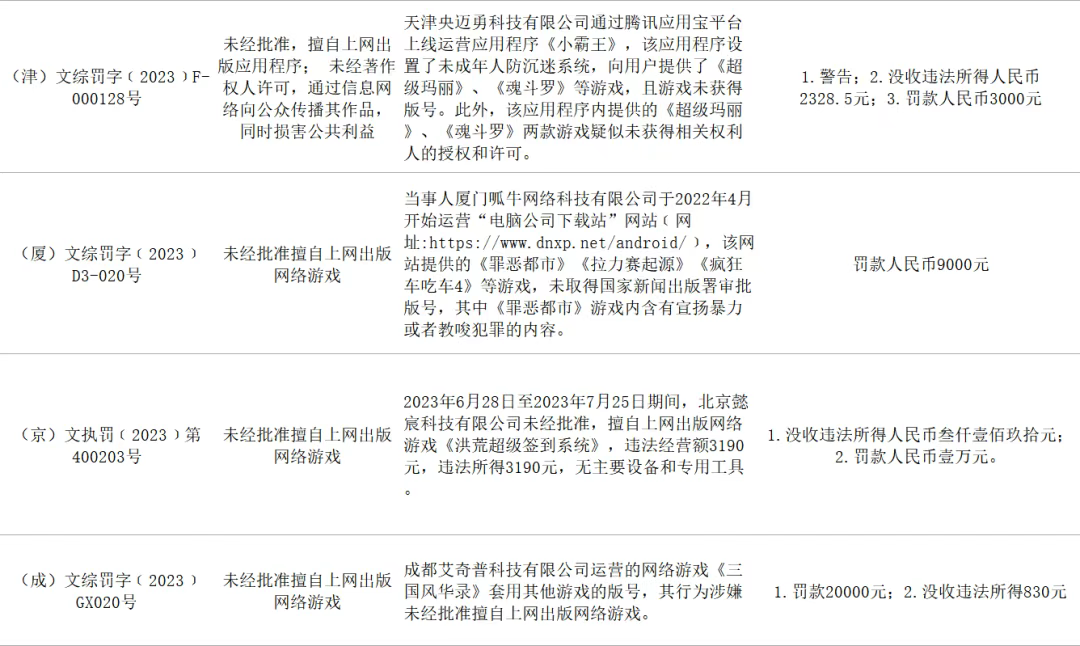 (因未取得版号/套用版号上架游戏被处罚的案例)
 (图源网络)
 在套版号运营中,冒用方往往直接复制权属方游戏的程序代码、美术资源、关卡设计甚至界面布局,将其作为自身游戏上线运营。这涉及两种著作权侵权行为: