
Online game license numbers (ISBN / game approval numbers) have become a core compliance threshold for lawful operation within the industry. Under the current legal and regulatory regime, games that have not obtained an approved license number may not be launched or operated domestically, and major distribution platforms have already made the possession of a license number a mandatory qualification for game listing review.
However, due to the high difficulty of obtaining license numbers, lengthy approval timelines, and significant agency costs, a considerable number of small and medium-sized game companies have opted to misappropriate license numbers in order to achieve rapid market entry. As a result, many games that have lawfully passed approval have instead encountered listing obstacles due to the impersonation or misuse of their license numbers by others.
Against this backdrop, this article analyzes the legal nature of license number misappropriation in light of current laws, regulations, and typical cases, with the aim of providing game companies with enforcement strategies to combat such conduct.
The Current Judicial Landscape of Civil Remedies
Civil enforcement is primarily aimed at resolving damages compensation, and is generally less efficient than administrative enforcement in promptly stopping misappropriation conduct. In prior judgments, courts have largely held that the act of misappropriating a game license number constitutes unfair competition in violation of commercial ethics and the principle of good faith under Article 2 of the Anti-Unfair Competition Law. Accordingly, game companies may rely on this provision to challenge acts of license number misappropriation per se.
In addition, pursuant to the Notice of the State Administration of Press, Publication, Radio, Film and Television on the Administration of Mobile Game Publishing Services:
“Where an approved mobile game undergoes changes to its publishing service entity, game title, or principal operating entity, the relevant change materials shall be submitted for review by the provincial publishing administrative authority and then reported to the State Administration of Press, Publication, Radio, Film and Television for completion of the change procedures.”
The game title used in listing and operation must be consistent with the game title reflected in the competent authority’s approval and the ISBN issuance form. This means that license number misappropriation is typically accompanied by infringement involving the use of the rights holder’s game title. In practice, relying on the Anti-Unfair Competition Law has become a relatively stable and feasible civil enforcement pathway.
Typical Case 1:
In the “XX Zhengba” case, when the plaintiff attempted to list its game XX Zhengba on the Huawei platform, Huawei rejected the listing on the grounds that there existed a historically non-compliant game with the same name. Upon learning of the defendant’s license number misappropriation, the plaintiff brought suit. The court held that the defendant’s conduct constituted unfair competition in violation of Article 2 of the Anti-Unfair Competition Law.
Typical Case 2:
The rights holder of the game XXX discovered that the infringing game’s login screen, main page background, and displayed qualification certificate numbers were all identical to those of the authorized game. The court held that the defendant’s conduct did not constitute confusion or false advertising, but did constitute conduct in violation of the principle of good faith in competition. The finding of no confusion was based on the plaintiff’s failure to prove that the authorized game’s name and interface had already acquired “a certain level of influence.”
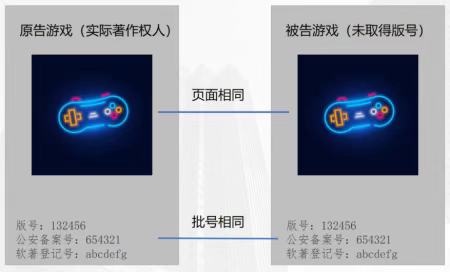 (Images are for illustrative purposes only and are unrelated to the games involved in the case.)
However, in a recent second-instance judgment issued by the Jiangsu High People’s Court, this previously established enforcement approach was reversed.
Typical Case:
In the “XX Baye” case, after the plaintiff obtained all qualifications required for game listing, it did not actually launch the game. It later discovered that the defendant had launched a different game while misappropriating the authorized game’s license number information, including the publication number and approval number. The plaintiff requested that the court determine the defendant’s conduct constituted unfair competition and sought damages and reasonable expenses totaling RMB 10.10 million.
The second-instance court rejected the plaintiff’s claims on the grounds that:
the authorized game had not been prevented from listing as a result of the misappropriation and the plaintiff had suffered no actual losses;
the plaintiff had not pursued administrative complaints; and
license numbers fall within the administrative regulatory domain and therefore cannot constitute a protected interest under the Anti-Unfair Competition Law.
This judgment by the Jiangsu High People’s Court represents the first domestic decision denying that a game license number can serve as a protectable interest under the Anti-Unfair Competition Law. According to the court’s reasoning, the fact that the misappropriating party obtained benefits through misappropriation does not necessarily mean that the rightful holder incurred losses. Where the plaintiff fails to adequately prove losses, civil compensation is difficult to obtain.
 The author considers that this reasoning is open to debate. The judgment overlooks the R&D costs, testing costs, and publishing cooperation costs incurred by the rightful holder in obtaining the license number, as well as the fact that the process of obtaining a license number itself constitutes a form of market competition. In practice, when applying for a license number, a game must generally be developed to a substantially complete state, including a full game framework and a closed-loop gameplay logic. Moreover, the Online Game Publishing Compliance Seminar hosted last year by the Huangpu District Audio-Visual and Digital Publishing Association of Guangzhou further clarified that the launched version of a game must overlap with the submitted review version by at least 80%, and that the publishing authority will impose quantity control on low-quality games in certain genres, such as legend-style, historical, celebrity cultivation, romance cultivation, religious (cultivation), and idle挂机 games.
This means that, within a given period, the number of license numbers available for certain genres is limited, and the approval process itself involves competitive selection. License number misappropriation allows the infringer to obtain a market entry ticket at extremely low cost, replacing the rightful holder’s substantial investment and occupying its market entry opportunity. Such conduct already constitutes a disruption of market competition order. Article 2 of the Anti-Unfair Competition Law is specifically designed to regulate conduct that violates principles of good faith and fair competition and disrupts market order, and therefore should not face obstacles in application to such conduct.
Civil Enforcement Approaches
As noted above, license number misappropriation is often accompanied by the use of the game’s title and launch interface. From the perspective of maximizing damages, infringement claims may be disaggregated as follows to achieve comprehensive enforcement:
1. Similar or Identical Game Screens, Promotional Materials, or Character Images
This may constitute copyright infringement of the authorized game’s art works. Evidence may be established from the following aspects:
Ownership Evidence: software copyright certificates, license number registration, asset registrations;
Infringement Evidence: notarization or blockchain preservation of infringing game footage;
IP Comparison Tables: clear graphical and textual comparison of identical or similar content;
Damages Evidence: download volumes, user numbers, revenue data, awards, etc.
2. Similar or Identical Game Titles or Game Logos
This may constitute trademark infringement, or confusion involving a well-known product name or sign under Article 7 of the Anti-Unfair Competition Law (2025 Edition):
Ownership Evidence: trademark registration information (where the game title is registered as a trademark), in-game usage;
Evidence of Notoriety: download volumes, user numbers, promotional exposure, awards. Where the game title is not registered as a trademark, evidence of notoriety and influence is particularly critical;
Infringement Evidence: comparison tables of infringing signs, infringement preservation records, user statements confusing A for B.
3. Pure License Number Misappropriation
Pure license number misappropriation should be addressed under Article 2 of the Anti-Unfair Competition Law. Where trademark or art work infringement is also involved, claims for trademark infringement and copyright infringement may be asserted concurrently:
Ownership Evidence: software copyright certificates, license approval replies and official approvals, public security filing records;
Use Evidence: listings on Platforms A, B, and C;
Infringement Evidence: preservation of infringing conduct, platform rejection letters evidencing refusal of listing on Platform D;
Damages Evidence: download volumes, user numbers, revenue figures, awards, etc.
Administrative and criminal enforcement pathways will be addressed in the next installment.
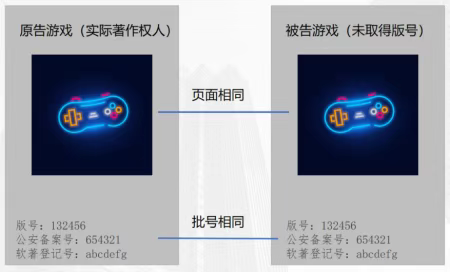 (图片仅用于示例,与涉案游戏无关)
 笔者认为,江苏省高院的这一裁判逻辑存在值得商榷之处,该判决忽视了权属方取得版号所需要投入的研发成本、测试成本、出版合作成本,也忽视了游戏公司取得版号的过程本身也是一种市场竞争。